Our customer support is available 24/7:


Doing Your Taxes: Can You Use Your Last Pay Stub To File Taxes?

- It is early in the year, you want your refund fast, and your W-2 still has not shown up. So you look at that final pay stub, maybe one from our pay stub maker, and wonder if you can just use it. If you have been thinking about filing taxes with last pay stub numbers, you are not alone, and you do have options. This guide will walk you through what your last pay stub can and cannot do at tax time, how to estimate your refund safely, and what to do if your W-2 never arrives.
Key Takeaways
- You can use your last pay stub to estimate your taxes, but the IRS does not accept it as your official filing document.
- If your W-2 never arrives, IRS Form 4852 lets you file using your pay stub numbers.
- Your W-2 and pay stub often show different totals, and that is completely normal.
- Always use your final year-end pay stub with full year-to-date totals.
Can You File Taxes With Your Last Pay Stub?
You can use your last pay stub to estimate your taxes, but the IRS does not accept it as your official filing document. So can you file taxes with last pay stub numbers? For planning, yes. For filing taxes with your last pay stub officially, run the numbers to see your likely refund, then wait for your W-2 (or use Form 4852) before you actually submit. In short, preparing a tax return with last pay stub figures is fine as a draft, but the final filing still needs the right paperwork.
Here is the honest answer. The real question is "can" versus "should." Yes, you can use your last check stub to file a preliminary estimate, and plenty of people do this in early January. Some people also ask, "can i do my taxes with my last pay stub" right now, and the answer is the same: estimate yes, submit no. But your last pay stub is not the document the IRS recognizes for your return. So while you can you use your last pay stub to file taxes as a planning step, do not send your return until your W-2 confirms the figures. The same goes if you wonder, "can i file taxes with my last pay stub" early, since the stub is your sneak preview, not the final cut.
Why Your W-2 and Pay Stub Show Different Numbers
When your W-2 finally arrives, do not panic if the wages do not match your last stub. This is a common surprise, and there is a simple reason for the difference. Your pay stub shows your full gross pay, while your W-2 Box 1 shows your taxable wages, which is gross pay minus certain pre-tax deductions. Understanding this gap is the part of filing taxes with last pay stub numbers that trips most people up. If you want the exact math, see how to calculate W-2 wages from a paystub.
Say you earn $48,000 a year. If you put $3,000 into a 401(k) and $2,400 into pre-tax health insurance, those amounts come out before taxes. So your W-2 Box 1 shows $42,600, not $48,000. Nothing is wrong, and you have not lost money. The two documents simply measure different things.
What Counts as Pre-Tax
Common pre-tax items include traditional 401(k) contributions, health and dental premiums, and HSA or FSA contributions. Learning how to file taxes with last pay stub data means knowing to subtract these items, since you may need to back them out before your numbers line up with the W-2. It also helps to brush up on understanding pay stub deductions before you compare the two.
Filing Taxes With Last Pay Stub: Step by Step
This step-by-step guide is mostly about reading two numbers correctly. If you want to use last pay stub figures to get a head start on your return, here is a simple path that keeps you safe. This is also the short answer to "can i use my last pay stub to file my taxes" before your W-2 lands.
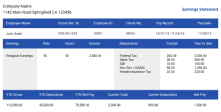
- Grab your final year-end stub. Use the stub with the highest year-to-date earnings on your pay stub. If you are paid biweekly, your last December check might process in January, so confirm the YTD numbers cover the whole year.
- Find your key numbers. Locate your YTD gross wages and YTD federal income tax withheld. These two figures do most of the work.
- Estimate your annual income. If your stub shows full-year YTD totals, you are set. If not, annualize: multiply a monthly amount by 12, or a biweekly amount by 26.
- Run a refund estimate. Plug your numbers into a free tax calculator or tax software to see your likely tax refund or balance due before you file your tax return.
- Wait for your W-2 before you submit. This is the step people skip. Estimate now, but do not file until your W-2 arrives or you use Form 4852.
That sequence lets you enjoy the preview without the risk of an amended return later.
Filing Taxes With Last Pay Stub Using Form 4852
If your W-2 truly never comes, you are not stuck. Per the IRS, Form 4852 is the official substitute for a missing W-2, and you complete it using your last pay stub. So filing taxes with last pay stub numbers is allowed this one way: through the substitute form. This is the legitimate way to file taxes without a W-2, and it lets you file your taxes compliantly when no W-2 ever shows up.
When you fill it out, focus on a few key lines. Line 6 is your wages. Line 7 is your federal income tax withheld. Line 9 is your employer's EIN if it is on the stub. Line 11 is where you explain how you tried to get your W-2. You can use your last check stub to file taxes this way, then attach Form 4852 to your 1040. It is not filed separately. Even here, can i use my last check stub to file taxes? Only with Form 4852 attached.
What to Do If Your W-2 Never Shows Up
Employers must furnish W-2s to employees by January 31, 2026, so start by checking your payroll portal, since many providers post a digital copy before the paper one arrives. You can also learn how to get a copy of your W2 online. If you have contacted your employer and still have nothing by the end of February, the IRS says to call 800-829-1040 for help. Have your personal information ready, including your name, address, Social Security number, and phone number, plus your employer's details and a wage estimate from your last paycheck stub. At this point some people ask, "can i file my taxes with my last paycheck stub" instead of waiting, but the safer move is Form 4852. If your job already ended, here is how to get pay stubs from an old job after leaving.
Common Mistakes to Avoid
A few easy slip-ups cause most of the headaches when people rush into filing taxes with last pay stub numbers:
- Filing too early. Submitting before your W-2 arrives often means an amended return, which delays your refund and can add fees.
- Skipping Form 4852. If you file without a W-2, you must use the substitute form and notify the IRS, not just guess.
- Missing state or local taxes. Pay stubs do not always capture every state or local detail your return needs.
- Using a mid-year stub. Always use your final year-end stub, never one from the middle of the year.
You Might Also Like
- What Does a 1099 Pay Stub Look Like
- Can You Have Two W-2 Jobs at the Same Time
- FIT on Paystub Explained
- How Much Do Minors Get Taxed on Their Paycheck
- Is There an Independent Contractor Pay Stub
Conclusion
So where does that leave you? Filing taxes with last pay stub numbers works for estimating, but file your official return with your W-2, or with Form 4852 if your W-2 never arrives. Estimate early, double-check your numbers, and you will be in great shape. If you are self-employed and need professional pay stubs for your records or income proof, our pay stub generator makes it quick and stress-free.