Our customer support is available 24/7:


Fwt Meaning: What It Is And How It's Calculated In 2026

The FWT meaning on a pay stub is simple. FWT stands for federal withholding tax. It's the part of your federal income tax that your employer takes out of each paycheck. Your employer sends that money to the IRS on your behalf, based on your Form W-4.
Whether you're reading a stub from your employer or checking one you made with a pay stub generator, FWT is usually one of the biggest deductions on it. The catch is that payroll software doesn't always label it the same way. This guide covers what FWT means, how it's calculated, how it differs from FICA, and what to do if your number looks too high, too low, or missing.
Key Takeaways
- FWT stands for federal withholding tax. It's the federal income tax your employer withholds and sends to the IRS each pay period.
- Payroll software may label it FIT, FITW, Fed W/H, or Fed Tax instead. They all mean the same deduction.
- The amount comes from your Form W-4 and IRS Publication 15-T. It isn't a flat percentage of your pay.
- FWT is separate from FICA (Social Security and Medicare). FICA is withheld no matter what your W-4 says.
- FWT Meaning: What Is Federal Withholding Tax (FWT)?
- FWT Meaning vs. Federal Income Tax: What's the Difference?
- How FWT Tax Is Calculated
- FWT vs. FICA and State Taxes
- Federal Tax Withholding Form (Form W-4)
- Why Is My Federal Tax Withholding So Low (or High, or Zero)?
- Who Is Exempt From Federal Income Tax Withholding?
- How FWT Affects Your Year-End Taxes
- For Employers: Handling FWT Correctly
FWT Meaning: What Is Federal Withholding Tax (FWT)?
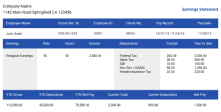
FWT is short for federal withholding tax. It's the federal income tax your employer withholds from your paycheck. Your employer then sends that money to the IRS as a prepayment toward what you'll owe for the year. Depending on your employer's payroll system, it can show up under a different label.
| Label | What It Means |
|---|---|
| FWT | Federal Withholding Tax |
| FIT | Federal Income Tax |
| FITW | Federal Income Tax Withheld |
| Fed W/H | Federal Withholding |
| Federal W/H (FWT) | Federal withholding, tied to the FWT line |
| Fed Tax | Federal Tax (withholding) |
Whichever label your stub uses, it's the same deduction. Like the rest of your pay stubs, it shows a current-period amount and a year-to-date (YTD) total. Still confused by a different abbreviation nearby? Our pay stub abbreviations guide covers the rest of the stub.
FWT Meaning vs. Federal Income Tax: What's the Difference?

They're close, but not identical. "Federal withholding," "FWT," and "federal income tax withholding" all describe the same per-paycheck deduction. "Federal income tax" is the broader term. It's your annual tax liability on your return, the amount FWT is prepaying all year.
How FWT Tax Is Calculated
FWT tax isn't a flat percentage taken off the top. It starts with your Form W-4. That's the form you fill out when you're hired, and you can update it anytime your situation changes. Your W-4 tells your employer your filing status. It also covers a second job or working spouse, any dependents, and any extra withholding you want.
Your employer combines your W-4 answers with your taxable wages. Taxable wages are your gross pay minus pre-tax deductions, like a 401(k) or Section 125 health premiums. Your employer looks up the result in IRS Publication 15-T. A pre-tax 401(k) lowers your taxable wages for FWT purposes only. A Section 125 pre-tax health premium lowers both your FWT wages and your FICA wages. Once you get the FWT meaning, the calculation itself is easy to follow: it's math based on your own paperwork, not a mystery formula.
Federal Tax Withholding Tables
Publication 15-T gives employers two ways to find the number. The Wage Bracket Method is a simple table lookup based on your pay and W-4 details. The Percentage Method is a formula-based calculation. It's typically used for higher pay or automated payroll systems.
Is There a Federal Tax Withholding Percentage?
Not a single one. Regular wages are taxed using the 2026 federal tax brackets. There are seven brackets, running from 10% to 37%. They apply to your annualized taxable income, the same graduated way your tax return works. Supplemental wages, like bonuses and commissions, are usually withheld at a flat 22% instead (37% on amounts over $1 million in a year). Want to check your own numbers? A paycheck calculator applies the current brackets for you.
FWT vs. FICA and State Taxes

FWT isn't your only payroll tax. FICA, Social Security and Medicare, is withheld separately. It applies no matter what you claim on your W-4. Social Security is 6.2%, up to the 2026 wage base of $184,500. Medicare is 1.45%, with no wage cap.
Most states also withhold their own state tax. They use a separate state withholding form, not your federal W-4. Nine states don't tax wages at all. Some cities and counties add a local tax on top of that. State and local withholding show up as their own lines on your stub, separate from FWT.
Do Social Security and Medicare Count as Federal Withholding?
No, they're two separate systems. Social Security and Medicare fund those specific programs, while FWT prepays your income tax bill. Even if you're exempt from FWT, Social Security and Medicare still come out of every paycheck.
Federal Tax Withholding Form (Form W-4)
Your Form W-4 is what actually moves your FWT up or down. Step 2 covers a second job or a working spouse. Step 3 claims dependents, which lowers your withholding. Step 4 covers other income, itemized deductions, and any extra flat-dollar amount you want withheld. For 2026, Step 4(b)'s deductions worksheet is also where eligible tips or overtime deductions get factored in. They can lower how much your employer needs to withhold.
Submit a new W-4 whenever your situation changes, like a marriage, a new baby, or a second job. By law, the change takes effect no later than the first payroll period ending 30 or more days after your employer receives it. So don't expect it on your very next check. Not sure your current withholding is on target? The IRS Tax Withholding Estimator is the fastest way to check before tax season surprises you.
How to Increase Federal Tax Withholding
Two ways to raise your FWT:
- File a new Form W-4 and add a specific dollar amount in Step 4(c).
- Lower (or remove) the dependent credits you claim in Step 3, since those credits reduce your withholding.
Why Is My Federal Tax Withholding So Low (or High, or Zero)?
A low, high, or zero FWT usually traces back to your Form W-4. Common causes: a recent pay raise or bonus, entries in Steps 3 or 4, an unchecked multiple-jobs box, an old pre-2020 W-4 still on file, exempt status, or pre-tax deductions like a 401(k). Review your current W-4, then use the IRS Tax Withholding Estimator to check it.
A raise or bonus can push more of your pay into a higher bracket. That raises your FWT, even though your tax rate on the rest of your income hasn't changed. Claiming extra dependents or a working spouse's second job lowers withholding on purpose, sometimes more than you expected. Haven't touched your W-4 since before 2020? It's worth filing a current one. The form's structure changed enough that an old version can calculate withholding differently than a newer one.
A short or partial pay period can also shrink a single check's FWT, with nothing actually wrong. The FWT meaning doesn't change just because the amount does; the fix, either way, is the same: submit an updated W-4 to your employer, since payroll can only work from whatever form is on file.
Who Is Exempt From Federal Income Tax Withholding?
You're exempt from federal income tax withholding only if you had no federal tax liability last year, and expect none this year. You must claim it on a new Form W-4, filed by February 15 each year, or your employer must default to standard withholding. FICA still applies even if you're exempt from FWT. The FWT meaning stays the same either way; only the amount changes.
This status is meant for people with genuinely low income, like students or part-time workers. It isn't a way to boost a single paycheck. Claiming exempt without qualifying can leave you owing a large tax bill, and possibly penalties, when you file.
How FWT Affects Your Year-End Taxes
The FWT on your final pay stub of the year becomes Box 2 on your W-2. Calculating your W-2 wages from a pay stub is a quick way to check that the two line up. When you file your Form 1040, you compare your total federal tax withheld for the year against your actual tax liability. Withhold too much, and you get a tax refund. Withhold too little, and you owe a balance, possibly with a penalty for significant underpayment. Excess withholding is recovered by filing your return itself, not a separate refund form.
For Employers: Handling FWT Correctly
If you run payroll, your job is to withhold FWT based on each employee's W-4 and current IRS tables. Deposit it, along with FICA, through EFTPS on your IRS-assigned schedule. Report FWT quarterly on Form 941, and reconcile it annually on each employee's W-2. For employers, the FWT meaning is no different, but the responsibility is bigger: withheld money belongs to the federal government, not the business, so mishandling it can carry serious penalties.
You Might Also Like
- What Is a Year End Pay Stub? Your 2026 W-2 Guide
- What to Do With Multiple W2 Forms From Different Employers
- How Many Pay Stubs Do I Need for a Car?
- What Is a Pay Stub?
- Where to Find Your EIN on a Pay Stub
Conclusion
FWT meaning and FWT calculation both trace back to one document: your Form W-4. It's your prepayment toward the federal income tax you'll owe for the year, based on your taxable wages, not a fixed percentage. If the number on your stub looks off, your W-4 is almost always the place to start.
Need a pay stub to double-check your own numbers or document your income? PayStubCreator.net can put one together in a couple of minutes.