Our customer support is available 24/7:

Paystub Records: What Are The Legal Requirements?

- You just got asked for a pay stub. Maybe it's for an apartment application, a car loan, or a new account. Now you're wondering whether your employer even has to give you one. And if you ever need one fast, you can make your own with a trusted pay stub generator. The honest answer is that pay stub requirements by state are all over the map. Some states make employers hand you a stub every payday. A few don't require one at all. This guide breaks it down in plain English. You'll learn your rights by state, what your stub should show, the recent 2024 to 2026 law changes, and what to do if you come up empty-handed.
Key Takeaways
- No federal law requires pay stubs, but most states do, and the rules vary from state to state.
- Pay stub requirements by state fall into a few simple buckets: access, printed, opt-out, opt-in, and no requirement.
- Only 8 states have no pay stub requirement at all.
- If your employer doesn't give you one, you can still get proof of income on your own.
- Recent 2024 to 2026 updates in Illinois, Maryland, and Ohio added new rules worth knowing.
What Is a Pay Stub?
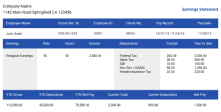
A pay stub is the record that comes with your paycheck. It shows what you earned, your hours, the taxes and other deductions taken out, and your final take-home pay. It's the document landlords, lenders, and banks ask for when they want proof of income.
Think of it as the receipt for your work, one slice of the payroll process. The math is simple: gross pay, minus deductions, equals net pay. For most people, employee pay stubs are the easiest way to prove a steady job and a reliable income.
Are Employers Required to Provide Pay Stubs? Federal Law (FLSA)
No federal law requires employers to give you a pay stub. The Fair Labor Standards Act (FLSA) only requires employers to keep accurate payroll records, not to hand you a stub. So whether you're owed one comes down to state law, and the payroll stub requirements that apply where you work.
This trips a lot of people up. When folks ask "are pay stubs required" or "are employers required to give pay stubs," they assume there's one nationwide rule. There isn't. The basic payroll requirements for employers in the United States cover tracking hours and wages. The stub itself is left to each state. So the real question isn't whether employers are required to provide pay stubs in general. It's whether they have to in your state. That's where pay stub requirements by state come in.
How Pay Stub Requirements by State Actually Work
Once the federal government leaves it to the states, things start to make more sense. Pay stub requirements by state come down to which of these categories your state falls into:
- No requirement: Employers don't have to provide a stub at all.
- Access states: Employers must give you a statement of earnings, and electronic access counts.
- Printed states: You're entitled to a paper or printable stub.
- Opt-out states: You get paper unless you agree to go electronic.
- Opt-in states: Electronic only works if you say yes first.
Most states are access states, so the majority of workers are entitled to some kind of stub. When someone asks "are pay stubs required" where they live, this is the bucket that gives the answer.
Pay Stub Requirements by State: No-Requirement States
Eight states have no pay stub requirement on the books: Alabama, Arkansas, Florida, Georgia, Louisiana, Mississippi, South Dakota, and Tennessee. So if you live in one of these and ask "do employers have to give pay stubs," the technical answer is no. Plenty still hand them out anyway, since it's standard payroll practice. They just aren't legally on the hook for it.
One important correction: Ohio used to appear on no-requirement lists, but that's outdated. Ohio now requires employers to provide pay stubs (more on that below). Even in a true no-requirement state, you can always create your own accurate stub when you need proof of income.
States Requiring Pay Stub Access
Most states are "access" states. That means your employer has to give you a statement of your earnings and deductions each pay period. Letting you view or download it online counts.
If you've ever wondered whether employers are required to provide pay stubs in PA, the answer is yes. Pennsylvania is an access state. The same goes for folks asking whether are pay stubs required by law in NY. New York requires detailed wage statements every payday. In any access state, an online portal you can log into counts.
States Requiring Written or Printed Pay Stubs
Some states go further and require a written or printed stub you can actually hold. California, Texas, and North Carolina fall into this group. Workers there are entitled to a physical or printable record, not just screen access. If you work in the Lone Star State, our guide on whether employers are required to provide pay stubs in Texas covers the specifics. And if your employer only offers a portal, you usually have the right to print a copy. That helps when a landlord or lender wants a hard copy on file.
Opt-Out and Opt-In States
A handful of states have special consent rules for electronic stubs. In opt-out states (Delaware, Minnesota, and Oregon), you get a paper stub by default. You only go electronic if you agree to it. Hawaii is the lone opt-in state, where employers can only go electronic if you say yes first.
Why does consent matter? In these states, an employer who switches everyone to electronic-only without sign-off risks Department of Labor complaints and penalties. As a worker, you can ask for a paper copy here anytime.
What Must Be Included on a Pay Stub
Pay stub requirements by state decide whether you get a stub at all. There are also rules about what the stub must contain. Knowing what belongs there helps you spot errors. It also makes sure the document holds up when someone reviews it.
Common Required Fields
Most states that require stubs expect the same core details:
- Gross pay (your earnings before deductions)
- Hours worked and your pay rate
- All deductions, like taxes, insurance, and retirement
- Net pay (your take-home amount)
- The pay period dates
If you're unsure what each line means, our guide to understanding pay stub deductions walks through them one by one, and the year-to-date earnings on your pay stub often trip people up too.
Employer Name and Address
Several states are specific about identifying the employer. California, Maryland, Minnesota, New York, Nebraska, and Oregon all enforce a pay stub must include employer legal name requirement. They want the employer's address on there too. That rule exists for a reason. When the document shows the real business name, anyone reviewing it can confirm it's legit. Put simply, the pay stub must show legal name of employer, not a nickname or a payroll vendor's name. It's a small detail that matters a lot when a landlord or bank is checking your paperwork.
Penalties When Employers Don't Comply
Pay stub requirements by state come with teeth. California is one of the strictest. Under California Labor Code 226, a worker hurt by bad wage statements can recover $50 for the first pay period and $100 for each later one. That's capped at $4,000 total, plus costs and attorney's fees. On top of that, an employer who fails to hand over pay records within 21 calendar days of a request owes a separate $750 penalty. Maryland's labor department can charge up to $500 for each employee who isn't given a compliant statement, per the state's pay stub law. Even where there's no set dollar figure, employers face Department of Labor audits and back-wage claims. So most treat the obligation and broader payroll compliance as a priority. One thing worth knowing: these state laws usually cover private employers. Many carve out state and local governments, which follow their own payroll rules.
2024 to 2026 Pay Stub Law Updates (Illinois, Maryland, Ohio)
Pay stub requirements by state aren't set in stone. State pay stub laws keep changing, and three recent updates matter if you live in these states.
Illinois
Public Act 103-0953 took effect January 1, 2025. Illinois employers now have to issue pay stubs and keep a copy on file for at least three years. They also have to give employees a copy on request within 21 days, up to twice a year. That's a jump from a loose standard to a firm requirement.
Maryland
Maryland's update (Chapter 305, also known as SB 38) took effect October 1, 2024, and the state labor department spells out what it covers. Now every private employer, even one with a single worker, must provide a written or online pay statement. It has to show the employer's name, address, and phone number, the pay period dates, hours, rates, gross and net pay, and each deduction.
Ohio
Ohio's HB 106, the Pay Stub Protection Act, took effect April 9, 2025 and added Revised Code Section 4113.14. It moves Ohio into the group of states that require a stub. Employers must now give every worker a written or electronic earnings statement each payday. So older guides that list Ohio as a no-requirement state are out of date. If you work in Ohio, you're entitled to a statement of your earnings.
What to Do If Your Employer Doesn't Give You Pay Stubs
Staring at a rental application or loan form with no stub in hand? Don't panic. First, check your state's category to figure out whether does an employer have to provide pay stubs in your case. Our guide on what to do when your employer doesn't provide pay stubs walks through your options. Here's the short version:
- Ask in writing. Email your employer or HR and request your pay records. In access and printed states they're generally required to provide them, so a written request often does the trick.
- Check your state's category. Use the buckets above to confirm whether are employers required to give you a pay stub where you work. If you work remotely across state lines, the rule usually follows the state where you actually do the work.
- Make your own if you need it fast. If you're self-employed or picking up gig work, you may not get stubs at all. There are simple ways to handle an independent contractor pay stub. Just generate an accurate one yourself for that apartment application, car loan, or new account.
A good rule of thumb: when in doubt, include every standard field even if your state only requires a few. A complete stub always looks more legitimate.
You Might Also Like
- How Many Pay Stubs Do You Need for an Apartment
- How to Find Your Employee ID on a Pay Stub
- How to Calculate W-2 Wages From a Pay Stub
- Free Employment Verification Letter Template
- How to Read a Pay Stub to Understand Your Earnings
Conclusion
Here's the short version. There's no federal pay stub mandate, so pay stub requirements by state set the rules. Most states require employers to provide some kind of stub. Only 8 have no requirement, and recent updates in Illinois, Maryland, and Ohio have tightened things up. Knowing your state's category tells you what you're entitled to.
And if you ever come up short, you don't have to stress. Create a clean, accurate stub in minutes with our pay stub generator and have your proof of income ready whenever you need it.