Our customer support is available 24/7:


W2 Boxes: What The Box 1 On W2 Mean And How To Verify It

The IRS uses the amount in Box 1 on W2 to determine how much an employee owes federal income tax for the year. This box is generally considered the most important number on your entire wage and tax statement.
Many employees need to understand box 1 on W2, as it's one of the first steps to a stress-free tax season. Employers need to make sure the amounts included in a Form W-2 are accurate. This goes for other documents, like employee pay stubs, too. They can use a paystub generator to create accurate pay documents.
Let's now break down Box 1 on W2, what it contains, and other related boxes you should understand.
Understanding Box 1 on W2
Box 1 on a Form W-2 contains the total amount of an employee's wages that are subject to federal income tax for the tax year. This box is labeled "Wages, tips, other compensation," and it holds employees' federal taxable wages.
What's Included in Box 1 of the Form W-2 Boxes?
Typically, box 1 includes compensation that the IRS considers taxable. This usually includes the amount that has been paid, including the taxable value of certain benefits. Box 1 includes:
1. Taxable Compensation and Earnings
This usually refers to the direct payments that an employee receives from an employer. It includes:
Salary and Hourly Wages: This includes an employee's pay for their work and any form of overtime. It also has any shift differentials or premium pay.
Bonuses, Commissions, Prizes, and Awards: Refers to any other additional compensation.
Paid Time Off: These are payments for vacation, sick leave, holidays, and personal days off.
Reported Tip Income: Includes any tips that are reported to employers.
2. Taxable Fringe Benefits and Other Items
These are non-cash benefits or special payments that have taxable value:
Non-cash Payments and Taxable Fringe Benefits: This includes the value of fringe benefits that an employee receives.
Group Term Life Insurance: It refers to the taxable cost of employer-provided life insurance coverage that exceeds $50,000.
Business Reimbursements: These are only reimbursements that are made under a "non-accountable" plan.
Taxable Moving Expenses: For most taxpayers, employer reimbursements for moving expenses are now taxable. Therefore, they should be included here.
Other Compensation: Include compensations for taxable educational assistance and certain employer contributions. For example, contributions to health savings accounts and distributions from non-qualified plans.
What’s Excluded From Box 1
Box 1 doesn't include pre-tax deductions. Pre-tax deductions are amounts that are usually subtracted from an employee's gross pay. They are removed right before employers calculate federal taxable wages, thereby reducing employees' income tax bills.
Common pre-tax deductions that reduce the Box 1 amount include:
Employee contributions to traditional and pre-tax retirement plans.
Premiums for health coverage, usually covered by employers.
Contributions to Health Savings Accounts (HSAs) or Flexible Spending Accounts (FSAs).
Total dependent care benefits provided through a dependent care assistance program, up to certain limits.
Employer-paid portions of health insurance premiums.
Certain payroll deductions for transit passes or parking.
Also check:Looking to create a quick pay stub? Use our pay stub creator to create pay stubs online.
Other Boxes on Your Wage and Tax Statement
On a W-2, there are other form W-2 boxes included:
1. Box 2: Federal Income Tax Withheld
This box shows the total federal income tax withheld from Box 1 earnings throughout the year. It represents the federal income tax that's paid to the IRS by employers. When filing returns, this amount is credited against the employee's total tax liability.
2. Box 3: Social Security Wages
Box 3 reports your Social Security wages. This is the amount of an employee's wages subject to the Social Security tax. The current annual Social Security wage base limit is $184,500. Once an employee's year-to-date earnings hit this cap, earnings above the Social Security wage base amount are not reported in Box 3.
3. Box 4: Social Security Tax Withheld
This W-2 box shows the Social Security tax withheld from your pay. The current rate is 6.2% for the employee portion. Employers would have to match another 6.2%, making it a total of 12.4%
4. Box 5: Medicare Wages and Tips
Box 5 reports your Medicare wages and tips. All total employee earnings are subject to it.
5. Box 6: Medicare Tax Withheld
This box shows the Medicare taxes withheld. The standard rate is 1.45% for employees. There's an Additional Medicare Tax of 0.9%. It applies to employee earnings over $200,000 ($250,000 for married filing jointly).
6. What Is Box 7 on W2: Social Security Tips
Box 7 reports the amount of tip income reported to employers. It includes amounts that are subject to Social Security tax. This amount is already included in the totals for Box 1 as other compensation and in Box 3 as Social Security wages. It's also in W-2 box 5 as Medicare wages and tips. W-2 box 7 simply provides a separate breakdown to make it easy to track.
Apart from the core wage form W-2 boxes, it also contains other boxes and codes:
Box 8: Allocated tips
Box 10: Dependent care expenses benefit.
Box 11: Nonqualified plans.
Box 12a-d: Codes and Amounts: Including specific, categorized information such as:
D: Elective deferrals to a 401(k) plan.
C: Taxable cost of group-term life insurance over $50,000.
W: Employer contributions to a Health Savings Account (HSA).
AA/BB/EE: Roth 401(k)/403(b)/457(b) contributions.
Box 13: Checkboxes: Indicates Statutory Employee, Retirement Plan, or Third-Party Sick Pay.
Box 14: Other information employers must report. They include union dues, state disability insurance taxes, or health insurance premiums deducted.
Box 15: Employer's state wages, tips, and state ID number.
Box 16: State wages subject to state income tax.
Box 17: State income tax withheld.
Box 18: Local wages subject to local tax.
Box 19: Local income tax withheld.
Box 20: Name of the locality.
Read more: W2 Vs W9 Form: Key Differences To Understand As A Worker.
Why Is Box 1 Different From Box 2 on W-2?
Box 1 and Box 2 on a W-2 form are different because they represent entirely different figures. Box 1 shows total taxable wages, while Box 2 shows the total federal income tax actually withheld from paychecks throughout the year. Box 1 is generally lower than your gross pay due to pre-tax deductions, while Box 2 is a cumulative tax payment.
Why Is Box 1 Different From W-2 Boxes 3 & 5?
Here are the most common reasons:
Pre-Tax Retirement Plan Contributions: When an employee contributes to a traditional 401(k), that money comes out of their paycheck. This is before federal income tax is calculated. It therefore reduces your W-2 Box 1. However, these contributions are still subject to Social Security tax and Medicare tax. So they remain in Box 3 and Box 5 totals.
Earnings Above the Social Security Wage Base: As we mentioned earlier, once your year-to-date earnings hit the annual Social Security wage base, you stop paying Social Security tax. Those excess earnings are excluded from W-2 Box 3. However, they are still fully taxable for federal income tax, so they remain in Box 1.
Also check:Choose a pay stub template here.
How To Verify Your Box 1 Information Is Accurate

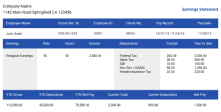
Don't just assume that information on a W-2 Box is correct. It's possible to quickly confirm its accuracy using your final pay stub:
Find your year-to-date (YTD) gross wages or gross pay on your last pay stub of the year.
Subtract all pre-tax deductions from your gross pay.
Add any taxable fringe benefits that are not your regular pay stubs.
Compare the amounts to Box 1. The final should closely match the amount in Box 1 on your Form W-2. Even a small rounding difference is still okay.
Read more:W2 Deadline: Late Penalty For Employer Not Sending W2
What To Do if Your W-2 Box 1 Is Wrong
After verifying, and you find that there's an error, here's what you can do:
Contact Your Employer: Once you notice the error, reach out to your company's payroll or human resources department immediately. Your employer is responsible for issuing a corrected Form W-2c.
File With Correct Form: The employer should issue the corrected form before filing the tax return. When an employee files taxes with incorrect data, it may lead to IRS notices, processing delays, and inaccuracies in your records.
Use Form 4852 if Necessary: If they don't provide a corrected W-2 by the tax filing deadline, file using IRS Form 4852.
Further reading:How To Get a W-2 From a Previous Employer in a Few Steps
In Summary
It's important to understand Box 1 on W2, as it can help manage employees' tax responsibilities correctly. Knowing this helps calculate federal income taxes and an employee's wages, tips, and other compensation. Remember that the differences between these boxes are standard, which is due to pre-tax deductions that lower taxable income.
For employers and self-employed individuals looking to create accurate W-2s, using a Form W-2 generator helps. If you also want to generate professional pay stubs, we have a stub maker to help.