Our customer support is available 24/7:


State Pay Stub Requirements: Are Employers Required To Provide Pay Stubs In Texas?

What if you were paid but couldn't track where your hard-earned buck ends up? For millions of Texas workers, pay stubs are far more than a piece of paper. Your employer is required to provide this document. However, if you need it quickly, you can create a pay stub online with a check stub generator.
In Texas, employee rights are taken seriously. The law has protections for employees to ensure they know all about their earnings. At this point, if you're asking, "Are employers required to provide pay stubs in Texas?" This article explains how pay stub laws affect employee access to these documents. By the end, you'll understand why your pay stubs are not simply numbers on a piece of paper.
What Are Pay Stubs?
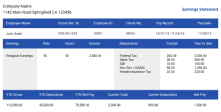
With a pay stub, it's so much more than pay to most employees. That's their work, a financial planning tool. It's a must-have document for personal and professional transactions. A pay stub is a detailed document that breaks down an employee's pay for a specific pay period. It is also known as a pay slip or wage statement. It serves as an accurate record for both the employee and the employer. It explains your gross wages, all payroll deductions, and then your final net pay.
You also need your pay stubs to track your hours worked and understand your deductions. You need to know deductions like your federal income tax, state income taxes, local taxes, and Medicare taxes. A pay stub also shows employee contributions, benefits and retirement plans. It's simply an essential part of an employee's personnel records.
However, pay stubs in Texas are different. Employers must provide clear and accessible information about their employees' pay.
Are Employers Required To Provide Pay Stubs in Texas?
In Texas, all employers are required to provide their employees with pay stubs for each pay period. The state's pay stub requirements are clear and fall into the category of "access print" states, meaning the provided pay statements must be in a format that employees can print.
Every employee's pay stubs have to show:
Name of the employee
Pay rates
Total amount of pay earned by the employee during the pay period (employee's gross pay)
Any deduction made from the employee's pay, and the purpose of the deduction
Amount of pay after all deductions are made (net pay)
Total number of:
Hours worked if the employee's pay is computed by the hour.
Units produced by the employee during the specific pay period. This is if the employee's pay is computed on a piece-rate basis.
The pay stub requirements in Texas help to make sure that employees understand their pay. They'll have a picture of their exact employee's wages and all deductions. The Texas pay stub requirements are a key part of the state's labor laws.
The Fair Labor Standards Act and Federal Law
The question, "Is an employer required to provide a pay stub in Texas?" is governed by Texas paystub state law. Therefore, while there are state laws in the US, there are also federal laws for providing pay stubs. The Fair Labor Standards Act (FLSA) sets the federal labor laws for fair labor standards.
The Fair Labor Standards Act does not require employers to provide pay stubs to employees. Instead, it requires that employers keep accurate payroll records for each employee. This includes details of their hours worked and wages paid. The IRS requires employers to maintain these employment records.
This federal law establishes standards for minimum wage and overtime. So it's up to the state laws to determine how to distribute pay stubs.
Therefore, when asking "Are pay stubs required by law?" and "Does your employer have to give you a pay stub?" You should know that this depends on your state.
Pay Stub State Requirements
Across the rest of the US, pay stub requirements are surprisingly varied. Every state has its own state laws. This leads to a highly interesting regulatory scheme comprising several distinct classes. Here are the categories for state requirements about stub laws:
States With No Pay Stub Requirements
Nine states do not require any form of pay stub documentation. In these states, there are no laws requiring employers to provide paycheck stubs. These states are:
Alabama
Arkansas
Florida
Georgia
Louisiana
Mississippi
Ohio
South Dakota
Tennessee
Access Pay Stub States
Twenty-six states stand in the "access" category. Under that category, employers must make the pay stub information available to the employees. They can provide their employees with printed or electronic pay stubs. This is as long as employees can access pay stubs. These states include:
Alaska
Arizona
Idaho
Illinois
Indiana
Kansas
Kentucky
Maryland
Michigan
Missouri
Montana
Nebraska
Nevada
New Hampshire
New Jersey
New York
North Dakota
Oklahoma
Pennsylvania
Rhode Island
South Carolina
Utah
Virginia
West Virginia
Wisconsin
Wyoming
Access Print States
Eleven states, including Texas, have stricter "access/print" requirements. These states require that employers deliver pay stubs in a printed or physical form. They can also provide their pay stubs in an electronic format that employees can easily access and print themselves. They include:
California
Colorado
Connecticut
Iowa
Maine
Massachusetts
New Mexico
North Carolina
Texas
Vermont
Washington
Opt In States and Opt Out States
Some states have distinctive approaches:
Hawaii is an "opt-in state" where electronic pay stubs require employee consent. Unless they ask for permission, employers must continue to provide paper pay stubs.
Delaware, Minnesota, and Oregon are "opt-out states". This means employees can choose not to receive electronic pay stubs. They can opt out of receiving printed pay stubs instead, which employers have to provide.
Electronic vs. Paper Employee Pay Stubs Requirements in Texas
Texas is progressive with regard to pay stub delivery. It is an access print state. Employers are allowed to give electronic or digital pay stubs to employees. However, here's what you should know:
Electronic pay stubs must be easy for employees to access, either as a printout or online. Employees must be able to receive electronic pay stubs. They must also be able to print them if they want.
Any electronic pay stub needs to be as comprehensive and clear as a physical one. It should contain all the required pay statement details.
Electronic wage statements require security and confidentiality from employers.
That flexibility means that a business can easily modernize a payroll process. They don't have to go over governmental levers. This preserves the integrity of wage documentation. To get your electronic or digital pay stubs, you can easily make a pay stub online.
Consequences of Non-Compliance for Employers

If employers in Texas fail to provide employees with pay stubs as required by state law, they may face certain claims. These may include:
Financial penalties: If an employer fails to provide required pay information, the Texas Workforce Commission (TWC) may investigate. Then the employer may be liable for unpaid wages, penalties related to wage violations, and legal claims.
Potential legal action: This can come from employees, especially in the form of wage claims. Employers who can't prove that they have already paid the employee can be liable.
Investigations: State labor authorities can investigate employers for non-compliance.
Potential damages: Employers that wilfully violate the law usually face such consequences. They may be required to pay damages for wage-related violations.
To Sum It Up
A pay stub is a really important document for employees. So, regarding the pay stub requirement in Texas, the law makes it clear. Employers must provide their workers with their pay stubs. An employee's earnings statement has to be complete and detailed. Understanding these pay stub requirements enables employers and employees to establish a safe work environment. They can build trust, clarity, and respect.
We understand the complexities of managing payroll for a business of any size. This is why you need to use pay stub generators. By using our user-friendly paystub generator, employers can easily generate pay stubs. It stays compliant with your state laws. Additionally, you can save time and reduce administrative stress. We're here to make payroll processing straightforward and right.