Our customer support is available 24/7:


Check Number On A Pay Stub: What It Means And Where To Find It (2026 Guide)

The check number on a pay stub is the reference number your employer's payroll system assigns to one specific payment. That payment might be a paper check or a direct deposit. Say you're digging through old pay stubs for a rental application or a loan. That number is one of the easiest ways to tell your payments apart at a glance.
Whether you're an employee or you build your own pay stubs with a pay stub generator, you'll usually see this number whether you're paid by check or direct deposit. It just shows up a little differently depending on your payroll system. Here's what it means, where to look, and what it doesn't mean, so you're not left guessing next time a landlord or lender asks for your pay stubs.
Key Takeaways
- A check number identifies one specific payment on your pay stub, not you as an employee.
- It comes from your employer's own payroll sequence, so it can repeat across different employers but shouldn't repeat within the same one.
- Direct deposit pay stubs usually still carry a check number, sometimes with a marker like the "Z" prefix New York City uses.
- It's different from your employee number, agency number, and account number. Each of those identifies something else.
- A missing check number on a direct-deposit stub is common and isn't a problem by itself.
What's a Check Number on a Pay Stub, and How Is It Assigned?
A check number on a pay stub is the number your employer's payroll system gives to that specific payment. (If you want the full breakdown of everything else on the document, here's what a pay stub is in general; this guide stays focused on the check number on your pay stub.) It comes from the employer's own payroll sequence, not a personal counter. That means it runs across every employee and every pay run, not just yours.
You might have heard it explained as a simple per-employee counter that starts at 1 for your very first paycheck. That's not quite right. Most payroll systems pull the number from the employer's own check register, the running list of every payment the company issues. The list moves forward across all employees and every pay run, not just one person's paychecks.
A few things follow from that. The number of digits depends on the payroll system, not a fixed rule. If a check gets lost or needs to be reissued, it gets a brand new number instead of reusing the old one. Each employer runs its own separate list. So two stubs from two different jobs could land on the same number purely by coincidence. Within one employer's payroll, though, numbers shouldn't repeat. Bottom line: how check numbers are assigned depends on your employer, not on you.
Where to Find the Check Number on Your Pay Stub

Where you look depends on whether your stub is a printed check or an electronic one from direct deposit. The label is usually similar either way.
| What you'll see | Typical label | What it identifies |
|---|---|---|
| A short number near the header | Check No., Chk #, Check Num | This specific payment |
| A longer ID, sometimes near the pay period | Voucher No., Advice No., DD No. | A direct deposit reference (not the check number itself) |
| A separate field that never changes | Employee ID, Emp. Num. | You, the person, not the payment |
| Dates near the top | Pay Period, Pay Date | When you worked and when you got paid |
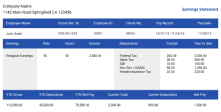
A full pay stub usually lists more than just the check number. Look for your hours worked, gross pay, income tax, Social Security, and other taxes and deductions, plus your year-to-date earnings and your take-home pay. On most templates, the check number on your pay stub sits in the header or payment summary next to the pay date, while earnings and deductions fill the body below. The exact spot varies by template, but it's almost always near the top. If a label looks unfamiliar, this pay stub abbreviations guide covers most of the shorthand you'll run into.
On a printed check, the same number that's on your pay stub also prints on the physical check itself. It's usually in the top right corner. It also appears again in the strip of numbers along the bottom, called the MICR line, that banks use to process it. If you build your own pay stubs, keep the check number in that same header spot so anyone reviewing the stub finds it without hunting.
Check Numbers on Direct Deposit Pay Stubs
Getting paid by direct deposit doesn't mean you lose the check number on your pay stub. According to the NYC Office of Payroll Administration, a "Z" appears in front of the check number when an employee is paid by direct deposit. A paper check shows no "Z," but the same number prints on both the check and the statement.
Your employer's system may not follow that exact convention. Still, the underlying idea holds broadly: direct deposit payments get a number in the same sequence as paper checks. Apart from a marker like that "Z," the number works the same way it would on a paper check. If your employer hasn't set this up for you yet, here's how to get pay stubs from direct deposit.
You might also spot a separate "advice number" or "voucher number" near the check number on a direct-deposit stub. That's a related but different field. It deserves its own explanation, so we cover it in a dedicated guide instead of here.
Why Your Paycheck Number Matters

This little number does more work than it looks like. For you as the employee, it's the quickest way to point to one exact payment. Say a landlord, lender, or background check asks you to confirm a payment, for example if you're wondering how many pay stubs you need for an apartment. Match the pay date and net pay on that stub to the deposit on your bank statement (banks usually don't show the payroll check number on a deposit), and quote the check number if payroll needs to look it up.
It also helps when something looks off. Maybe your bank shows a deposit that doesn't match your expected net pay. Note the check number, pay date, and amount from your stub. Then compare them line by line against what actually landed in your account. That's usually enough to catch a payroll error or a bank delay before it turns into a bigger headache.
On the employer side, the same number backs up bank reconciliation, matching what payroll issued against what actually cleared. If a check is lost or a payment needs to be voided and reissued, the old number gets flagged. A new one takes its place. That keeps the books clean and gives an accountant a clear trail to follow.
One habit worth picking up: name your saved pay stub PDFs with the pay date and check number. For example: 2026-09-26_chk-10482.pdf. It sounds small. But it makes finding the right stub for a rental application or a loan officer's request much faster later on. If you're a freelancer or contractor without a traditional employer, these tips for proving self-employed income cover more ground than a single pay stub can.
Check Number vs. Other Numbers on Your Pay Stub
A pay stub can get crowded with numbers, and it's easy to mix them up. Telling them apart comes down to one thing: what each number identifies. Here's how the check number on your pay stub stacks up against the other numbers you'll typically see.
Your employee number, sometimes called an employee ID, identifies you as a person within the company, not a single payment. Unlike the check number, it stays exactly the same every pay period. The NYC Office of Payroll Administration, for example, gives each city employee a unique 7-digit Employee Number that stays on all of their records.
Agency Number on a Pay Stub
If you work for a city, county, or state government, you've probably seen an extra field you don't recognize.
The NYC Office of Payroll Administration's pay statements include one called "Payroll #." It's a three-digit number that identifies which city agency issued the payment. That's a separate idea from both the check number, which identifies the payment, and the employee number, which identifies the person.
Account Number vs Electronic Account Number
Setting up direct deposit through a credit union can trip people up for a different reason entirely.
There's your everyday member or account number. Then there's a separate, longer number some credit unions issue specifically for electronic transactions. First Entertainment Credit Union, for example, issues a 14-digit Electronic Account Number that members use for direct deposit, automatic payments, or transfers. It's distinct from the shorter number tied to the account itself. If a direct deposit setup gets rejected, double-check which number your bank or credit union actually wants.
Missing, Duplicate, or Wrong Check Number: What To Do
A blank check number field on a direct-deposit pay stub is common. By itself, it isn't a sign of a problem; plenty of basic payroll templates simply don't include one. If you need that number for a lender, landlord, or any other reason and it's missing, ask your payroll or HR department. They can give you the payment reference. You can also lean on the pay date and net pay amount to verify a payment even without one.
If you spot the same number on two stubs from the same employer, or a number that just looks wrong, flag it to payroll right away. Don't assume it will sort itself out. Employers are required to keep payroll records, including data tied to each payment, for at least three years. Supporting wage-computation records, like time cards, need to be kept for at least two years. That's under federal recordkeeping rules (29 CFR 516.5 and 516.6). Disputes over check numbers are rare, but they're easy to resolve. There's almost always a record your payroll department can check against.
You Might Also Like
- How to Access Pay Stubs from Walmart
- How to Access Compass Pay Stubs
- How to Calculate W-2 Wages from a Pay Stub
- How Can I Get a Copy of My W-2 Online?
- What Does a 1099 Pay Stub Look Like?
Conclusion
A check number is a small detail, but it's genuinely useful. It ties a single payment to a single pay stub. That makes proving your income for a rental application, a loan, or a new job that much easier. Once you know where to look, and what the number does and doesn't mean, there's nothing left to guess.
Need a pay stub with an accurate check number of your own? Create yours in under 2 minutes at PayStubCreator.net, no subscription required.