Our customer support is available 24/7:


Paycheck Stub Abbreviations: A Complete Guide For 2026

Every paycheck stub is packed with codes and abbreviations most employees have never been formally taught. For business owners and HR managers generating pay stubs for staff, understanding these codes isn't optional.
It's the baseline for producing accurate payroll documentation. Use PayStubCreator.net to generate professional, compliant pay stubs with the correct abbreviations built in. This article discusses the paycheck stub abbreviations and why they matter.
Key Takeaways
- Paycheck stub abbreviations fall into four categories: earnings, mandatory taxes, voluntary deductions, and summary codes
- YTD (Year to Date) resets every January 1 and should match your W-2 at tax time
- OASDI (Social Security) is deducted at 6.2% until an employee hits the $176,100 wage base (2025)
- ERMED is the employer's Medicare match and does not reduce employee take-home pay
- Different payroll systems (ADP, Gusto, Workday, Paychex) may label the same deduction differently
- Why Paycheck Stub Abbreviations Matter to Employers
- Common Paycheck Stub Abbreviations: A Quick-Reference Table
- Tax Deduction Abbreviations: FED, FICA, and State Codes
- What Does YTD Mean on a Pay Stub?
- What Is OASDI on a Pay Stub?
- MED, MEDI, and ERMED: Medicare Abbreviation Variations
- Gross Pay vs Net Pay on Your Paycheck Stub
- Company-Specific Abbreviation Variations
- You Might Also Like
- Final Thoughts
Why Paycheck Stub Abbreviations Matter to Employers
When you generate pay stubs for employees, every code on that document carries legal and financial weight. Three things go wrong when payroll abbreviations are misunderstood.
Withholding errors compound over time. An incorrect FICA calculation in January shows up as a tax gap in December.
Benefit deductions get misapplied. If FSA and HSA codes are confused, employees may receive the wrong pre-tax treatment.
Incorrect codes create employee disputes during the annual W-2 review.
Proactive documentation and clear labeling prevent all three. For a deeper look at common employee payroll documentation questions, see our guide on finding your employee ID on a paystub.
Common Paycheck Stub Abbreviations: A Quick-Reference Table
Paycheck stub abbreviations are organized into four categories.
- Earnings codes describe how compensation was earned.
- Tax codes capture mandatory withholdings.
- Deduction codes cover both voluntary and involuntary reductions to take-home pay.
- Summary codes track totals and pay period data.
| Category | Abbreviation | Meaning |
|---|---|---|
| Earnings | REG | Regular wages |
| Earnings | OT | Overtime pay (typically 1.5x regular rate) |
| Earnings | PTO | Paid time off |
| Earnings | HOL | Holiday pay |
| Earnings | BON / BN | Bonus |
| Mandatory Taxes | FED / FIT | Federal income tax |
| Mandatory Taxes | FICA | Social Security + Medicare combined |
| Mandatory Taxes | SS / OASDI | Social Security tax |
| Mandatory Taxes | MED / MEDI | Medicare tax |
| Mandatory Taxes | SIT / ST | State income tax |
| Mandatory Taxes | SDI | State disability insurance |
| Voluntary Deductions | 401k | Employee 401(k) contribution |
| Voluntary Deductions | HSA | Health Savings Account |
| Voluntary Deductions | FSA | Flexible Spending Account |
| Voluntary Deductions | GARN | Wage garnishment |
| Summary | YTD | Year-to-Date cumulative total |
| Summary | GROSS | Total earnings before deductions |
| Summary | NET | Take-home pay after all deductions |
Tax Deduction Abbreviations: FED, FICA, and State Codes
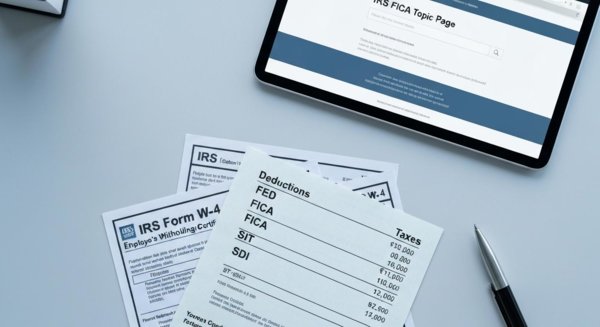
The tax section of a paycheck stub is where most confusion occurs. Among all paycheck stub abbreviations, tax codes generate the most questions. Understanding these codes helps employers verify that withholding is calculated correctly for each pay period.
FED / FIT / FITW
This refers to federal income tax withholding. The amount is determined by each employee's Form W-4 filing status and withholding elections. Employers remit this directly to the federal government via EFTPS.
FICA
This is the umbrella code for Federal Insurance Contributions Act taxes. It covers two programs, which are the Social Security (6.2% employee rate) and Medicare (1.45% employee rate). Employers match both. The IRS FICA topic page provides the official withholding rules.
State Codes
These vary by jurisdiction. Common codes include SIT or ST for state income tax, SDI for state disability insurance, and SUI or SUTA for state unemployment insurance. Understanding what FUTA means for payroll can also help employers budget for their federal unemployment tax obligations.
Nine states (Alaska, Florida, Nevada, New Hampshire, South Dakota, Tennessee, Texas, Washington, and Wyoming) have no individual income tax, so employees in those states won't see an SIT line.
What Does YTD Mean on a Pay Stub?
YTD stands for Year to Date. It shows the cumulative total of a specific line item (earnings, taxes, or deductions) since January 1 of the current year. YTD resets at the start of each new year and is one of the most useful figures for verifying your annual W-2 at tax time.
The YTD meaning in paycheck terms is straightforward. It's a running total. If you've ever asked, "What does YTD stand for on a pay stub?" the answer is "Year to Date". What is YTD on pay stub? It's the sum of all amounts in that category from January 1 through the current pay date.
For employers running payroll, YTD tracking is critical for two compliance reasons.
First, it enforces the Social Security wage base. Once an employee's YTD earnings hit $176,100 in 2025, OASDI withholding stops.
Second, the final year-end YTD figures feed directly into W-2 preparation.
Our guide on how to calculate W-2 wages from a paystub walks through this reconciliation in detail. Box 4 of the W-2 (Social Security tax withheld) should match the employee's final YTD OASDI total. Box 6 (Medicare tax withheld) should match the YTD MED total. Any discrepancy signals a withholding error that must be corrected before filing.
A simple example: An employee paid $500 in federal tax each bi-weekly period for 10 pay periods. This will show a YTD federal tax figure of $5,000 on their 10th stub.
What Is OASDI on a Pay Stub?

OASDI stands for Old-Age, Survivors, and Disability Insurance, the official name for the Social Security tax. It is deducted at 6.2% of gross wages up to the annual wage base ($176,100 for 2025). Once an employee's earnings exceed this threshold, OASDI no longer appears on their stub for the rest of the year.
If you've searched "What is OASDI on paystub?" or wondered "What does OASDI mean on my paycheck?", the answer is the same. It's your Social Security withholding.
"What is OASDI on my paystub?" is one of the most common payroll questions employees raise, particularly when they see OASDI on paystub for the first time and don't recognize the acronym. Our dedicated article on OASDI tax meaning covers this in further depth.
High-earning employees often notice OASDI disappears from their stub mid-year. This is normal and expected. Once the wage base is reached, no further Social Security withholding applies until January 1. The wage base adjusts annually. In 2026, the IRS will set a new figure that employers should confirm. The Social Security Administration's tax rate tables publish the updated figures each year.
Employers contribute a matching 6.2% on top of the employee deduction. Employees see only their side, labeled as OASDI, SS, or SOCSEC, depending on the payroll system in use.
MED, MEDI, and ERMED: Medicare Abbreviation Variations
Medicare tax covers the hospital insurance portion of FICA. The standard employee rate is 1.45% of all gross wages, with no wage base cap (unlike Social Security).
MED
This is the most common label. When employees ask, "What does MED stand for on pay stub?", the answer is Medicare. Workday and some other platforms display it as "MEDI". Seeing MEDI on paystub or MEDI on paycheck stub is exactly the same deduction as MED.
It's just a platform-specific label. Employees who switch employers may see a different abbreviation for the same line item and wonder if something changed. It hasn't, the payroll platform has.
Additional Medicare Tax
Employees earning over $200,000 in a calendar year ($250,000 for married filing jointly) are subject to an additional 0.9% Medicare surtax. Employers are required to withhold this once the $200,000 threshold is crossed, regardless of the employee's household filing status.
ERMED
This is the employer's Medicare contribution, also 1.45%. This appears on some detailed pay stubs as a separate line. Seeing ERMED on paycheck or ERMED on a pay stub shows what the employer contributes, not an additional employee cost. It does not reduce employee take-home pay. The combined Medicare rate is 2.9% (1.45% for employees and 1.45% for employers).
Gross Pay vs Net Pay on Your Paycheck Stub
Gross pay is the total compensation before any deductions. Net pay is the amount deposited into the employee's bank account. The math is straightforward:
Net Pay = Gross Pay - Mandatory Tax Withholdings - Voluntary Deductions
Mandatory withholdings include:
- Federal income tax
- FICA (OASDI + MED)
- Applicable state taxes.
Voluntary deductions include:
- 401k contributions
- Health insurance premiums
- FSA or HSA elections
After-tax deductions, such as garnishments (GARN) or child support (CHSPPRT), come out last. For a full breakdown of the difference, see our resource on net vs gross income.
Company-Specific Abbreviation Variations
Not every payroll system uses the same label for the same deduction. When employees encounter unfamiliar paycheck stub abbreviations after switching jobs, the confusion is almost always due to platform-specific labeling. HR staff reviewing stubs from various departments using different platforms face the same issue.
Common platform-specific variations:
- ADP: Typically uses OASDI for Social Security and MED for Medicare
- Gusto: May display "SS Tax" and "Medicare Tax" as full labels rather than abbreviations
- Workday: Often uses MEDI instead of MED or may display ER contributions on the stub
- Paychex: Uses MED, FICA/SS, and FICA/MT (Medicare) in some configurations
Company-specific codes also exist beyond the standard set. ERP covers employee retirement plan contributions beyond the standard 401(k). DCR refers to deferred compensation. CHSPPRT is child support withholding. If an employee asks what a code means and you can't find it in a standard list, check your payroll provider's documentation. Our guide on understanding pay stub deductions covers the full range of common deduction types.
The best practice for HR teams is to include a one-page paycheck stub abbreviations guide in your employee onboarding packet. This reduces payroll support requests and builds trust with your workforce.
Need professional pay stubs for your employees that use industry-standard abbreviations? PayStubCreator.net generates compliant stubs with every standard code built in, in under two minutes.
You Might Also Like
- How to Access Pay Stubs from Walmart
- How Much Do Minors Get Taxes Taken Out of Their Paycheck?
- Do Pay Stubs Have Your Social Security Number?
- What Is SUI Tax? State Unemployment Insurance Explained
- Medicare Tax: What Employers Need to Know
- How to Access Your DoorDash Pay Stub
Final Thoughts
Mastering paycheck stub abbreviations requires knowing four categories. These include earnings, taxes, deductions, and summary codes. These paycheck stub abbreviations follow consistent logic across the industry. Earnings codes describe what was paid, tax codes show what was withheld, deduction codes capture benefit contributions and garnishments, and summary codes track YTD totals. Knowing "What does MED stand for on a pay stub, why OASDI disappears mid-year, or what ERMED means on employer stubs?" makes payroll documentation straightforward rather than confusing.
For HR managers and business owners who generate pay stubs for their teams, using a reliable pay stub generator ensures your documentation uses the correct, recognizable codes employees expect to see.