Our customer support is available 24/7:


Net Vs Gross Income: What Employers Need To Know (2026)

Understanding payroll calculations can protect your business from compliance risks. Every payroll cycle requires employers to calculate two numbers correctly. These include the gross pay and net pay.
Getting the net vs gross income calculation wrong leads to compliance issues, tax filing errors, and employee disputes.
Your team may ask about gross pay vs net pay. This guide covers the definitions, calculations, and deductions that sit between the two. If you need a fast way to generate accurate documentation, try our paystub generator.
Key Takeaways
- Gross pay is total compensation before deductions. Whereas, net pay is the take-home amount after taxes and withholdings
- Employers must accurately calculate both for each pay period to stay compliant
- Common deductions include federal and state income taxes, FICA, 401(k) contributions, and health insurance
- The 2026 Social Security wage base is $176,100, up from $168,600 in 2025
What Does Gross Pay Mean?
Gross pay is the total compensation an employer pays before any deductions. For salaried employees, it is the annual salary divided by the number of pay periods. For hourly workers, it is the hourly rate multiplied by hours worked. Gross pay appears on Form W-2 as total annual wages.
From an employer's perspective, gross pay is the figure used when negotiating compensation and reporting wages to the IRS. So, what is a gross salary? It is the total annual compensation before any taxes or deductions.
Gross income and gross pay are often used interchangeably, though gross income may include non-wage sources. For example, a gross salary of $55,000 per year, paid semi-monthly, means each paycheck shows $2,291.67 in gross payment before anything is subtracted. This amount determines applicable tax brackets, contribution limits, and your Adjusted Gross Income (AGI) on your tax return.
For contractors, gross income is reported on Form 1099 rather than a W-2. If you need to calculate W-2 wages from a pay stub, the process starts with gross pay.
Read more: Is There an Independent Contractor Pay Stub?
What Is the Difference Between Gross Pay and Net Pay?


Employers must understand both calculations to process payroll correctly. Gross pay is total earnings before deductions. Net pay (also called net income or take-home pay) is the amount remaining after federal taxes, state taxes, FICA, and voluntary withholdings. Employers calculate both at each pay period. The gap between these figures depends on filing status and elected benefits.
What is the difference between gross and net pay? To explain these two figures, refer to this comparison:
| Category | Gross Pay | Net Pay |
| Definition | Total earned before deductions | Amount after all deductions |
| Includes | Base salary, overtime, bonuses | Only what remains post-deductio |
| Reported on | W-2 Box 1 (wages) | Pay stub "net pay" line |
| Used for | Tax brackets, loan applications | Budgeting, direct deposit amount |
| Employer action | Calculate per pay period | Subtract all withholdings from gross |
This table is a quick reference when employees ask, "What's the difference between gross pay and net pay?" It also helps answer the common questions, like what is the difference between gross pay and net pay? The short answer is that gross vs net pay comes down to deductions.
Common Payroll Deductions: Net vs Gross Income Breakdown
Is net pay before or after taxes? Net pay is always after taxes. It's the amount deposited into the employee's bank account. Knowing "What is net pay and gross pay at the line-item level?" can help employers audit payroll deductions accurately. For a full list of common codes, see our guide to pay stub abbreviations.
The gap between gross wages vs net wages comes down to these deductions:
Federal Income Tax
This is usually withheld based on the employee's Form W-4 elections. Filing status, dependents, and additional withholding requests all affect the amount. Your taxable income determines your bracket. You may see this listed as FWT on your pay stub.
State Income Tax
This varies by state. Nine states have no income tax. Others use progressive tax brackets that reduce your net income.
FICA Taxes
Social Security tax is 6.2% of wages, up to the 2026 wage base of $176,100. Medicare tax is 1.45% on all wages, plus an additional 0.9% on earnings above $200,000. Employers match the standard FICA amounts. This is sometimes labeled OASDI on a pay stub.
Retirement Contributions
Pre-tax 401(k) contributions reduce taxable income and net pay simultaneously. These lower your Adjusted Gross Income (AGI) for the year.
Health Insurance Premiums
Employer-sponsored plans typically split costs. The employee's share is deducted each pay period. Some employers offer a health savings account (HSA) or health reimbursement account (HRA) for eligible high-deductible plans.
Wage Garnishments
Wage garnishments are court-ordered deductions taken directly from an employee’s paycheck. These may be required for child support, back taxes, or debt repayment.
Is net before taxes? No. Net pay always reflects what's left after all mandatory and voluntary deductions. For a deeper look, read our guide to understanding pay stub deductions.
Read more: What's the 30/70 Rule for Budgeting?
Calculating Gross Pay and Net Pay for Your Team

Use the correct pay schedule to determine both figures per period:
| Pay Schedule | Periods per Year |
| Weekly | 52 |
| Bi-weekly | 26 |
| Semi-monthl | 24 |
| Monthly | 12 |
Salaried example:
An employee earning $55,000 annually on a semi-monthly schedule receives $2,291.67 gross per period.
Deductions include:
Federal tax = $275
State tax = $92
Social Security = $142
Medicare = $33
401(k) at 5% = $115
Health insurance = $85
Net pay is approximately $1,549.67. This shows "How is net pay different from gross pay?" in real terms.
Is base salary net or gross? It's always a gross figure. When communicating compensation to new hires, clarify that the offer reflects gross pay. Understanding the difference can help employees plan their budgets and calculate their debt-to-income ratio for loan applications. Net pay vs gross pay differences vary depending on individual deductions. Net amounts can't be guaranteed in an offer letter.
Need accurate pay documentation for your team? Create professional pay stubs in under 2 minutes with a paystub generator.
How To Verify Net vs Gross Income on Employee Pay Stubs
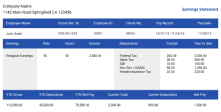
Every pay stub should clearly show the path from gross to net. Understanding net vs gross income at the pay stub level can help prevent errors. Verify these elements each period:
- Gross pay line matches the expected salary or hourly calculation
- The deductions section lists each withholding with the correct amount
- Net pay line equals gross minus all deductions
- Year-to-date totals for net vs gross income track correctly across periods. Learn more about year-to-date earnings on a pay stub.
Common payroll mistakes include:
- Applying the wrong filing status from an outdated W-4
- Miscalculating overtime for non-exempt employees
- Confusing pre-tax deductions (401(k), HSA) with post-tax ones (Roth, garnishments).
Catching these early can help save time and prevent IRS penalties.
You Might Also Like
- FIT on a Pay Stub: What It Means
- How to Get Pay Stubs from Direct Deposit
- Can You Have Two W-2 Jobs at the Same Time?
- What Is LTD on Paystub? Employer Guide (2026)
- Is PTO Taxed? 2026 Employer Guide to Rates and Calculations
- Medicare Tax: 2026 Rates, Rules, and Employer Obligations
- What Is Paychex?
To Sum It Up
Accurate net vs gross income calculations are the foundation of compliant payroll. Knowing the difference between gross pay and net pay can help build employee trust and reduce HR inquiries. Keep Form W-4s current, audit deductions quarterly, and verify net vs gross pay on each pay stub.
Streamline your payroll documentation. Generate professional pay stubs at PayStubCreator.net.