Our customer support is available 24/7:


How To Make Paystubs: Quick & Easy Guide (2026)

You’re applying for an apartment, and the landlord asks for recent pay stubs. Suddenly, you’re unsure what to provide. Either your employer doesn't provide them, you're freelancing, or you're not sure how to make paystubs that look professional and accurate. Sound familiar?
This guide covers everything you need to know about how to make paystubs. This also includes what fields must be included, whether your employer is legally required to give you one, and three practical methods you can use today.
If you already know you need one right now, head straight to PayStubCreator.net to get it done in under two minutes.
Key Takeaways
Federal law does not require employers to provide pay stubs, but most states do
A valid pay stub must show gross pay, tax deductions, FICA, and net pay
The fastest way to make paystubs is with an online pay stub generator, done in minutes
Self-employed workers and freelancers can legally generate their own pay stubs for proof of income
Keep pay stub records for at least 3 to 7 years per IRS guidance
- What Is a Pay Stub and Why Does It Matter?
- What Information Goes on a Pay Stub?
- Are Employers Required To Provide Pay Stubs?
- How To Make Paystubs: 3 Simple Methods
- How To Make Paystubs as a Freelancer or Independent Contractor
- Using Pay Stubs for Proof of Income
- Common Mistakes To Avoid When Making Pay Stubs
- You Might Also Like
- In Closing
What Is a Pay Stub and Why Does It Matter?
A pay stub is a document that shows what you earned during a pay period and what was taken out. It lists your gross pay, tax deductions, and take-home (net) pay. Landlords, lenders, and employers use pay stubs to verify income, making them essential for rental applications and loan approvals.
Think of a pay stub as your financial receipt for work completed. For most employees, it arrives with every paycheck. But if you're a freelancer, gig worker, or have an employer who doesn't issue them regularly, you may need to know how to make paystubs on your own.
Pay stubs go by many names. This can be "paycheck stub", "check stub", or "earnings statement." They all refer to the same document. Whatever you call it, lenders and landlords want to see one. If you've been wondering how to make paystubs that look official and hold up to lender scrutiny, start by understanding exactly what belongs on one.
What Information Goes on a Pay Stub?
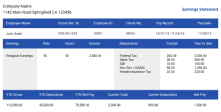
A complete pay stub includes your name and employer name, pay period dates, gross pay (total earned), deductions for federal income tax, state income tax, and FICA (Social Security and Medicare), plus any other deductions like health insurance. It ends with your net pay (take-home amount) and year-to-date totals for every figure.
Here's a full breakdown of what belongs on every pay stub you make:
Employee and Employer Details
Employee name, address, and last 4 digits of Social Security number
Employer name, address, and Employer Identification Number (EIN)
Pay Period Information
Pay period start and end dates
Payment date
Earnings
Gross pay (total wages before anything is taken out)
Regular hours and hourly rate (if applicable)
Overtime pay (hours worked beyond 40/week are paid at 1.5× the regular rate)
Any bonuses or commissions
Deductions
Federal income tax withheld (based on your W-4 filing status)
State income tax (varies by state)
FICA taxes. That is, the Social Security (6.2% of gross pay) and Medicare (1.45% of gross pay)
Optional deductions like health insurance premiums, 401(k) contributions, paid time off (PTO) deductions, and wage garnishments
Understanding gross pay vs net pay is key. Gross pay is what you earn before payroll deductions, and net pay is what you actually take home after every deduction is applied.
Net Pay
Your take-home amount after all deductions
Year-to-Date (YTD) Totals
Cumulative totals for every earnings and deduction line since January 1
Quick example: Say your gross pay is $3,000 for a bi-weekly period. After deducting approximately $420 in federal income tax, $229 in FICA (Social Security + Medicare), and $120 in state income tax, your net pay comes out to around $2,231. YTD columns track these amounts as they accumulate throughout the year.
If you're working out how to make paystubs that are complete and accurate, every single one of these fields needs to be present. Missing the YTD column or leaving out a deduction line is one of the most common mistakes. Landlords and lenders will notice.
Are Employers Required To Provide Pay Stubs?

Federal law under the Fair Labor Standards Act does not require employers to give you pay stubs. However, most states do have their own state pay stub requirements. Rules vary. Some states require paper stubs, others allow electronic access, and a few states have no requirement at all. Check your state's labor department for the specific rules.
Here's a quick overview of how state categories break down:
State Category | What It Means | Example States |
|---|---|---|
No requirement | Employer has no legal obligation to provide stubs | Alabama, Florida, Georgia, Ohio |
Access only | Employee must be able to view stubs (digital is fine) | California, New York |
Access + printable | Employee must be able to print or save stubs | Colorado, Texas, Oregon |
Opt-out digital | Digital default, employees can request paper | Delaware, Minnesota |
Opt-in digital | Paper default, employees must consent to digital | Hawaii |
What if Your Employer Doesn’t Provide Pay Stubs?
If you're in a state that requires pay stubs and your employer isn't providing them, contact your state's labor department. If you're in a no-requirement state, or if you need stubs faster than your employer can produce them, understanding how to make paystubs yourself is important. You can generate accurate records using an online paystub generator and have them ready the same day.
How To Make Paystubs: 3 Simple Methods
There's no single "right" way to make paystubs. The best approach depends on how often you need them, whether you're an employee or self-employed, and how much time you want to spend. Here are the three most practical options:
Option 1: Use an Online Paystub Generator (Fastest)
This is the easiest option if you need accurate, professional-looking pay stubs quickly. An online pay stub generator does the tax math for you. You don't need to know how to calculate FICA or federal withholding. For most people who need to make paystubs fast, this is the go-to method.
Here's how the process works with PayStubCreator.net:
Enter your details: Add your name (or company name if you're an employer), employee name, address, pay period start and end dates, and EIN or Social Security number.
Add pay information: Enter gross wages, hours worked, pay type (hourly or salary), and any deductions like health insurance or 401(k) contributions. The tool auto-calculates federal and state taxes.
Review and download: Check the calculated net pay, preview the formatted PDF, and download it. The whole process takes no more than 2 minutes.
Want to see what a professional pay stub looks like first? Browse pay stub templates at PayStubCreator.net. No payroll knowledge required.
Option 2: Use a Spreadsheet Template
If you prefer to keep things offline or want full control over every number, a spreadsheet template is a good option for simple pay stubs. Google Sheets and Microsoft Excel both have free templates you can download and customize.
To save time, pre-fill your recurring details. This includes your employee SSN, home address, employer EIN, and standard deduction amounts. Save that as your master template. Each pay period, you only need to update hours worked and dates. This cuts prep time significantly.
The downside is that you're responsible for calculating taxes manually, which increases the chance of errors. For occasional use, it's workable. For regular paychecks, "Option 1" is faster and more reliable.
Option 3: Use Payroll Software
Payroll platforms like ADP handle all payroll deductions automatically and generate pay stubs with every payroll run. They integrate with direct deposit and year-end W-2 filing.
This option makes the most sense if you're a small business owner paying three or more employees on a regular schedule. Monthly subscription costs typically start at $40 per month plus per-employee fees.
For individuals who just need one or two pay stubs, or for freelancers generating personal income records, payroll software is overkill. You can consider sticking with "Option 1".
How To Make Paystubs as a Freelancer or Independent Contractor

If you're self-employed, there's an important distinction to understand. Businesses generally don't issue W-2 pay stubs to 1099 independent contractors. You get a 1099 form at year-end, not a regular pay stub.
But that doesn't mean you can't create pay stubs for yourself. You absolutely should if you need proof of income. Knowing how to make paystubs as a freelancer, also called making a pay stub for self-employed income, gives you the documentation that landlords, lenders, and mortgage underwriters expect.
Self-employed people can legally generate pay stubs for:
Rental and lease applications (most landlords request 2–3 months of stubs)
Personal loan and auto loan approvals
Mortgage qualification
Personal financial records and IRS-related tax prep
When making paystubs as a freelancer, include these key fields:
Your full name or business name
Your EIN (or SSN if you haven't formed a business entity)
The amount paid to yourself for the pay period
Pay period dates
A consistent format across all stubs (lenders compare month-to-month)
The IRS doesn't mandate a specific format for self-employment income records. Just make sure every number is accurate. Lenders may cross-check your stubs against bank statements.
Using Pay Stubs for Proof of Income
Pay stubs aren't just paperwork. For most people, they're the primary document proving income to landlords, lenders, and government agencies. Once you know how to make paystubs consistently and accurately, income verification becomes a lot less stressful.
Here's how real situations play out:
Maria, a freelance graphic designer in Austin, was applying for a car loan. The lender asked for the last three months of pay stubs. Because she invoiced clients independently, she had no employer-issued stubs. She generated three months of accurate income records using a paystub generator and submitted them alongside her bank statements. The loan was approved.
A barista who recently started catering on weekends needed to show proof of employment for an apartment application. Her part-time catering gig didn't come with employer-issued pay stubs. She used an online generator to document her earnings and submitted them with her application.
Common situations where pay stubs are required:
Apartment applications: Most landlords want 2–3 months of pay stubs showing income at least 2.5–3 times the monthly rent
Personal and auto loans: Lenders verify gross income against the requested loan amounts
Mortgage qualification: Underwriters typically require 2 years of income history plus recent pay stubs
Utility service setup: Some providers request proof of income for new accounts
Government assistance: Programs like SNAP and Medicaid require income verification
Your pay stub is your financial ID. Keep digital copies saved in cloud storage. If a landlord or lender also asks for additional documentation, you may need a free employment verification letter alongside your stubs. It's a lot easier than hunting for paper when you need it in a hurry.
Common Mistakes To Avoid When Making Pay Stubs
If you're learning how to make paystubs for the first time, these are the errors that trip people up most. Lenders and landlords are trained to spot them.
Wrong pay period dates: Double-check start and end dates every time. A stub showing "March 1–March 31" when you're paid bi-weekly is an instant red flag.
Missing year-to-date totals: Lenders specifically look for YTD columns to verify income consistency over time. A stub without YTD figures looks incomplete.
Forgetting overtime pay: Under federal law, overtime is paid at 1.5 times the regular rate for hours worked beyond 40 per week. If you worked OT, it must show up correctly.
Not accounting for all deductions: Net pay must reflect every deduction. This includes federal income tax, state income tax, FICA, health premiums, 401(k), and any wage garnishments. Omitting one makes the math not add up.
Missing state-required fields: Some states require specific information (like sick leave balances in California). If you're generating stubs for employees, check your state's requirements.
Using false information: Submitting a pay stub with inflated income figures on a loan or rental application isn't just risky. It's a federal crime under 18 USC 1344. Use accurate numbers every time.
You Might Also Like
In Closing
Knowing how to make paystubs gives you more control over your financial documentation. It's useful for employees whose employer doesn't always provide stubs, freelancers who need proof of income, and small business owners paying their first workers.
There are certain key things to get right. Ensure you include every required field (especially YTD totals), match your numbers to your actual income, and keep records consistent over time. Understanding how to make paystubs correctly from the start saves you headaches later when a landlord or lender asks for documentation you don't have.
Making pay stubs doesn't have to be complicated. Use our pay stub generator to create accurate, professional pay stubs in minutes. No payroll experience needed.