Our customer support is available 24/7:


Medicare Tax: 2026 Rates, Rules, And Employer Obligations

Every pay cycle, your business is responsible for correctly withholding and remitting medicare tax. Getting it wrong means IRS penalties, employee trust issues, and potential audits.
A reliable paystub generator can help ensure your documentation reflects accurate deductions. This guide breaks down the current medicare tax rate, surtax thresholds, exemptions, and what employers need to do to stay compliant in 2026.
Key Takeaways
- The standard Medicare tax rate is 2.9%. This is usually split equally between the employer and the employee at 1.45% each.
- There is no wage cap; all earned income is subject to withholding under FICA (Federal Insurance Contributions Act).
- Employers must withhold an additional 0.9% surtax on employee wages exceeding $200,000.
- Self-employed individuals pay the full 2.9% through SECA (Self-Employment Contributions Act) as part of the self-employment tax.
What Is Medicare Tax?
This is a mandatory payroll tax under FICA that funds Medicare Part A hospital insurance. Employers withhold 1.45% from each employee's wages and contribute a matching 1.45%. This makes a combined rate of 2.9%. There is no wage cap.
Signed into law on July 30, 1965, by President Lyndon B. Johnson, the Medicare tax definition is straightforward: it's a federal payroll deduction that funds hospital insurance for Americans 65 and older. The Med tax meaning on your pay stub refers to this same deduction, typically labeled "Medicare" or "Med."
Understanding what Medicare taxes are and how they work is essential for any employer managing payroll. For a detailed guide on pay stub abbreviations, review our full breakdown.
Read more: Understanding Pay Stub Deductions
What Is the Medicare Tax Rate in 2026?

The current rate is 2.9% total, split evenly between employer and employee at 1.45% each. Self-employed workers pay the full 2.9%. This rate has remained unchanged since 1986, and there is no income cap.
So, what is Medicare tax rate in practical terms? Unlike Social Security, it applies to all earned income with no wage base limit.
For example: How much is Medicare tax on a $60,000 salary?
The employee portion is $870 annually. That is, $60,000 x 1.45% and the employer matches that amount.
The Medicare rate applies consistently regardless of income level, which simplifies payroll calculations. The Medicare percentage stays flat at 1.45% per side.
The Medicare tax rate 2025 was identical at 1.45% per side. The 2024 Medicare tax rate was also the same. This consistency means employers don't need to adjust withholding rates year over year.
Withholding for Self-Employed Workers
Self-employed individuals owe the full 2.9% Medicare tax percentage as part of their self-employment tax. This is because they act as both employer and employee. The IRS allows a deduction for the employer-equivalent half (1.45%) when filing annual returns. If you're self-employed and need to document your earnings, an independent contractor pay stub can help.
Read more: FWT Meaning on Your Pay Stub
What Is the Medicare Surtax?
The Medicare surtax includes two additional taxes on high earners. This was introduced by the Affordable Care Act (ACA) in 2013. What is Medicare surtax exactly? The Additional Medicare Tax adds 0.9% on earned income above $200,000 for single filers. Also, the Net Investment Income Tax (NIIT) applies a 3.8% rate on certain investment income above the same thresholds.
Additional Medicare Tax
The Additional Medicare Tax is a 0.9% surtax on wages, compensation, and self-employment income exceeding specific thresholds. What is Additional Medicare Tax in practice? Employers must begin withholding it once an employee's wages pass $200,000 in a calendar year, regardless of filing status.
| Filing Status | Threshold Amount |
| Single | $200,000 |
| Married Filing Jointly | $250,000 |
| Married Filing Separately | $125,000 |
| Head of Household | $200,000 |
The Additional Medicare Tax 2024 thresholds were the same. These amounts are not indexed for inflation and have remained unchanged since 2013.
Net Investment Income Tax
The Net Investment Income Tax (NIIT) is a separate 3.8% surtax on net investment income, including capital gains, dividends, rental income, and interest. It applies when Modified Adjusted Gross Income (MAGI) exceeds the same thresholds listed above.
To reduce NIIT exposure, high-earning business owners can shift investments into tax-advantaged accounts like 401(k) plans, Roth IRAs, or HSAs. Municipal bond interest is also exempt from NIIT.
What Does Medicare Tax Fund?

Why do I pay Medicare tax? Because it funds Medicare Part A, which covers hospital insurance for Americans aged 65 and older and those with qualifying disabilities. This includes inpatient hospital stays, skilled nursing facility care, hospice services, and some home health care. Taxes are held in the Hospital Insurance Trust Fund, managed by the U.S. Treasury.
The Trust Fund faces projected depletion by 2031, according to CMS trustees. This doesn't mean the tax goes away. It means Congress may need to adjust benefits or funding mechanisms. For employers, the withholding obligation remains regardless of the fund's solvency status.
Medicare Part B (outpatient services) and Medicare Part D (prescription drugs) are funded separately through premiums and general revenue, not payroll taxes.
Who Pays Medicare Tax (and Who Is Exempt)?
Nearly all U.S. workers pay this tax, including employees, employers, and self-employed individuals. Limited exemptions exist for:
- Foreign students on certain visas
- Members of qualifying religious groups
- U.S. citizens employed by foreign governments
- Certain pre-1986 state employees
- Students working for their enrolled university.
If you need to claim an exemption on your pay stub, understand the specific criteria first.
For HR managers, the key question is whether your workforce includes employees in any exempt category. Most standard W-2 employees (Form W-2) will have Medicare employee tax withheld. Does everyone pay Medicare tax? Effectively, yes, with the narrow exceptions above. What is employee Medicare tax at its core? It's the 1.45% withheld from each paycheck.
Employer Obligations for Medicare Tax Withholding
As an employer, you're required to withhold the correct amount from every paycheck. Medicare wages and tips include all covered compensation. These include:
- Regular wages
- Overtime
- Bonuses
- Commissions
- Vacation pay
The answer to "What is Medicare wages and tips?" is that it's the total gross compensation subject to the 1.45% withholding.
How Is Medicare Tax Calculated?
For a biweekly paycheck on a $60,000 salary:
$60,000 / 26 pay periods = $2,307.69 gross pay
$2,307.69 x 1.45% = $33.46 withheld per paycheck.
The employer matches this amount. You can also use a weekly paycheck calculator for other pay frequencies.
When an employee's year-to-date wages exceed $200,000, you must begin withholding the additional 0.9% on every dollar above that threshold. Failure to withhold correctly can result in penalties under IRS guidelines, including interest on unpaid amounts.
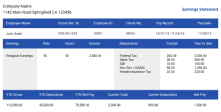
What is Medicare tax on my paycheck? Employees should see a line item labeled "Medicare" or "FICA-Med" showing the 1.45% deduction. If your pay stub creator calculates deductions automatically, verify that the amount withheld matches the expected amount.
Medicare Tax vs. Social Security Tax
Both fall under FICA, but they differ in key ways. Medicare applies to all wages with no income cap, while Social Security only applies up to $176,100 in 2025. Medicare taxes fund hospital insurance. Whereas Social Security funds retirement and disability benefits. For more on how the OASDI tax differs, see our detailed guide.
| Feature | Medicare Tax | Social Security Tax |
| Rate (employee) | 1.45% | 6.2% |
| Rate (self-employed) | 2.9% | 12.4% |
| Wage cap | None | $176,100 (2025) |
| Additional surtax | 0.9% above $200K | None |
| Funds | Hospital insurance | Retirement, disability |
The Medicare and Social Security tax rates combined equal 7.65% for employees (1.45% + 6.2%), with employers matching the same percentage.
You Might Also Like
- FUTA Meaning: Federal Unemployment Tax Explained
- How to Calculate W-2 Wages from a Paystub
- How Much Do Minors Get Taxed on Their Paycheck
- What Is LTD on Paystub? Employer Guide (2026)
- Is PTO Taxed? 2026 Employer Guide to Rates and Calculations
- Net vs Gross Income: What Employers Need to Know (2026)
- What Is Paychex?
To Sum It Up
Medicare tax is a fixed-rate obligation that applies to every dollar of earned income. For employers and HR professionals, the rules are clear. Withhold 1.45% from employee wages, match it with your employer contribution, and trigger the additional 0.9% surtax when wages exceed $200,000. Staying compliant protects your business from IRS penalties.
Streamline your payroll documentation. Generate professional pay stubs at PayStubCreator.net.