Our customer support is available 24/7:


What Is A Year End Pay Stub? Your 2026 W-2 Guide

What is a year end pay stub? It's the last detailed earnings statement your employer sends you for the calendar year, totaling your gross pay, deductions, and net pay for that final period, plus year-to-date (YTD) totals for everything you earned all year. It's not the same document as your W-2.
Plenty of people turn to a paystub generator around tax season, or whenever a landlord, lender, or new apartment application wants proof of what you actually make before your W-2 shows up. This guide covers how a year-end pay stub compares to your W-2, what one looks like, whether you can file taxes with it, and how to get your own.
Key Takeaways
- A year-end pay stub is your last paycheck stub of the year, a running summary of gross pay, deductions, and net pay, not a tax form.
- Your final stub's YTD gross can differ from your W-2's Box 1 because of pre-tax 401(k) and health insurance deductions.
- You can't file your taxes with a pay stub instead of a W-2.
- Employers must send W-2s by January 31, or the next business day; for the 2026 tax year that's Monday, February 1, 2027.
Year End Pay Stub vs W2: How the Two Documents Differ
A year-end pay stub, also called a final pay stub or last paycheck stub, is simply the last detailed earnings statement you get for the year. It itemizes your gross pay, deductions, and net pay for that final period, plus YTD totals for everything since your first paycheck. (How a pay stub differs from a paycheck is covered separately.)
Your W-2, the Wage and Tax Statement, is different. It's one of the tax forms your employer must send you and the IRS, and it's what you use to file your return.
The difference comes down to purpose: your pay stub is a personal record for tracking finances or proving income; your W-2 exists for the IRS and your state tax authority.
What Does a Year End Pay Stub Look Like?

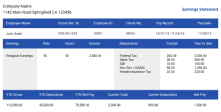
A year-end pay stub lists your final pay period's gross pay, pre-tax deductions like 401(k) and health insurance, taxes withheld, and net pay, alongside year-to-date (YTD) totals for each. The YTD gross figure, not the current-period number, is what counts as your annual income for loans, leases, or rental applications. Apartment hunting? See how many pay stubs you'll typically need.
Here's a simplified example for someone paid biweekly (26 pay periods) with a $52,000 salary:
| Line Item | Current Period | Year-to-Date |
|---|---|---|
| Gross Pay | $2,000.00 | $52,000.00 |
| 401(k) (6%, pre-tax) | $120.00 | $3,120.00 |
| Health Insurance (Section 125, pre-tax) | $92.31 | $2,400.00 |
| Federal/State Tax Withheld | Varies by your W-4 and state | Varies by your W-4 and state |
| Net Pay | Gross minus all deductions | Gross minus all deductions |
Annual Income on Paystub
When someone asks to see proof of what you make in a year, whether it's a landlord, a lender, or a new employer verifying your background, they mean your gross income for the year: the YTD figure on your final stub, not your net pay. See our guide to year-to-date earnings on a pay stub for more.
Why Your Final Stub and W-2 Numbers Differ
Why doesn't your final stub's gross pay always match Box 1 on your W-2? Pre-tax deductions lower your taxable wages before they hit Box 1, and timing plus a couple of IRS rules explain the gap. Our guide to calculating W-2 wages from a pay stub walks through the math.
| Item | On Your Stub | W-2 Box 1 | W-2 Box 3/5 |
|---|---|---|---|
| 401(k)/403(b) pre-tax | Deducted from gross | Reduces it | No change |
| Section 125 (health, dental, vision, FSA) | Deducted from gross | Reduces it | Reduces it |
| Non-taxable reimbursements | Added to gross | Not included | Not included |
| Taxable fringe benefits (company car, group-term life over $50,000) | Often not shown as cash | Added | Added |
| Social Security wage base | Shown all year | N/A | Caps at $184,500 (2026); no cap on Box 5 |
A 401(k) is a common retirement plan. Money you put into retirement plans lowers what shows up in Box 1, but not in Box 3 or Box 5. Reimbursements for mileage or travel under an accountable plan aren't taxable: they can show up on your stub but never touch your W-2 wages. Box 3 stops counting once your Social Security wages hit the $184,500 cap for 2026. Medicare wages (Box 5) keep counting with no limit at all. Still not sure what a line item means? Check our pay stub abbreviations guide.
There's also a timing quirk: the IRS taxes wages in the year they're paid, not earned. A late-December pay period paid out in early January belongs to next year's W-2, though the work was done in December.
New for 2026: Box 12 adds code TT for qualified overtime compensation and code TP for cash tips reported to your employer. A final stub with overtime or tips won't map to one familiar W-2 line the way regular wages do.
Before you file, run this quick check:
- YTD gross minus 401(k) and Section 125 should equal Box 1.
- YTD gross minus Section 125 only should equal Box 3 and Box 5.
- Box 2 should match your stub's federal tax withheld.
- Off by more than a rounding error? Ask payroll for a corrected W-2 (a W-2c) before you file.
Can You File Taxes With Your Last Pay Stub?

No. The IRS requires your official W-2, not a pay stub, when you file. Only the W-2 reports your taxable income to the IRS; a pay stub lacks required details like your employer's EIN. If your W-2 never arrives, contact your employer, then the IRS after February, and use Form 4852 as a substitute.
Employers must send W-2s by January 31 each year; for the 2026 tax year that date falls on a Sunday, pushing the deadline to Monday, February 1, 2027. If it still never shows up, even after you've contacted the IRS, Form 4852 is filled out using the numbers from your final pay stub, the one legitimate tax use for that document.
How to Get Year End Pay Stub
Still working there? Check whatever payroll portal or app your employer already uses (ADP, Paychex Flex, Workday, and Gusto are common). Can't find it online? Ask HR or payroll for a paper copy.
Already left the job? Contact your former employer's HR or payroll department directly. Employers must keep payroll records for at least three years, so your final stub is still on file. The same goes for getting a W-2 from a previous employer.
Self-employed or a 1099 contractor? Nobody issues you a stub, and that's normal. See what a 1099 pay stub looks like if you want your own income record.
Save your final stub as a PDF the day it posts. Portal access often disappears the moment a job ends.
You Might Also Like
- How Can I Get a Copy of My W2 Online?
- What Does FWT Mean on Your Pay Stub?
- What to Do With Multiple W2 Forms From Different Employers
- How Many Pay Stubs Do I Need for a Car?
- Pay Stubs for 1099 Contractors
Conclusion
A year-end pay stub and your W-2 tell two different stories about the same paycheck. Your stub is a personal running total for tracking finances or proving income; your W-2 is what the IRS actually wants. Small gaps are usually just pre-tax deductions at work.
Need a pay stub to document your income right now, for a lease, a loan, or your own records? Our pay stub generator can put one together in a couple of minutes.