Our customer support is available 24/7:

Casdi: What Employers Need To Know In 2026

If you run payroll for California employees, CASDI is a line item you handle every pay period.
This guide covers current CASDI rates, employer obligations, eligibility rules, and W-2 reporting. A reliable paystub generator ensures CASDI-E deductions appear correctly on every pay stub you produce.
Understanding the CASDI meaning and "What is CASDI tax?" starts here.
Key Takeaways
CASDI stands for California State Disability Insurance, funded entirely by employee payroll deductions
The 2025 CASDI employee contribution rate is 1.2% with no wage cap
Employers must withhold and remit CASDI taxes to the EDD each pay period
CASDI-E on pay stubs indicates the employee contribution amount
Businesses can opt out by offering an approved voluntary plan
- Key Takeaways
- What Is CASDI?
- What Is CASDI-E on a Paycheck?
- CASDI on W-2: Box 14 Reporting
- CASDI Contribution Rate 2025
- Is CASDI Mandatory?
- Who Is Eligible for CASDI Benefits?
- CASDI Benefit Amounts
- How To File a CASDI Claim
- Employer CASDI Responsibilities
- Can Employers Opt Out of CASDI?
- Is CASDI Refundable?
- CASDI vs SSDI
- You Might Also Like
- To Sum It Up
What Is CASDI?
What does CASDI stand for? CASDI stands for California State Disability Insurance. It is a state-run program that provides short-term wage replacement benefits to eligible California employees who cannot work due to non-work-related illness, injury, or pregnancy.
The program is funded entirely through employee payroll deductions, not employer contributions. Like the OASDI tax, CASDI appears as a standard deduction on California pay stubs. The CASDI tax meaning refers to the payroll tax that funds this program.
What is CASDI tax in practice? A mandatory deduction from every California paycheck.
The program has two components:
- Disability Insurance (DI) covers employees temporarily unable to work.
- Paid Family Leave (PFL) provides wage replacement for bonding with a new child, caring for a seriously ill family member, or supporting a military family member.
What is California SDI tax? California is one of five states (along with Hawaii, New Jersey, New York, and Rhode Island) requiring employee-funded disability insurance. The CA SDI tax meaning refers to California's version of this program.
What Is CASDI-E on a Paycheck?

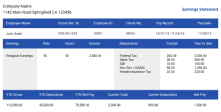
CASDI-E on a paycheck stands for "California State Disability Income tax; Employee contribution." It appears in the deductions section of employee pay stubs. The 2025 rate is 1.2% of gross wages.
When employees ask, "What is CASDI on my paycheck?", direct them to the deductions section. The CASDI-E meaning is the employee's share of California's disability insurance funding. What does CA SDI mean on my paycheck? The same deduction, sometimes labeled "CA SDI" or "CASDI E", depending on your payroll system.
The CASDI-E tax amount is calculated identically regardless of label. If your company needs accurate pay stub documentation reflecting CASDI-E deductions, verify your payroll setup uses the current rate.
What does CASDI mean on my paycheck? It confirms that the state disability insurance contribution was properly withheld. The CASDI on paycheck and CA SDI on paycheck labels both represent this withholding. What is CASDI-E on my paycheck? It is the specific amount deducted for that pay period.
CASDI on W-2: Box 14 Reporting
Employers report CASDI withholding amounts in Box 14 of the W-2 form. This represents the total California State Disability Insurance tax withheld during the calendar year. Employees can use this as a state and local tax deduction.
What is CASDI on W2? The total annual amount withheld for California disability insurance. If you need to calculate W-2 wages from a paystub, Box 14 is where CASDI appears. The CASDI on W2 entry in Box 14 allows employees to claim it as an itemized deduction.
What's CASDI on W2 in practical terms? It reduces taxable income on state returns. Ensure each CASDI W2 entry matches payroll records.
What does CASDI mean on W2? It is the annual sum of all CASDI-E deductions. What does CASDI mean on my W2 is a common question employees bring to HR during tax season.
CASDI Contribution Rate 2025

According to the California Employment Development Department (EDD), the 2025 CASDI tax rate is 1.2%, up from 1.1% in 2024. California eliminated the taxable wage ceiling in 2024.
| 2025 | 2024 | |
| Employee contribution rate | 1.2% | 1.1% |
| Taxable wage ceiling | None (eliminated) | None |
| Maximum weekly benefit | $1,681 | $1,620 |
| Maximum annual benefit | $87,41 | $84,240 |
The EDD announces rates annually. You can verify current 2026 rates at edd.ca.gov before processing payroll.
Is CASDI Mandatory?
Yes, CASDI is mandatory for all California employees, both full-time and part-time. Employers must withhold the CASDI tax from every paycheck and remit it to the Employment Development Department.
Is CASDI mandatory for every CASDI employee on your payroll? Yes. There are no exemptions for W-2 employees. Understanding FWT meaning and other payroll deductions is equally important for compliance. Contractors and self-employed individuals can enroll in the Disability Insurance Elective Coverage (DIEC) program. Learn more about independent contractor pay stubs and how they differ from employee documentation.
Who Is Eligible for CASDI Benefits?
California employees who cannot perform their regular work for at least eight consecutive days due to a non-work-related illness, injury, or pregnancy may qualify. They must have earned at least $300 in wages with SDI deductions during the prior 12-month base period.
Additional requirements:
Lost wages due to the disability
Employed or actively seeking employment when the disability began
Under the care of a licensed physician during the first eight days
Claim filed within 49 days of disability onset
The CASDI max weekly benefit for both DI and PFL is $1,681 in 2025.
CASDI Benefit Amounts
Eligible employees receive 70% to 90% of their average quarterly gross wages. DI benefits last up to 52 weeks. PFL benefits last up to 8 weeks within a 12-month period.
Employees can estimate their weekly benefit using the EDD benefit calculator.
Need to create a pay stub showing accurate CASDI-E deductions? It takes under two minutes.
How To File a CASDI Claim
When an employee files a CASDI claim, employers can expect:
Employee applies online at edd.ca.gov or by mail (form DE 2501)
Physician submits medical certification
EDD sends the employer a Notice of Claim Filed (DE 2503)
Employer responds with wage and employment information
EDD processes and issues payments within approximately two weeks
There is a mandatory 7-day unpaid waiting period. CASDI does not provide job protection. Employees should check FMLA or CFRA eligibility separately.
Employer CASDI Responsibilities
Your CASDI obligations include:
Withholding CASDI contributions from every employee's paycheck
Remitting withheld amounts to the EDD on schedule
Posting required workplace notices, that is, DE 1857A, DE 2515, and DE 2511
Responding to claim notices (DE 2503 and DE 2503F)
Reporting withholdings in Box 14 of W-2 forms
For a complete breakdown of deduction codes, see our guide on pay stub abbreviations.
Can Employers Opt Out of CASDI?
Yes, California employers can opt out of CASDI by establishing an approved voluntary plan. The plan must:
- Provide all SDI benefits plus at least one additional benefit
- Cost employees no more than CASDI
- Receive majority employee approval before taking effect.
Voluntary plans must match any benefit increases CASDI implements. Submit approval documentation to the EDD.
Is CASDI Refundable?
No, CASDI contributions are not refundable, even if an employee never files a claim. However, if total withholdings exceed the annual maximum due to multiple employers, employees may claim a refund for the excess.
Employees can deduct contributions when itemizing state and local taxes via Box 14 on their W-2. For more on understanding pay stub deductions, review the full breakdown of common withholding codes.
CASDI vs SSDI
CASDI and SSDI serve different purposes despite similar names.
| CASDI | SSDI | |
| Level | State (California) | Federal |
| Funding | Employee payroll deductions | FICA taxes (employer + employee) |
| Duration | Up to 52 weeks | Long-term (can be permanent) |
| Eligibility | $300+ earnings with SDI deductions | Work credits based on employment history |
| Benefit | 70-90% of wages | Based on lifetime earnings |
Five states operate SDI programs. They include:
- California
- Hawaii
- New Jersey
- New York
- Rhode Island
You Might Also Like
To Sum It Up
CASDI compliance is a baseline payroll requirement for every California employer. Stay current on annual rate changes, ensure CASDI-E appears correctly on every pay stub, and report accurately in Box 14 at year-end.
Streamline your payroll documentation. Generate professional pay stubs at PayStubCreator.net.