Our customer support is available 24/7:


What Fica Stands For And How It Affects Payroll (2026)

Every payroll cycle, your business withholds FICA taxes from employee paychecks. But what does FICA actually stand for? And how do you know your payroll math is right?
FICA stands for the Federal Insurance Contributions Act. It's the federal law that requires employers and employees to fund Social Security and Medicare through payroll taxes.
Getting FICA right matters for accurate pay stubs, clean tax reporting, and staying compliant. You can use a reliable pay stub generator to ensure your FICA deductions are always correct.
This article explains everything you need to know about FICA, including what it means and its exemptions.
Key Takeaways
FICA stands for the Federal Insurance Contributions Act, which funds Social Security and Medicare
Employers and employees each pay 7.65% (6.2% Social Security and 1.45% Medicare)
The 2025 Social Security wage base is $176,100. Wages above this cap aren't subject to the SS tax
FICA appears as separate line items (OASDI and Medicare) on employee pay stubs
Self-employed individuals pay both halves (15.3% total) through SECA
FICA stands for the Federal Insurance Contributions Act, the payroll tax law that funds Social Security and Medicare. Employers withhold 6.2% for Social Security (up to $176,100 in wages) and 1.45% for Medicare from each paycheck, then match those amounts dollar-for-dollar from their own funds.
FICA is an umbrella term. It's not a single tax but two payroll deductions. This includes Social Security (also called OASDI) and Medicare. This matters for payroll because each part has its own rules, caps, and reporting needs.
A common mix-up is that FICA is not the same as federal income tax withholding. FICA funds Social Security and Medicare. Federal income tax funds general government spending. Your payroll system should show them as separate line items.
So, what is FICA Medicare? It's not a separate tax. Medicare is part of FICA, not the whole thing. Does FICA include Medicare? Yes. Medicare is one of FICA's two components. The confusion arises because pay stubs list each component separately.
FICA Components: Social Security and Medicare

FICA consists of two payroll taxes with distinct rules:
Social Security Tax
Rate: 6.2% for both employer and employee (12.4% total)
2025 Wage Base Limit: $176,100
Once wages pass $176,100, Social Security withholding stops for the rest of the year
Maximum Annual Employee Contribution: $10,918.20
Medicare Tax
Rate: 1.45% for both employer and employee (2.9% total)
No Wage Base Limit: Medicare applies to all wages
Is Medicare part of FICA? Yes. Is Medicare FICA? Not entirely. It's one-half of the FICA tax
The FICA vs Medicare tax question is simple. FICA is the full 7.65% tax. Medicare is just the 1.45% slice. The key difference in FICA vs Medicare is that Medicare has no wage cap. Social Security does.
| Component | Employee Rate | Employer Rate | Wage Cap |
|---|---|---|---|
| Social Security | 6.2% | 6.2% | $176,100 (2025) |
| Medicare | 1.45% | 1.45% | None |
| Total FICA | 7.65% | 7.65% |
When planning payroll costs, remember that the employer match adds 7.65% to every dollar of wages.
Additional Medicare Tax
Employees earning above $200,000 (single) or $250,000 (joint) owe an extra 0.9% Medicare surtax. Employers don't match this part. But you must withhold it once an employee's pay passes $200,000 in the calendar year.
How FICA Appears on Employee Pay Stubs

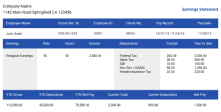
When you create pay stubs for your team, FICA won't appear as a single line item. Instead, it splits into two parts:
OASDI or SS: Social Security tax (6.2%)
FED MED/EE or Med: Medicare tax (1.45%)
Some payroll systems use "FICA/SS" and "FICA Med." The FICA/Med tax label refers to the Medicare portion of FICA. For a full list, see our guide to pay stub abbreviations. No matter the label, both should show on every pay stub.
Here's what a $1,000 gross pay period looks like:
| Line Item | Calculation | Amount |
|---|---|---|
| Gross Pay | $1,000.00 | |
| Social Security (OASDI) | $1,000 x 6.2% | $62.00 |
| Medicare (FED MED/EE) | $1,000 x 1.45% | $14.50 |
| Total FICA Deduction | $76.50 |
Check that your payroll tool gets these numbers right. Wrong FICA amounts can create IRS issues and lead to penalties.
Need accurate pay stubs with properly calculated FICA deductions Create professional pay stubs in under two minutes with PayStubCreator.net.
What FICA Stands For in Your Payroll Calculations
The math is simple. Multiply gross wages by each FICA rate:
Social Security: Gross wages x 6.2% (stop when employee hits $176,100 annually)
Medicare: Gross wages x 1.45% (no cap)
Additional Medicare: Wages over $200,000 x 0.9% (employee only)
Annual example for a $60,000 salary:
Social Security: $60,000 x 6.2% = $3,720
Medicare: $60,000 x 1.45% = $870
Total Employee FICA: $4,590
Employer Match: $4,590
Combined FICA: $9,180
Compare these numbers to your payroll software output each quarter. You can also calculate W-2 wages from a pay stub to verify year-end totals and catch errors early.
FICA for Self-Employed and Multiple Employers
Self-employed workers often ask, "Why do I pay FICA and Medicare at double the rate?" There's no employer to split the cost. Under SECA (Self-Employment Contributions Act), they pay both halves. This means 12.4% for Social Security and 2.9% for Medicare. That's 15.3% total. Review pay stub deductions to understand how these amounts appear. The IRS lets them deduct the employer half (7.65%) on Schedule SE.
For employees with multiple jobs, each employer withholds Social Security on its own. If total wages top $176,100, the employee claims excess SS tax as a credit on Form 1040. Medicare has no cap, so overpayment isn't an issue.
FICA Exemptions
Now that you know what FICA stands for and how it's calculated, note that not all workers are subject to it. As an employer, flag these categories in your payroll system:
Federal employees hired before January 1, 1984
Some state and local workers with their own pension plans
Student employees working at the university where they're enrolled (learn more about claiming exemption from withholding)
Religious groups that filed IRS Form 8274
Foreign workers on F-1, J-1, M-1, or Q-1 visas (with conditions)
Check the IRS FICA guidelines to confirm who qualifies before changing any withholding.
You Might Also Like
To Sum Up
FICA stands for the Federal Insurance Contributions Act. It funds Social Security and Medicare. Employers and employees each pay 7.65% of wages. Accurate FICA math, proper pay stubs, and timely withholding are must-haves for payroll compliance.
Streamline your payroll documentation. Generate professional pay stubs with accurate FICA, Social Security, and Medicare deductions with our paystub templates.