Our customer support is available 24/7:


Are Employers Required To Give Pay Stubs? (2026 Guide)

If you manage payroll for a business, understanding your pay stub obligations isn't optional. Are employers required to give pay stubs? The short answer is that federal law doesn't mandate it, but 41 states do.
Getting this wrong can cost you hundreds per violation. This guide breaks down federal requirements, state-by-state pay stub requirements, and what noncompliance actually looks like for your business. A pay stub generator can help you stay compliant regardless of your state.
Key Takeaways
No federal law requires employers to provide pay stubs, but the FLSA mandates accurate payroll recordkeeping
41 states require some form of pay stub access for employees, falling into five categories
North Carolina requires employers to provide written or printed pay statements each pay period
Penalties for noncompliance range up to $750 per violation in California and $500 per instance in Maryland
Even in states with no requirement, providing pay stubs reduces wage disputes and supports W-2 reconciliation
- Key Takeaways
- What Is a Pay Stub?
- Are Employers Required To Give Pay Stubs?
- Federal Pay Stub Requirements Under the FLSA
- Are Employers Required To Give Pay Stubs in Every State?
- States That Require Pay Stub Access
- States That Require Printed Pay Stubs
- North Carolina Pay Stub Requirements
- Consequences of Noncompliance
- You Might Also Like
- In Conclusion
What Is a Pay Stub?
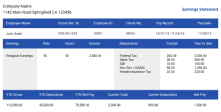
A pay stub is a written statement that details an employee's compensation for a specific pay period. It itemizes gross earnings, hours worked, tax withholdings (federal, state, Social Security, Medicare), voluntary deductions like retirement contributions and insurance, and the resulting net pay. Employers use pay stubs to document wage payments.
For employers, pay stubs serve a dual purpose. They provide employees with transparent records of their compensation while creating documentation that protects your business during audits or wage disputes. A properly formatted pay stub includes the pay period dates, regular and overtime hours worked, gross wages, all deductions itemized, and net pay.
Are Employers Required To Give Pay Stubs?

No federal law requires employers to provide pay stubs. However, 41 states mandate some form of pay stub access for employees. Requirements vary by state. Some require printed statements, others allow electronic access, and a few let employees opt in or out of paperless delivery. Check your state's specific rules below.
State requirements fall into five categories. These include:
- No requirement
- Access
- Access/print
- Opt-out
- Opt-in
If your business operates in multiple states, you must follow the rules of each state where your employees work. Recent updates in Illinois (2025 mandate) and Maryland (stricter penalties) make staying current essential.
Federal Pay Stub Requirements Under the FLSA
The Fair Labor Standards Act doesn't require you to distribute pay stubs. It does require you to maintain accurate payroll records for at least three years. The Department of Labor can inspect these records at any time.
FLSA recordkeeping requirements include:
Employee's full name and Social Security number
Address, including zip code
Birth date (if younger than 19)
Sex and occupation
Time and day of the week the workweek begins
Hours worked each day
Total hours worked each workweek
The basis on which wages are paid
Regular hourly pay rate
Total daily or weekly straight-time earnings
Total overtime earnings for the workweek
All additions to or deductions from wages
Total wages paid each pay period
Date of payment and pay period covered
The FLSA applies to employers with annual gross sales of $500,000 or more, or those involved in interstate commerce. Even if you're not required to distribute stubs, generating them for your records is a compliance best practice.
Are Employers Required To Give Pay Stubs in Every State?

Nine states have no pay stub requirement. They include:
- Alabama
- Arkansas
- Florida
- Georgia
- Louisiana
- Mississippi
- Ohio
- South Dakota
- Tennessee
Employers in these states aren't legally obligated to provide pay stubs.
So are employers required to give pay stubs in these states? No. But skipping them creates risk. Without documentation, wage disputes become harder to resolve. Employees also need pay stubs for apartment rentals, car loans, and mortgage applications. Providing stubs proactively prevents HR headaches and builds workforce trust.
States That Require Pay Stub Access
Twenty-six states require employers to provide pay stubs in written, printed, or electronic format. These access states include:
Alaska
Arizona
Idaho
Illinois
Indiana
Kansas
Kentucky
Maryland
Michigan
Missouri
Montana
Nebraska
Nevada
New Hampshire
New Jersey
New York
North Dakota
Oklahoma
Pennsylvania
Rhode Island
South Carolina
Utah
Virginia
West Virginia
Wisconsin
Wyoming
Illinois enacted a new mandate effective January 1, 2025, under Public Act 103-0953. Employers must now provide pay stubs every pay period and retain copies for three years. Employees can request copies up to two times per 12-month period.
States That Require Printed Pay Stubs
Eleven states require employers to provide pay stubs that employees can print. These states include:
California
Colorado
Connecticut
Iowa
Maine
Massachusetts
New Mexico
North Carolina
Texas
Vermont
Washington
Need compliant pay documentation for your employees? Choose from ready-made pay stub templates that include all required fields and generate professional stubs in under 2 minutes.
Opt-Out States
Delaware, Minnesota, and Oregon require employers to provide paper pay stubs by default. Employees may opt into electronic delivery, but employers can't default to paperless without offering the paper option first. If you're transitioning to digital payroll, ensure your opt-out process is documented.
Opt-In States
Hawaii is the only opt-in state. Employers must obtain written employee consent before implementing an electronic pay stub system. Without that consent, paper stubs remain the default. This applies regardless of company size.
North Carolina Pay Stub Requirements
North Carolina is classified as an access/print state under N.C. Gen. Stat. § 95-25.13. Employers must furnish each employee a written statement of deductions made from their wages for each pay period.
NC pay stubs must include hours worked, pay rate, itemized deductions, gross wages, and net pay. Employers can provide electronic statements as long as employees can print them. If you operate in North Carolina, ensure your payroll system generates compliant documentation each pay cycle.
Consequences of Noncompliance
Failing to provide required pay stubs carries real financial penalties. In California, employers who don't provide payroll records within 21 calendar days of an employee's request face a $750 penalty per violation. Courts can also grant injunctive relief and attorneys' fees.
Maryland's updated rules under Chapter 305, SB 38 (effective October 2024), impose penalties of up to $500 per instance for noncompliant pay statements. Beyond state penalties, noncompliance invites Department of Labor audits, employee wage claims, and reputational damage. The cost of compliance is always lower than the cost of penalties. Accurate W-2 calculations also depend on having proper pay stub records throughout the year.
You Might Also Like
In Conclusion
Are employers required to give pay stubs under federal law? No. But 41 states do require it, and the penalties for getting it wrong are significant. Maintaining compliant pay documentation protects your business from audits, wage claims, and fines, regardless of how many states you operate in.
Streamline your payroll documentation. Generate professional, compliant pay stubs in under 2 minutes with PayStubCreator.net.