Our customer support is available 24/7:


Loans For Bad Credit: What Lenders Want To See In 2026

Search for loans for bad credit and you'll find page after page of lenders promising the "best" rate for your situation. What most of those pages skip is what's actually happening on the lender's side of your application. A low credit score doesn't shut every door. It just means the lender leans harder on everything else in your file. That includes your income, and how well you can document it, ideally with a reliable paystub generator behind you.
This guide walks through how loans for bad credit actually work in 2026. You'll see the loan types available, what to weigh before you compare offers, and the exact steps that help you get approved. It also covers something most lender comparison sites skip entirely: the proof-of-income documentation that can make or break your application. By the end, you'll know what to gather before you apply, not just where to apply.
Personal loans, auto loans, and loans secured by home equity all get evaluated the same basic way. Lenders can't verify income they can't see. A shaky-looking paper trail is one of the most common, and most avoidable, reasons an otherwise qualified borrower gets turned down. That's true even more so with bad credit. Small application mistakes carry a bigger cost when your score is already working against you.
Key Takeaways
- Lenders lean harder on income documentation once your credit score drops, so a clean paper trail matters almost as much as the number itself
- Secured loans, like an auto loan or a loan against home equity, usually approve easier and cost less than unsecured personal loans for bad credit
- A soft credit check lets you prequalify with several lenders without hurting your score
- Missing or inconsistent pay stubs (or no averaged income record if you're self-employed) are one of the most avoidable reasons for a denial
How Loans for Bad Credit Work: What Lenders Actually Look At
"Bad credit" isn't just a feeling. It's a specific range. myFICO, the consumer arm of the company behind the FICO score, breaks scores into five bands. Below 580 is poor. 580 to 669 is fair. 670 to 739 is good. 740 to 799 is very good, and 800 and up is exceptional. Most loans for bad credit target applicants in the fair range and below, though the exact cutoff varies by lender and loan type.
Here's the part that surprises people: your score is only one input. Lenders also look at your debt-to-income ratio, which is how much of your monthly income already goes toward debt payments. They also weigh the depth of your credit history. Increasingly, they weigh how stable and verifiable your income looks. Two applicants with the same 590 score can get very different offers. It depends on how well the rest of their file backs them up.
That's actually good news if your score took a hit for a reason that doesn't reflect your current situation. Maybe it was a medical bill, a job gap, or a rough stretch a few years back. A lender that can clearly see steady income and a manageable debt load has more reason to approve you. That's true even at a fair or poor credit score. A thin or messy income record does the opposite. It gives an already cautious lender one more reason to say no.
In practice, shopping in the fair-to-poor range usually means a smaller maximum loan amount. It also means a higher APR than what's advertised for prime borrowers. Sometimes a lender will ask for a cosigner or collateral to offset the risk. None of that is fixed. It shifts depending on your income, your existing debt, and how complete your application looks on the first try.
Types of Loans for Bad Credit and Which One Fits You

Not every loan works the same way once your credit score is a factor. Here's a quick rundown of the main types you'll run into, and when each one tends to make sense.
Unsecured personal loans. No collateral required, but expect a higher APR and a lower minimum credit score than what's advertised for prime borrowers. Approval leans heavily on income and debt-to-income ratio, since there's nothing backing the loan if you default. These work well for a fixed, one-time expense where you don't want to put an asset at risk.
Secured loans. An auto loan or a home equity loan uses the vehicle or your equity as collateral. That collateral lowers the lender's risk. It usually means an easier approval and a better interest rate. It also means the lender can repossess the asset if you stop paying. Say you already own the collateral outright, or close to it. A secured loan is often the cheapest borrowing option available with bad credit.
Joint and cosigned loans. A joint loan with a cosigner who has stronger credit can unlock a lower rate. It can also mean a higher loan amount than you'd qualify for alone. The cosigner is equally responsible for repayment. This only works if both people fully understand the risk; a missed payment affects both credit histories, not just yours.
Credit union payday alternative loans (PALs). Federal credit unions offer PAL I loans of $200 to $1,000, with 1 to 6 month terms. PAL II loans go up to $2,000, with 1 to 12 month terms. Both are capped at 28% APR under NCUA rules. They're worth checking if you belong to, or can join, a federal credit union and need a smaller amount fast. The rate cap alone puts them well below what most bad-credit personal loans charge.
Home equity loans and lines of credit. If you have significant equity built up, borrowing against it can mean a lower rate than an unsecured personal loan for bad credit. That's because the loan amount is backed by your property. The trade-off is real: your home is the collateral. This option deserves more caution than a smaller unsecured loan.
What to Consider Before You Compare Loans for Bad Credit
Comparing loans for bad credit by interest rate alone is a mistake that costs real money. A handful of numbers determine what a loan actually costs, and whether the monthly payment fits your budget.
Reading the APR, Not Just the Rate
The interest rate and the APR (annual percentage rate) aren't the same thing. The APR wraps in the origination fee and other required costs, so it's the more honest number for comparing offers. A loan advertised at a lower interest rate can still cost more overall. That happens once its origination fee is factored into the APR. Always compare APR to APR, never rate to APR. That mismatch alone can make a worse offer look better on paper.
Loan Term and Total Interest Trade-offs
Two offers at the same APR can end up hundreds of dollars apart depending on how long you stretch the payments. A longer repayment term lowers your monthly payment, but you'll pay more in total interest over the life of the loan. A shorter term costs more per month and less overall. Run both scenarios against your actual budget before picking a term, not just the payment that looks easiest today. A payment that barely fits your monthly budget now leaves no room if your income dips.
Fees That Change the Real Cost
Origination fees typically get deducted from your loan amount upfront, or rolled into the balance. Either way, they reduce what actually lands in your account. A 5% origination fee on a $10,000 loan means you might only receive $9,500, while still owing the full $10,000. Some lenders also charge a prepayment penalty if you pay the loan off early. That matters if you expect to pay it down faster than scheduled. Ask about autopay discounts too; enrolling can shave a small percentage off your rate over the full loan term.
Eligibility Requirements and What Lenders Verify
Beyond the minimum credit score, most lenders publish eligibility requirements covering minimum income, employment length, and state of residence. Some set a minimum loan amount as low as $1,000. Others start at $2,500 or higher. Check that the amount you actually need falls inside a lender's range before you apply. It's also worth confirming whether the lender reports payments to all three credit bureaus. On-time payments only help rebuild your credit history if they're actually being reported.
How to Get Approved for a Loan With Bad Credit?

Check your credit report free at annualcreditreport.com and fix any errors first. Gather recent pay stubs or income records. Then prequalify with two or three lenders using a soft credit check, which won't affect your score. Compare offers within a short window, then submit one full application to the best match.
That order of operations matters more than people realize. A lot of applicants apply to five or six lenders over several weeks. That racks up hard credit inquiries the whole time, which can ding an already fragile score further. Prequalifying first with soft checks, then clustering your real applications into a short shopping window, protects your score while you compare.
Here's the full process, in order:
- Pull your credit report from annualcreditreport.com and check it for errors. An incorrect late payment or an account that isn't yours can drag your score down for no reason. Disputing it can take weeks, so start here.
- Gather your income documentation before you apply anywhere. This means recent pay stubs, and tax returns if you're self-employed. Bring anything else that backs up the income you plan to list on the application.
- Prequalify with two or three lenders using their soft-check tools. This shows you real, personalized rate ranges without touching your score. It lets you compare actual offers instead of advertised "as low as" rates that rarely apply to fair or poor credit.
- Compare the real offers, not just the interest rate. Look at APR, term, fees, and the total amount you'd repay over the life of the loan.
- Apply to your top choice within a short window, ideally the same week you prequalified. That way your hard inquiry lands while the offer is still valid.
Once you've prequalified and picked the best offer, it's time for the full application. It usually asks for identification, your Social Security number, and proof of employment alongside your income documents. Having that paperwork ready before you start speeds up approval. It also avoids the back-and-forth that can stall or sink an application. Getting approved for loans for bad credit usually comes down to this kind of preparation as much as the score itself.
Self-Employed and Gig Income
Traditional pay stubs aren't the whole story here. If you're self-employed or work gig jobs, a single pay period doesn't tell a lender much. Most will average your income over three to six months instead. They use bank deposits or tax returns to smooth out weeks that were busier or slower than usual. Bring more documentation than you think you need; it's easier to have extra records ready than to scramble for them mid-application. A lender that can see a consistent, averaged income trend is far more likely to approve you. A lender that only sees a single strong or weak month has less to go on.
Proof of Income Checklist for Loans for Bad Credit
What actually counts as proof of income? Recent pay stubs are the gold standard. An offer letter, tax returns, or bank statements can work too, especially if a formal pay stub isn't available. Most lenders ask for your last 30 days of pay stubs, usually two to three consecutive pay periods. They'll also want some way to confirm you're currently employed.
If you're paid hourly with hours that swing week to week, send more than the minimum. A few consecutive stubs that show your actual range give the lender a realistic picture. One unusually strong or weak week alone could work against you either way.
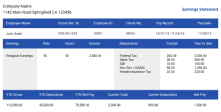
One detail trips up more applicants than it should. The year-to-date totals on your pay stub need to reconcile with the income you typed into the loan application. Say your application lists $52,000 a year, but your latest stub's year-to-date figure doesn't support that math. Expect a request for clarification, or a denial with no explanation at all. Double-check this before you hit submit; it takes two minutes and it's one of the easiest problems to avoid.
Self-Employed, Gig, and 1099 Borrowers
Without a traditional pay stub, lean on your two most recent tax returns and three to six months of bank statements showing deposits. Knowing how to calculate monthly income from an irregular schedule makes this whole step faster. Some lenders also accept a signed profit-and-loss statement. Whatever you submit, keep the numbers consistent across every document. Conflicting figures read as a red flag, even when nothing dishonest is going on. Say your income varies a lot month to month. Add a short cover note explaining the pattern, like seasonal work or a new client. It can help a loan officer read the numbers correctly.
Keep a Continuous Income Record
Don't wait until an application is due to piece together months of income history. Save each pay stub as it's issued. Keep the files somewhere you can actually find them, and check that year-to-date totals line up before you apply anywhere. If your employer doesn't hand you detailed pay records, or you need a clean copy for a lender, having pay stubs ready for a loan application makes it simple to put one together. You're never scrambling the week an application is due.
Rates and the Real Cost of Borrowing With Bad Credit
Most lender sites drop a loan calculator widget here instead of showing you real numbers. Here's what the gap between good and bad credit actually costs on paper.
Take a $10,000 loan over a 3-year term. At an illustrative 11% APR, roughly what a good-credit borrower might see, the monthly payment comes to about $327. You'd pay around $1,786 in total interest over the life of the loan. At an illustrative 32% APR, more typical for a bad-credit personal loan, that same $10,000 costs about $436 a month, roughly $109 more. Total interest lands around $5,680, more than three times as much.
These figures are illustrative, not a quote from any specific lender. But the pattern holds, and it's a big part of why loans for bad credit carry a reputation for being expensive. A lower credit score doesn't just make approval harder. It makes every dollar you borrow cost more. A lower origination fee or a shorter term can narrow that gap somewhat. The credit-score penalty on the interest rate itself is usually the biggest factor by far.
That's one more reason a strong application, backed by clean income documentation, is worth the extra effort. It won't erase a low credit score. But it can be the difference between the higher end of a lender's rate range and the lower end. On a loan this size, even a few points of APR adds up to real money over the loan term.
Common Scams and Predatory Lending Red Flags
Anyone searching for loans for bad credit is a common target for predatory lending. It pays to know the warning signs before you hand over any information.
Walk away if a lender guarantees approval before checking your credit or income at all; legitimate lenders always verify something. Be wary of any request for an upfront fee before funds are disbursed. Real lenders take fees out of the loan proceeds, not your bank account in advance. Pressure to sign the same day is a red flag. So are vague terms that aren't in writing, and lenders that aren't licensed in your state.
A few more signs worth watching for: a lender that contacts you first out of nowhere. Or an APR that isn't disclosed until after you've provided personal information. Repeated calls pushing you to "act now" before a deal expires are another warning sign. Legitimate lenders don't need to rush you. They'll always give you the APR and terms in writing before you sign anything.
The Consumer Financial Protection Bureau publishes current guidance on predatory lending and loan scams. Check it if you want to research a specific offer or lender before signing anything. It's also worth confirming that a lender is licensed in your state through your state's financial regulator.
What Happens If You Can't Repay a Bad Credit Loan?
Missing a payment usually triggers late fees first. The account can then be charged off and sent to a debt collector after 120 to 180 days of nonpayment. That drops your credit score sharply. If the loan is secured, like an auto loan, the lender can repossess the collateral. Call your lender before you miss a payment; hardship plans exist.
That collateral risk is worth sitting with before you choose a secured loan. A repossessed car doesn't just cost you the vehicle. The lender can often still come after you for whatever balance is left after selling it, sometimes called a deficiency balance. An unsecured personal loan doesn't put a specific asset at risk. But a default still does real damage to your credit history, and can lead to a collections lawsuit down the line.
A charge-off or collections account can stay on your credit report for up to seven years, and repeated loan default can eventually lead toward bankruptcy for borrowers already stretched thin. That's a long time to carry the consequences of a few missed payments on loans for bad credit. Before you're in default, most lenders have some form of financial hardship program. Options include a temporary deferment, a modified payment plan, or an interest-only period. These options exist, but only if you ask before you fall behind, not after. Waiting until the account is already in collections closes off most of these choices.
Alternatives to Loans for Bad Credit
A traditional loan isn't the only option, and depending on your situation, it might not be the right one.
Credit union payday alternative loans (PALs), covered earlier, are worth checking first, and they're a safer bet than a cash advance app or a storefront payday loan. This works best if you need a smaller amount and belong to a federal credit union. The 28% APR cap beats most bad-credit personal loan rates by a wide margin. A secured credit card, like a Self credit card, is backed by a refundable deposit and can rebuild your credit history over several months if your timeline isn't urgent. Many issuers automatically review your account for an upgrade to an unsecured card after six to twelve months of on-time payments. Some products bundle in a credit-builder account too, which reports payment history the same way.
If the real issue is several existing balances rather than a single new expense, debt consolidation might be the better fix. It can solve the underlying problem better than another one of the many loans for bad credit on the market. Consolidation means combining what you owe into one payment. It won't work for everyone. It typically requires a credit score high enough to qualify for a rate that's actually lower than what you're already paying, so run the math before committing.
Whatever route you choose, the same rule applies across all of them. A documented, verifiable income is what turns a maybe into a yes. That's true no matter which type of loan or credit product you're applying for.
You Might Also Like
- How Perpay Works
- The 70/30 Budgeting Rule
- How to Show Proof of Income
- How Many Pay Stubs Do You Need for an Apartment
- How Banks Verify Income for an Auto Loan
Conclusion
Your credit score decides which doors are open. But it's rarely the only thing deciding whether you get approved. Clean, consistent income documentation is what closes the gap for a lot of borrowers with fair or poor scores. That means the kind that reconciles cleanly from your application to your pay stub to your bank account. Check your credit report, gather your pay stubs before you start shopping, and prequalify with a few lenders before committing to one.
None of this guarantees approval. But it removes the avoidable reasons a lender says no when you're shopping loans for bad credit. That's the part of this process you actually control. Need a pay stub for a loan application? Use our paystub generator to create accurate pay stubs in minutes.