Our customer support is available 24/7:

Proof Of Income: Documents, Examples And How To Verify (2026)

Every business handles proof of income verification at some point. From tenant screening to employee onboarding, knowing which income verification documents to accept keeps operations running smoothly.
This guide covers accepted documents, how to verify them, and solutions for self-employed workers who need to create their own with a paystub generator.
Key Takeaways
- Pay stubs, W-2 forms, and tax returns are the most universally accepted proof of income documents
- Self-employed workers can use bank statements, 1099 forms, and profit & loss statements
- Most institutions require documents dated within the last 30 to 90 days
- Business owners can generate professional pay stubs at PayStubCreator.net in under 2 minutes
What Is Proof of Income?
Proof of income is official documentation that verifies a person's earnings. Common examples include pay stubs, W-2 forms, tax returns, and bank statements. Employers, landlords, and lenders use these records to confirm financial stability.
Income verification is the foundation of risk assessment. Lenders check debt-to-income ratios. Landlords confirm that a tenant can cover rent. Employers validate salary history during onboarding. What is considered proof of income varies by institution, but the core need remains the same. It must be an official, dated record from a verifiable source.
When Is Proof of Income Required?

Income verification is required for rental applications, mortgage approvals, employee onboarding, government programs, and visa processes. Most landlords follow the 30% rent-to-income ratio. That means a $2,000 monthly rent requires at least $6,667 in gross monthly income.
Business owners managing payroll will get verification requests from staff needing documents for apartments, car loans, or aid programs. Wondering how many pay stubs you need for an apartment? Most landlords ask for 2 to 3 recent stubs. Mortgage lenders need the most thorough verification of income, often requesting 2 years of tax returns plus recent pay stubs.
Proof of Income Documents: 8 Accepted Types
Understanding what counts as proof of income can help businesses and individuals prepare the right documentation. Below are the most common proof-of-income examples, each carrying a different weight depending on the requesting institution.
Pay Stubs
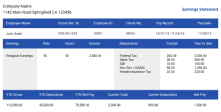
The most widely accepted income verification document. A valid pay stub shows gross wages, deductions, net pay, and employer details. Most institutions request 2 to 3 recent stubs. Don't use traditional payroll software? Generating compliant pay stubs is simple with PayStubCreator.net.
W-2 Forms
Filed yearly with the IRS, the W-2 form records an employee's wages and tax withholdings. Its link to federal tax records makes it one of the most credible income verification documents. Learn more about how to calculate W-2 wages from a pay stub.
Tax Returns and 1099 Forms
IRS Form 1040 shows total annual income from all sources. For contractors, 1099-NEC and 1099-MISC forms document payments received from clients. In 2026, the IRS 1099-K reporting threshold for gig platforms sits at $600, making platform earnings easier to document. See what a 1099 pay stub looks like for a visual example.
Bank Statements
These show consistent deposit patterns. Covered in detail in the dedicated section below.
Employment Verification Letter
A letter from an employer confirming job title, salary, and employment dates. It's useful when pay stubs aren't available or when a third party requires employer confirmation.
Social Security and Pension Statements
The Social Security Administration issues Benefit Verification Letters for retirees. Pension recipients can use 1099-R forms documenting annual distributions.
Workers Compensation and Court-Ordered Awards
Workers' compensation letters and court-ordered payments (child support, alimony) serve as valid proof of salary for individuals receiving them.
Profit and Loss Statements
A P&L statement summarizes revenue and expenses over a set period. This proof of earnings statement is often required with tax returns for mortgage applications.
Are Bank Statements Proof of Income?

Does a bank statement count as proof of income on its own? Not always. Statements show deposits but don't separate income from transfers. To use bank statements as proof of income, highlight recurring business deposits.
Can I show bank statements as proof of income alone? For rentals, often yes. For mortgages, pair them with tax returns. To show proof of income with bank statements, use a dedicated business account.
Self-Employed Proof of Income
Self-employed professionals face a common challenge. No employer creates their pay records. Knowing how to prove income when self-employed starts with the right documents. Accepted proof of income documents for self-employed workers include:
- Tax returns with Schedule C (Form 1040) showing business income
- 1099 forms from clients (1099-NEC for services, 1099-K for platform payments)
- Profit and loss statements prepared quarterly or annually
- Bank statements showing consistent business deposits
- Invoices and contracts documenting agreed-upon compensation
Independent contractors can also use a dedicated contractor pay stub as formal income documentation.
Gig Workers and Platform Income
For DoorDash, Uber, and Instacart workers, annual earnings summaries from the app serve as valid proof.
For how to get proof of income from DoorDash, open your tax summary in the app's earnings section. It shows total earnings and your 1099-K if you made $600 or more. For a step-by-step guide, see how to access your DoorDash pay stub.
Keep 3 to 6 months of platform payout records as supplementary documentation. This is increasingly accepted as gig work represents a growing portion of the workforce in 2026.
The bottom line for self-employed proof of income is that you may need to combine multiple document types. A single source rarely satisfies lenders or landlords on its own. Generate professional pay stubs at PayStubCreator.net for accurate documentation in under 2 minutes.
What Does Not Count as Proof of Income?
Photos of cash, handwritten income notes, unofficial spreadsheets, and outdated pay stubs older than 3 months do not qualify. Screenshots from PayPal, Venmo, or crypto wallets are also generally rejected unless accompanied by official tax documents or bank statements.
Common mistakes that get documents rejected include:
- Employer names that don't match tax filings
- Black-and-white scans of color documents
- Statements over 90 days old.
Check every detail before you submit.
How To Show Proof of Income
Knowing how to provide proof of income correctly prevents delays and rejections. Follow these steps:
- Confirm accepted documents. Ask the requesting party which specific income verification documents they accept. Requirements vary by institution.
- Gather recent records. Rentals need documents from the last 30 to 60 days. Mortgages need 60 to 90 days. Government programs usually require 60-day recency.
- Ensure quality. Scan at 300 DPI minimum. Include all pages of multi-page documents.
- Submit through the requested channel. Follow the institution's preferred method, whether that's a secure portal, email, or physical copies.
If your employer doesn't provide pay stubs, you may need to request them directly from HR or generate your own.
You Might Also Like
- Year-to-Date Earnings on Your Pay Stub Explained
- Are Employers Required to Provide Pay Stubs in Texas?
- How to Access Your Instacart Paystub
- Can You Have Two W-2 Jobs at the Same Time?
- How to Get Pay Stubs from Direct Deposit
- Can You Get a Voided Check Online?
In Conclusion
Income verification is a fundamental part of business operations, from tenant screening to employee onboarding to loan processing. Pay stubs remain the gold standard, but tax returns, bank statements, and employment letters all serve important roles depending on the situation.
For self-employed professionals and business owners who need compliant pay documentation, accuracy and professionalism matter. Create accurate, compliant pay stubs in under 2 minutes with PayStubCreator.net.