Our customer support is available 24/7:

What Is A 1099 Employee? Employer's Guide (2026)

If you're choosing between W-2 hires and independent contractors, you need to know "What is a 1099 employee?" The right classification affects your taxes, legal risk, and payment records. You may face IRS penalties, back taxes, and lawsuits if you get it wrong.
This guide covers "How does 1099 work from an employer's view?" We'll explain the classification rules, payment methods, and misclassification risks. It also covers contractor pay records using a pay stub generator.
Key Takeaways
- A "1099 employee" is technically an independent contractor, not a traditional employee
- Employers do not withhold taxes or provide benefits for 1099 workers
- IRS classification depends on behavioral control, financial control, and relationship type
- Misclassification penalties include back taxes plus up to 40% of the unpaid FICA
- Contractors can make their own pay stubs for income proof
- Key Takeaways
- What Is a 1099 Employee?
- What Is a 1099 Employee vs a W-2 Employee?
- How Does 1099 Work for Employers
- How Do You Pay Independent Contractors?
- Pros and Cons of Hiring a 1099 Employee
- Do 1099 Employees Get Pay Stubs?
- How To Create a 1099 Pay Stub
- Penalties for Misclassifying a 1099 Employee
- You Might Also Like
- In Conclusion
What Is a 1099 Employee?
A 1099 employee is an independent contractor who receives a Form 1099-NEC instead of a W-2. Unlike regular employees, 1099 workers handle their own taxes, use their own tools, and don't receive employee benefits. The term "1099 employee" is not quite right. The correct term is "Independent contractor."
Using the wrong terminology may seem minor, but it can create real risk. Referring to someone as a “1099 employee” in written agreements can undermine your position in the event of an IRS or DOL audit. The proper term is independent contractor or 1099 worker.
So, what is a 1099 independent contractor in practice? They work as freelancers, consultants, or gig economy workers under a written contract. They control how and when they do the work. They can serve many clients at once. Common examples:
- Web developers
- Marketing consultants
- Accountants
- Graphic designers
The hiring party defines the outcome. The contractor determines how to achieve it.
What Is a 1099 Employee vs a W-2 Employee?
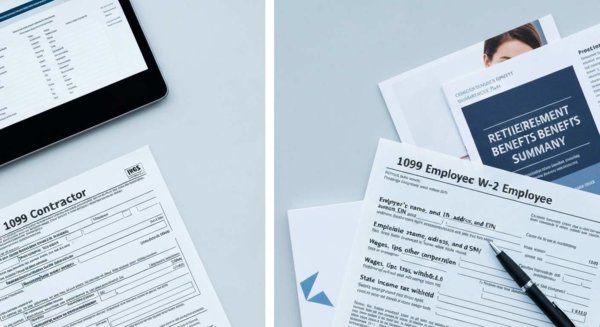
The 1099 vs W-2 comparison is the next key thing to know. The difference affects your payroll costs, tax duties, and audit risk. Here's a side-by-side breakdown:
| Factor | 1099 Contractor | W-2 Employee |
|---|---|---|
| Tax withholding | None. Contractor handles own taxes | Employer withholds federal and state income tax |
| FICA taxes | Contractor pays full 15.3% self-employment tax | Split: employer pays 7.65%, employee pays 7.65% |
| Benefits | Not provided (no health insurance, retirement, PTO) | Employers typically provide a benefits package |
| Work control | You define deliverables. They choose methods | You control the schedule, tools, and process |
| 1099 pay structure | Per invoice, project, or retainer | Regular salary or hourly wage |
| Year-end documentation | Form 1099-NEC | Form W-2 |
The cost gap is real. W-2 employees cost 20-30% more once you add employer FICA, benefits, workers' comp, and unemployment insurance. With 1099 contractors, those costs shift to the worker.
Contractors pay the full 15.3% self-employment tax. This means they are required to pay 12.4% for Social Security and 2.9% for Medicare. W-2 employees split this cost with their employer at 7.65% each. Contractors also handle their own quarterly tax payments using Form 1040-ES, with due dates in April, June, September, and January.
For your business, the administrative burden is lighter. You pay the agreed-upon rate and issue a Form 1099-NEC at year-end. The contractor manages their own tax obligations.
How Does 1099 Work for Employers
If your business controls only the end result, not how the work gets done, the worker qualifies as a 1099 contractor. Wrong classification triggers penalties, including back taxes and up to 40% of unpaid FICA.
Knowing "What is a 1099 employee?" is just the start. Classification isn't based on what you call someone. It's based on the real working relationship. Both the IRS and the Department of Labor apply their own tests, and both can lead to penalties. The 1099 process uses three IRS factors to classify workers. These include:
Behavioral Control
This factor looks at who controls how the work gets done. Telling a graphic designer to work in your office from 9 to 5 on your computer is an example of behavioral control. It looks like employment, no matter what the contract says. True independent contractors choose their own methods, tools, and hours. You set the goal and deadline. They pick the process.
Financial Control
Independent contractors invest in their own tools, carry their own costs, and can earn or lose money. If your business supplies all tools and covers all costs, the IRS may view that worker as an employee. This is especially true when you pay a set rate no matter the result. Contractors also market their skills to other clients. They don't rely on one company for all their income.
Type of Relationship
The IRS looks at whether there's a written contract, whether you offer benefits, and how long the work lasts. Long, open-ended work looks more like a job than a set project.
Beyond the IRS rules, the Department of Labor applies the DOL economic reality test. Updated in March 2024, it has six factors:
- Control
- Profit or loss
- Worker investment
- Permanence
- How core the work is
- Skill level
Some states also use the ABC test, which treats a worker as an employee unless the employer proves otherwise. If the class isn't clear, file Form SS-8 with the IRS for an official ruling.
How Do You Pay Independent Contractors?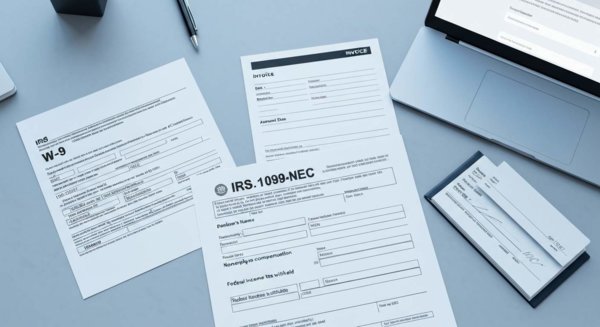
Pay independent contractors in accordance with your contract. This may be hourly, per-project, or on a retainer basis. Collect a Form W-9 before work starts. Then pay by check, direct deposit, or services like PayPal when invoices come in. File Form 1099-NEC and Form 1096 by January 31 for any contractor paid $600 or more in the year.
Knowing "What is a 1099 employee?" also means understanding how their payment process works. Here's the step-by-step:
Collect Form W-9 before any work starts. This gives you the contractor's legal name, address, and tax ID. Keep W-9s on file for at least four years.
Set payment terms in a written contract that covers rate, invoice schedule, and payment method.
Process invoices as they come in. Pay via direct deposit, check, or ACH transfer per your agreement.
- File Form 1099-NEC by January 31 for any contractor paid $600 or more. Starting in 2026, this threshold rises to $2,000. The 1099 form self employed workers receive is their annual pay record from your business.
If you need pay records for contractors, a pay stub generator can make formal documents in minutes.
Pros and Cons of Hiring a 1099 Employee
Now that you know "What is a 1099 employee?", weigh these trade-offs before hiring contractors:
Advantages:
- Lower Costs: No employer FICA match, health insurance, retirement contributions, or unemployment insurance
- Workforce Flexibility: Scale up or down based on project needs without layoffs
- Specialized Skills Access: Hire experts for specific projects without long-term commitments
- Faster Onboarding. Contractors don't need much training or HR processing
Disadvantages:
- Less Control: You can't dictate schedules, methods, or tools without risking wrong classification
- Misclassification Risk: Penalties are severe if the IRS decides a contractor should have been an employee
- Limited Loyalty: Contractors work for multiple clients and may not prioritize your projects
- Workflow Disruption: Higher turnover means repeated onboarding of new contractors
Contractors work best for project-based tasks with clear goals. They also fit highly specialized roles that don’t require a full-time hire. For core ongoing functions, however, W-2 employees give more stability.
Do 1099 Employees Get Pay Stubs?
No, 1099 employees do not get traditional pay stubs from the businesses that hire them. Unlike W-2 employees on a company payroll, independent contractors track their own income. But contractors can make their own pay stub for 1099 contractor work. Sites like PayStubCreator.net create formal income proof in minutes.
Employers who know "What is a 1099 employee?" often ask about their paperwork duties. Since 1099 workers aren't on your payroll, your business won't create an independent contractor pay stub or any regular earnings record. You provide a Form 1099-NEC at year-end with total pay.
Platforms like Upwork may show earnings history, but those records won't replace formal pay records for loans or leases. Many contractors save a 1099 pay stub template to create records each pay period.
For contractors, the lack of pay records may create real problems. Landlords, lenders, and banks require recent pay stubs for apartments, mortgages, and car loans. A self-employed pay stub solves this problem. It's an income record that contractors create on their own. It shows gross earnings, estimated tax deductions, and net pay for a set period.
Do independent contractors get pay stubs from their clients? No. But they can create their own contractor pay stub using an online generator. Many 1099 workers use a pay stub for 1099 employee income to track earnings across clients.
How To Create a 1099 Pay Stub
Creating one takes less than two minutes with the right tool. A complete contractor pay stub includes:
Contractor Information: Name, address, and tax ID.
Client or Payer Details: Business name and address.
Pay Period: Start and end dates.
Gross Earnings: Total amount before deductions.
Estimated Deductions: Federal tax, state tax, and self-employment tax.
- Net Pay: Take-home amount after deductions.
Here's a 1099 pay stub example:
A freelance designer earns $4,500 for a two-week period.
- Federal Tax: $675
- State Tax: $225
- Self-employment Tax: $688
- Net pay: $2,912
Self-employment pay stubs are quick to make. A 1099 paystub generator like PayStubCreator.net handles all the math. Enter your payment details, then download, print, or share your document.
Unlike a printed 1099 form contractors file for taxes, a pay stub covers each pay period rather than annual totals. You can also use it to create a 1099 employee pay stub for loan or lease applications.
Penalties for Misclassifying a 1099 Employee
Understanding "What is a 1099 employee?" isn't just academic. Wrong classification has real financial and legal costs. If the IRS finds your 1099 contractors should have been W-2 employees, your business faces:
$50 penalty for each W-2 you failed to file
3% of worker wages and 40% of unpaid FICA taxes, plus 100% of the matching employer FICA, you should have paid
0.5% per month of unpaid tax liability, growing up to 25% of the total owed
FLSA violations for unpaid overtime or minimum wage under the Fair Labor Standards Act
Since the Department of Labor updated its rules in March 2024, enforcement has grown. Willful misclassification can lead to criminal charges. Workers who were misclassified can sue for back pay and damages. They may also file a complaint with the Equal Employment Opportunity Commission if discrimination was involved.
When unsure about a worker's class, treat them as a W-2 employee. Doing it right costs less than facing penalties.
You Might Also Like
- How Many Pay Stubs Do You Need for an Apartment?
- How to Calculate W-2 Wages From a Pay Stub
- What Does YTD Mean on Your Pay Stub?
- Can You Have Two W-2 Jobs at the Same Time?
- FUTA Tax: What It Means and How It Works
In Conclusion
Knowing "What is a 1099 employee?" protects your business from costly penalties while giving you the freedom to build a strong contract workforce. Focus on three things. Classify your workers right using IRS and DOL rules, document every contractor with a written contract, and keep proper payment records, including 1099-NEC filings.
For pay documentation needs, create accurate pay stubs in under 2 minutes. Get started at PayStubCreator.