Our customer support is available 24/7:

How To Direct Deposit Rent To Landlord: A 2026 Renter's Guide

Your landlord just asked you to start sending rent payments electronically. This guide on how to direct deposit rent to landlord walks you through every step. You're staring at the request, trying to figure out the right place to start (and the easiest way to grab a quick pay stub generator if they want proof of income first). You're not alone. According to Zillow's 2024 Consumer Housing Trends Report, 69% of renters prefer paying rent online. Most landlords in 2026 expect it too. The good news: setting direct deposit up usually takes 10 minutes inside your bank's app. It costs nothing for most personal accounts. It also saves you the mailing-check headache. Below, we'll cover what to ask your landlord for, how to set ACH transfers in your bank portal, how to handle proof of income, and what to do when something goes sideways. We'll keep it simple, with real numbers and zero fluff.
Key Takeaways
- How to direct deposit rent to landlord boils down to one core idea: use the ACH network to push money from your bank to theirs.
- You only need three things to set ACH up: your landlord's routing number, account number, and your own online banking access.
- Most major banks (Chase, Bank of America, Wells Fargo, Citibank) let you set free recurring rent payments in under five minutes.
- Many landlords ask for two to three recent pay stubs as proof of income before approving the setup for new tenants.
- Direct deposit rent is usually a good idea for both sides: predictable rent collection for the landlord, fewer late fees for you.
What Direct Deposit Rent Actually Is
Direct deposit rent is an electronic transfer from your checking account to your landlord's bank account. It moves through the Automated Clearing House (ACH) network. That's the same nationwide system that handles paychecks, tax refunds, and bill payments. Your bank tells the ACH network to send a set amount to a set account on a set date. A day or two later, the money lands.
You may hear it called electronic funds transfer (EFT), ACH rent, or simply autopay. They all mean roughly the same thing for everyday use. The network is overseen by NACHA, a nonprofit that sets the rules every bank in the US has to follow. That's why your transfer behaves the same way at a credit union in Texas as it does at a big national bank in New York.
For you as a renter, it's basically a regular bank transfer. It repeats every month without you having to click anything. That's the simple version of how to direct deposit rent to landlord at the plumbing level.
How to Direct Deposit Rent to Landlord as a Tenant
This is the part most guides skip because they're written for landlords. Here's the actual five-step process for how to direct deposit rent to landlord from the renter's side:
- Ask your landlord for their routing number and account number. Get the numbers in writing (text, email, or signed addendum). Confirm the account holder name matches your lease. If your landlord uses property management software like TenantCloud, Baselane, or Azibo, they'll send you an invite link instead.
- Log into your online banking. Major banks like Chase, Bank of America, Wells Fargo, and Citibank all support this. Look for Transfers, Send Money, or Bill Pay.
- Choose Add external account or Transfer to another bank. Enter your landlord's routing and account numbers exactly as written. Most banks send a tiny test deposit (a few cents) to verify the account. Only after that will they let you push larger amounts.
- Set the recurring transfer. Enter the rent amount, choose monthly, and pick a date. Set it for two to three days before rent is actually due so the payment posts on time. ACH transfers usually take one to three business days.
- Send confirmation. Screenshot the first scheduled transfer and email it to your landlord. Save every monthly confirmation in a folder labeled by year. This paper trail protects you in any future security deposit dispute.
Pro tip: double-check the routing number using the free ABA lookup at aba.com/routing-number. A single transposed digit sends your rent into a stranger's account. Getting it back is a slow, painful process.
How Landlords Collect Rent on the Other Side

If you're curious what's happening on the other side, here's the short version. Landlords first open a business bank account separate from their personal money. That keeps Schedule E tax reporting clean and protects them legally. Next they pick how they'll collect rent. The two main ways to collect are through their own bank's portal or through a dedicated rent collection platform. Tools like Avail and RentRedi automate receipts and track late rent payments.
Then they send each tenant an ACH authorization form to sign. That gives them permission to pull rent from your account on a set date each month. Some landlords prefer pull-style setups (they take the money). Others prefer push-style (you send it). Either is fine. Once the setup is signed, the landlord schedules the recurring pull. They reconcile the payments to landlord against the lease terms every month.
For you as a renter, push-style is usually safer. You stay in control of the timing. It's also a good idea because you can pause or change the transfer in your own banking app.
Proof of Income Before Direct Deposit Starts
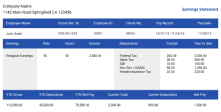
Before your landlord agrees to set you up on electronic rent, they almost always ask for pay stubs for rental applications. The standard rule of thumb is monthly income at or above three times the monthly rent. This is sometimes called the 40x annual rule. Most landlords also have a clear answer to how many pay stubs you need for an apartment (usually two to three). They use this to confirm you can comfortably afford the unit.
If you work a regular job, request the last two to three pay stubs from your employer. Or download them from your company portal. If you're self-employed, freelancing, or working gig jobs and don't get traditional employer stubs, you can build clean pay stubs from your real earnings in under two minutes. Pair them with a recent bank statement showing matching deposits. Most landlords will accept the package.
The key word here is accurate. Pay stubs exist to document what you actually earn. They're your record, not a workaround.
Why Direct Deposit Rent Is Worth It

Once you know how to direct deposit rent to landlord, the upside lands fast. For renters, the value is mostly about peace of mind. You stop worrying about whether the check made it to the mailbox. You stop paying late fees because life got busy. You stop driving across town to drop off rent before close of business. Once it's scheduled, rent pays itself.
You also get a clean digital paper trail. Every transfer is timestamped, traceable, and FDIC-protected at the deposit level. That matters in a few situations. It matters when there's a dispute about whether rent was paid. It matters when you need to confirm whether a pay stub counts as proof of residency for a loan. It also matters when you apply for a new lease and the future landlord asks for payment history.
For landlords, the benefits are predictable cash flow and less chasing. That's why so many are pushing tenants toward ACH in the first place. They've done the math. They know the time savings are real.
Direct Deposit vs. Other Rent Payment Options
Direct deposit isn't your only option for paying rent. But it usually wins on cost and reliability. Here's how the common methods stack up for a $1,500 monthly rent:
| Method | Cost per month | Speed | Paper trail |
|---|---|---|---|
| ACH direct deposit | $0 – $1.50 | 1–3 business days | Strong (bank statement) |
| Zelle | $0 | Instant | Weak (no business invoice) |
| Venmo (business profile) | ~$28.50 (1.9% fee) | Instant | Medium |
| PayPal (goods/services) | ~$48 (~3.2% fee) | Instant | Strong |
| Credit card via Venmo/PayPal | $30 – $60 (2–4% fee) | Instant | Strong |
| Personal check | Free | 5–10 days clear | Strong but mailable, losable |
On a $1,500 rent, choosing Venmo over ACH costs you around $342 a year. Credit card payments can run $360 to $720 a year in fees. Zelle is free but doesn't issue formal business invoices. It's better for small one-off payments than ongoing rent. Gig workers who already use payment apps for work (for example, drivers who access their DoorDash pay stub every week) usually find it cleanest to keep work payouts and rent on separate apps. For most renters in 2026, learning how to direct deposit rent to landlord is the highest-value upgrade you can make to your monthly money flow.
Fees and Costs You'll Actually See
Here's what to expect on the cost side. Most personal checking accounts charge $0 for standard outgoing ACH transfers. That includes Chase, Bank of America, Wells Fargo, and most credit unions. A handful of banks tack on $1 to $3 for same-day or expedited ACH. You almost never need that for rent. If you're not sure where your rent fits in your budget, our guide to calculating monthly income walks through the same math landlords use.
The fees to actually worry about are insufficient funds charges. If your transfer hits on rent day and you don't have enough in checking, your bank will typically charge $25 to $35 for the failed transfer. Your landlord may charge a late fee on top. To dodge both, set your transfer date two to three days early. That buffer covers weekends, bank holidays, and any short-term cash flow surprises in your account. Cost-wise, knowing how to direct deposit rent to landlord through your own bank is almost always cheaper than payment apps.
Security and Safety When Direct Depositing Rent
Direct deposit rent is one of the safer ways to move money. Bank-to-bank ACH transfers are encrypted in transit. Your deposit account is FDIC-insured. Most banks also require multi-factor authentication every time you add a new external account.
The risks are mostly human, not technical. Stick to these four habits:
- Never share your bank login password with anyone, including your landlord.
- Only share your routing and account numbers, and only with someone you have a signed lease with.
- Initiate the setup from your bank's official app or website. Never use a link sent in a text message.
- Screenshot every payment confirmation. Back it up in a year-by-year folder.
If you're ever asked to send money outside your normal bank channels (a Venmo to a personal account, a wire to an unfamiliar name, a payment app you've never heard of), pause. Verify the request with your landlord by phone before sending anything.
Legal Considerations by State
Landlord-tenant law varies by state. Electronic rent rules are no different. Here's a quick snapshot as of 2026:
| State | Direct deposit allowed? | Key notes |
|---|---|---|
| California | Yes | Landlord can encourage electronic payment but must offer at least one non-electronic option per state guidance; tenant consent in writing. |
| New York | Yes | Both parties must agree in writing; some NYC rent-stabilized units add notice requirements. |
| Texas | Yes | Broadly permitted; the lease must specify electronic payment terms to be enforceable. |
One important eviction note: if you're behind on rent and your landlord starts eviction proceedings, talk to a local attorney before sending another direct deposit. In some states, a landlord who accepts any rent payment (even a partial one) after serving a notice to quit can accidentally restart the clock and invalidate the eviction. The same goes in reverse. Tenants under eviction should pause the recurring transfer until the dispute is resolved.
For anything beyond basic setup, check your state's landlord tenant law. Or talk to a local housing attorney. A 15-minute call can save you hundreds of dollars.
Common Mistakes When Learning How to Direct Deposit Rent to Landlord
Most renter problems trace back to the same five errors. Avoid these:
- Mixing up the routing number and the account number. They're not interchangeable.
- Sharing your full online banking password instead of just your landlord's routing and account numbers.
- Switching to electronic rent without updating the lease agreement. Some states require this in writing.
- Scheduling the transfer for the exact rent due date with no buffer. A weekend or holiday can push it late.
- Ignoring a failed transfer or insufficient funds alert. One missed rent payment can spiral into late fees, then notices, then worse.
You Might Also Like
- Pay Stubs for Rental Applications: A Deeper Dive
- How to Calculate W-2 Wages From a Pay Stub
- Net vs. Gross Income: What Renters and Landlords Should Know
- Year-to-Date Earnings on a Pay Stub Explained
- How to Access Your Instacart Pay Stub
Conclusion
Learning how to direct deposit rent to landlord is one of those small upgrades that pays off every month: no checks to mail, fewer late fees, a clean digital record, and one less thing on your mental to-do list. Ask your landlord for the routing and account numbers, set up the recurring transfer in your bank app, and screenshot every confirmation.
And if your landlord asks for proof of income before approving the setup, you can build a clean, accurate pay stub from your real earnings in under two minutes at PayStubCreator.net.