Our customer support is available 24/7:


Lying On Your Rental Application: 2026 Risks And Honest Alternatives

You found the apartment you love. But when you crunch the numbers, your income on paper falls short of the 3x rent rule. Maybe you wait tables, freelance, or work in a warehouse on probation pay. Lying on your rental application can feel like a quick fix in 2026. It is not. The National Multifamily Housing Council reports that 80% of property managers caught fraud on rental applications in the past year. This guide covers what counts as lying on your rental application, how fast each lie gets caught, the real costs, and the honest paths that work.
Key Takeaways
- Lying on your rental application is fraud. Any lease agreement signed under false pretenses can be voided.
- The most common tenant lies are income, employment status, and fake references. Each gets caught fast through a credit check, a credit report, or a phone call.
- After move-in, you risk eviction, a forfeited security deposit, and around $3,500 in costs for the landlord.
- Honest options like bank statements, tax returns, and a real pay stub from your true earnings work just as well.
- Self-employed and gig workers can use a tool like PayStubCreator.net to document real income with no fake numbers.
What Counts as Lying on Your Rental Application?
Lying on your rental application means giving false information on purpose. The lie can cover income, employer, references, criminal history, or pets. It is not the same as a typo. The key is intent. Did you mean to mislead the landlord? If yes, that is application fraud.
A simple test: if the false information helps you, the landlord treats it as fraud. If it does not help (like a misspelled employer name), it is treated as an honest mistake.
Under the Fair Credit Reporting Act (FCRA), tenants have rights about how their data is used. But the FCRA does not protect anyone who lied on a rental application.
Common Types of Tenant Lies (Ranked by How Fast You Get Caught)

Not every tenant lie has the same odds of being found. Here are the common types, ranked from "almost always caught" to "rarely caught up front":
- Hidden criminal history. Catch rate: near 100%. A standard background check pulls this up at once.
- Fake income or a fake pay stub. Catch rate: very high. One call to your employer or a quick look at the format gives it away. Padded gross numbers fail the moment a landlord checks your gross vs. net income against bank deposits.
- False employment status or job title. Catch rate: very high. Property managers verify this in income verification calls.
- Fraudulent references. Catch rate: medium. Landlords often call the contacts you list.
- Hidden pets, smokers, or extra people. Catch rate: low up front, but often caught after move-in.
Some tenants try to pass off a regular pet as an emotional support animal without real paperwork. That is also a form of falsifying documents.
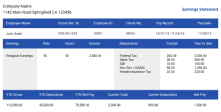
Red flags landlords look for on a fake pay stub: mismatched fonts, round-number earnings, missing year-to-date totals, and no employer EIN. Identity fraud cases tied to altered stubs carry real legal weight.
Real Consequences of Lying on Your Rental Application
What happens depends on when you get caught.
Caught before lease signing. Your application is denied. You lose the application fee. Tenant screening services may flag your file as rental application fraud. That flag can follow you to future rental applications for years.
Caught after lease signing. This is where things get serious. The lease agreement can be voided. The landlord can issue an eviction notice within 3 to 30 days in most states. Your security deposit is often forfeited. Any judgment from the eviction stays on your credit report for seven years.
TransUnion data shows the average eviction costs the landlord around $3,500 per unit. In many states, the tenant can be held liable for that cost. Add long-term harm to your rental history, and a small lie can hurt you for nearly a decade.
Legal and Criminal Repercussions

Lying on your rental application is more than a lease problem. It can rise to document fraud, identity fraud, or even perjury, since most leases are signed under penalty of perjury. Criminal charges are rare for everyday tenant lies, but they are not out of reach. They show up on background checks for a long time.
State law also matters. Under the Fair Housing Act, landlords have to follow set rules. California, New York, and Texas give tenants more time to respond. Florida and Arizona move faster. Check your state attorney general site for the current rules.
Honest Alternatives When Your Income Is Complicated
If your income does not fit the 3x rent rule, you have honest options. Here is the 3-step income verification kit that works for most self-employed, freelance, and gig workers:
- Three months of bank statements showing steady deposits. This is one of the simplest ways to show proof of income without a regular pay stub.
- Last year's tax return, with a Schedule C if you are self-employed. If you do not have a 1099, here is how to report freelance income without one.
- A real pay stub from your true earnings. A tool like PayStubCreator.net lets self-employed and gig workers create a clean pay stub that reflects what they actually earn. No fake numbers. If you are not sure how many pay stubs to bring, most landlords ask for two or three of the most recent.
Some landlords will also accept a co-signer, an extra month of rent up front, or a CPA letter. Showing many honest documents almost always works better than padding numbers on one.
How does this compare to other potential tenants? Property managers screen potential tenants the same way. Honest files clear faster. Padded files raise red flags.
Conclusion
Lying on your rental application almost never pays off in 2026. Background checks, credit reports, and a quick call to an employer catch most lies. The cost of lying on your rental application can follow you for years. The good news? If your income is complicated, there is almost always an honest path.
Need a pay stub that reflects your real earnings? You can create yours in under 2 minutes at PayStubCreator.net and apply with confidence.