Our customer support is available 24/7:


Medical Er On Paystub: Understanding Employer Health Contributions

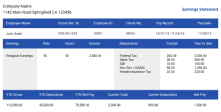
The code for medical ER on paystub means "Employer Responsible" or "Employer Paid”. You may have looked at your paystub and wondered, "What is medical ER on my paystub?" or "What does ER medical on paycheck mean?" These abbreviations are important in understanding your total compensation.
Using a reliable paystub generator can help you create your pay stub. In this document, all codes and abbreviations are organized clearly for you to understand.
This article explains "ER" (Employer Responsible) codes. You'll be able to understand "What is Medical ER on paystub?" and how it works. This will help you understand your employee benefits and how they affect your total compensation.
Understanding Medical ER on Paystub and How It Works
Your paycheck stub is your detailed financial statement. However, to understand your ER health contributions, you must first understand certain pay stub codes and abbreviations listed in them.
What Is ER Medical on Paycheck?
The code for Medical ER on paycheck means "Employer Responsible". It could also mean "Employer Paid". You could see codes like ER medical on pay stub or simply ER health. It indicates the portion of your health insurance premiums. Dental insurance and vision coverage are usually listed separately, depending on the plan and payroll format. These are premiums that your company pays directly to the insurer on your behalf.
You need to understand that this figure is not deducted from your wages. Instead, it's a reported contribution. It is a line item that shows the investment your employer pays into your healthcare coverage. This amount is a major component of your total compensation. It remains separate from your taxable income.
EE vs ER Payroll
While ER stands for Employer, "EE" stands for Employee:
EE Health: This is your share of the cost. Your employer deducts this employee contribution from your gross pay as a paycheck deduction. You typically have to fund this portion with pre-tax income. Then, this lowers your taxable income.
ER Health: This is your employer's share. The employer contribution is money that your company pays directly. They'll add it to your benefits on your pay stub. But it's not taken from your employee's pay.
In essence, you have a health plan that has a total monthly premium. The EE code shows what you pay. The ER code shows what your employer pays.
Locating and Interpreting ER Health Costs on Pay Stub
You need to know how to find this ER on a pay stub. Your employer's responsibilities depend on your employer and their payroll. You will typically find ER health contributions in one of these sections:
"Employer Contributions" Section.
"Benefits Summary" Section.
"Deductions/Contributions" Section
It's possible that you don't see this as "ER Health" on your pay stub. Look for other abbreviations like ER Health Cov, ER HCV, Medical ER, or simply ER medical.
Also Read: Where To Find Your Employer Identification Number
ER Cost of Medical on Pay Stub: Calculating Your Total Health Premium
The total health premium is the entire cost you pay monthly or annually. You use this to keep your health insurance policy active. You and your employer share this cost. You may be asking, "What is ER cost of Medical?" Let's do a quick calculation:
Let's say your company's total monthly premium for your selected health insurance plan is $600. On your pay stub, you see "EE Health" listed as a paycheck deduction of $180. In the employer contributions area, you see "ER Health" listed as $420.
This shows your employer is covering 70% of the total cost:
$420 / $600 = 0.70
Your pay stub shows that this significant portion of your health coverage is employer-funded. When you see both numbers, this confirms your total premium. You'll understand how the cost is being shared.
Importance of Reporting ER Health Contributions
You may be wondering why this information is on your pay stub if it's not your money. Reporting ER contributions is simply important for legal and regulatory compliance. It also ensures accurate financial management and tax reporting, and trust between employers and their employees.
Furthermore, this report allows for accurate benefits administration. You’d be able to correctly determine how much you’re to pay. In all, reporting this simply provides a record you can always verify.
Legal Requirements
The Patient Protection and Affordable Care Act (ACA) requires employers to report the cost of healthcare coverage. This information should appear annually on your employee W-2 Forms in Box 12 with Code DD.
Check Out: Easily Create Your W2 in Minutes With Our W2 Generator
Understanding Medicare Taxes and Other Deductions

You could mistake ER health for other mandatory payroll deductions. However, they're completely different. They also have different purposes. Here's how your Medicare taxes and Federal Income Tax work:
Fed MED/EE
This refers to "Federal Medicare Tax/Employer-Employe". It is a mandatory payroll tax that funds the Medicare Health Insurance Program. It is a part of FICA, the Federal Insurance Contributions Act. All employees and employers in the United States are required to pay their portion of the Federal MED/EE tax. It is taken out of a person's paycheck.
Medicare tax payments are a fixed percentage of an employee's income. Every employed person is required to pay 1.45% of their income for Medicare tax. On the other hand, your employer must also match the 1.45%. If you are self-employed, however, you are required to pay both parts of the Medicare tax. This is a total of 2.9% of your income. High earners may also see the Additional Medicare Tax (0.9%) withheld once wages exceed the threshold. Employers withhold it but do not match it.
Fed MED/ER
This typically refers to the Federal Medicare Employer Responsibility tax. It is the employer's part of this tax. As already mentioned, they are also required to pay a tax rate of 1.45%. This brings the total contribution to 2.9%.
Both the ER Health contribution and the Fed MED/ER tax are employer-paid items. However, one is for your private insurance, while the other is a government payroll tax.
Also, your EE Health contributions typically consist of pre-tax income. This reduces your gross income subject to federal income tax and Social Security and Medicare taxes. The ER Health contribution is tax-free to you. Therefore, this means that you don't have to pay any income tax on this employer-provided benefit.
Other Common Deductions on Your Pay Stub
The following are deductions shown on your payslip that affect your net income:
Social Security (FICA/OASDI): You contribute 6.2 percent, subject to an income cap each year. The employer matches that contribution. When you see OASDI on paystub, it refers to this specific Social Security tax.
Federal & State Income Tax: These are withholdings that are based on how much you earn. It also depends on your filing status. You’ll find Federal Income Tax as FWT on pay stub.
Retirement Contributions: This covers the contributions you make to your retirement programs. For instance, 401 (k) and/or 403(b) plans. Sometimes these contributions are deducted from your pre-tax income.
Group Term Life: You might also see GTL payroll on your pay stub. It means Group Term Life insurance. It’s another employer-provided benefit that has both EE and ER contributions.
Other Employee Benefits
Your pay stub may also include other benefits for which your employer contributes, and shares the cost:
Health Savings Accounts/HSA ER Meaning
It offers a triple tax benefit. It is for individuals who are covered under a High-Deductible Health Plan (HDHP). It is then used to pay for qualified medical expenses or prescription drugs. It is also useful for healthcare savings and retirement planning.
Flexible Spending Accounts (FSA)
It is a tax-advantaged savings account. It is usually funded with pre-tax income to pay for qualified medical expenses.
Short-Term and Long-Term Disability Insurance (STD ER / LTD ER)
These disability insurance benefits also provide income protection:
STD ER (Short-Term Disability): Short-Term Disability (STD) is an insured benefit. It substitutes for a portion of your earnings. This is when you can't work for a short while. It covers a portion of your income till you can resume your job.
LTD ER (Long-Term Disability): This insurance pays a portion of your income because of your illness or injury. It includes disabilities where you can't work anymore. It replaces a portion of your earnings to cover daily living costs.
Frequent Errors to Review on Your Pay Stub
Errors may occur. This is why you must monitor your paycheck. This way, you can assure yourself that you are getting the proper benefits. Check for:
Incorrect ER Cost of Medical Amounts: Ensure the amount listed on the document matches your contribution.
Outdated Health Plan Information: Confirm that your employer is crediting your account for your contributions.
Missing Contributions: Ensure that your employer is properly depositing your contributions.
If you spot an issue, first check your enrollment documents. If there's a problem, contact your HR or payroll department right away. Ensure you have a copy of your pay stub with you.
Read More: What To Look For To Spot Errors On Pay Stub
In Summary
"ER Health" displayed on your paycheck indicates the cost of your health care that your employer contributes to your health plan. You no longer need to ask, "What is medical ER on my paystub?" Understanding all these can help you fully appreciate your total benefits. You can do your health and financial planning properly for the next calendar year.
Understanding your pay stub helps you make better decisions about your employment benefits. You can generate a pay stub easily with our free paystub generator to understand your benefits and health insurance. Check our tool out today.