Our customer support is available 24/7:


Gross Weekly Pay: What It Means And How To Calculate It

You've just been asked to list your gross weekly pay on a rental application, but you're not sure what number to write. It's not your take-home amount. It's not your annual salary. It's something in between, and lenders and landlords use it every single time they review your application.
This guide explains what gross weekly pay is, how to calculate it, and what gets taken out before you see your paycheck. If your paystub generator doesn't show the breakdown clearly, we'll cover that too.
Key Takeaways
- Your total earnings for the week before taxes and deductions are removed
- For hourly workers: Hours worked × hourly rate = weekly gross
- For salaried workers: Annual salary ÷ 52 = weekly gross
- Landlords and lenders use gross pay, not your take-home amount, to qualify you
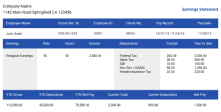
- Your pay stub may label it "gross wages," "gross earnings," or "total earnings." These are all the same thing
What Is Gross Weekly Pay?
Your weekly gross is the total amount you earn in a week before any taxes or deductions are removed. It includes your regular wages, overtime pay, tips, and any bonuses for that period. It is the income before deductions that landlords and lenders use to verify your ability to pay. It's not your take-home amount.
Your employee gross wages are different from what lands in your bank account each payday. Taxes, health insurance, and retirement contributions are all deducted afterward. Gross pay is the full amount your employer pays for your work before any of that happens.
You'll see it labeled a few different ways on your pay stub. "Gross wages," "gross earnings," and "total earnings." They all mean the same thing. Different payroll systems just use different names for it. You'll also see a year-to-date total on your stub, which tracks how much you've earned since January 1st.
Gross Weekly Pay vs. Net Pay
Gross pay is the full amount your employer pays you before any deductions. Net pay is what you actually take home after all taxes and benefit contributions come out. Most workers keep roughly 70 to 80 percent of their gross pay, depending on their tax situation and benefit elections.
When you apply for an apartment or a personal loan, lenders and landlords always ask for your gross income, not your net. They use gross pay because it reflects your total earning power, not the choices you've made about retirement or benefits.
There's also a distinction between gross pay and gross income. Gross pay is specifically what your employer pays you. Gross income is a broader IRS concept that includes all your income sources. These include wages, freelance work, and investment returns. Your weekly earnings feed into your gross income, but the two aren't always the same number.
How To Calculate Gross Weekly Pay for Hourly Employees

To find your hourly employee gross pay, multiply your hourly wage by the number of hours worked that week.
For example: $18/hr × 40 hours = $720 gross weekly pay.
For overtime hours, multiply those hours by 1.5 times your hourly rate (time and a half) and add the result.
The core formula is straightforward: Hours per week × hourly rate = weekly gross.
At the federal minimum wage of $7.25/hr, a 40-hour week earns $290. In states like California or New York, where the minimum wage is $16/hr, that same week earns $640. Overtime adds on top. If you worked 44 hours at $18/hr, you'd earn $720 for the regular 40 hours plus $108 for the four overtime hours ($18 × 1.5 × 4). That puts your weekly gross at $828.
Use a weekly paycheck calculator to double-check your estimate for any pay period.
How To Calculate Gross Pay for Salaried Employees
For a salaried employee gross pay, divide your gross annual salary by the number of pay periods in the year. Different schedules break that base salary down in different ways.
Here's what $50,000 a year looks like across the most common pay schedules:
| Pay Schedule | Pay Periods Per Year | Gross Pay Per Period |
|---|---|---|
| Weekly | 52 | $961.54 |
| Bi-weekly | 26 | $1,923.08 |
| Semi-monthly | 24 | $2,083.33 |
| Monthly | 12 | $4,166.67 |
To find your weekly equivalent from a biweekly pay period, divide your bi-weekly gross pay by two. Your offer letter or HR department can confirm which pay schedule applies to you.
What's Taken Out of Your Gross Pay?
Several payroll deductions are subtracted from your gross pay before you receive your take-home amount. Mandatory deductions include federal income tax, state income tax, and FICA taxes. This is the Federal Insurance Contributions Act, which funds Social Security and Medicare. Voluntary deductions like health insurance premiums and 401(k) contributions reduce your paycheck based on what you've enrolled in.
Mandatory Deductions
These come out automatically regardless of your elections:
- Federal income tax: Based on your Form W-4 filing status and progressive tax brackets
- State income tax: Varies by state (some states have none)
- FICA taxes: For 2026, you pay 6.2% for Social Security on wages up to $176,100, plus 1.45% for Medicare with no cap
Voluntary Deductions
These are the benefit elections you chose when you enrolled:
- Health insurance premiums
- 401(k) or other retirement contributions
- FSA or HSA deposits
Most pre-tax deductions are subtracted before your taxable wages are calculated, which matters at tax time. Your W-2 Box 1 shows taxable wages, not your full gross pay. If you earned $55,000 and contributed $3,000 to a 401(k), Box 1 will show $52,000.
Wage garnishments are another involuntary deduction that occurs when a court orders payments from your paycheck. Direct deposit doesn't affect how your gross pay is calculated. It only controls where your net pay lands.
If your employer doesn't provide a detailed pay stub, you can create your own pay stub with every deduction clearly labeled. That's exactly what a landlord or lender expects to see.
You Might Also Like
- How Many Pay Stubs Do You Need for an Apartment?
- What to Do If Your Employer Doesn't Provide Pay Stubs
- How to Get Pay Stubs from an Old Job After Leaving
- Is a Pay Stub Proof of Residency?
- How to Calculate W-2 Wages from a Pay Stub
In Conclusion
Your full earnings before taxes and deductions are what matter most when you're applying for an apartment, a loan, or any situation that asks you to verify your income. For hourly workers, it's hours times your rate. For salaried workers, it's your annual pay divided by 52.
Now that you know the formula and what shows up on your pay stub, you're ready to answer that income question with confidence. Need a professional pay stub that clearly shows all of this? Create your pay stub at PayStubCreator.net in minutes. This is perfect for rental applications, loan paperwork, and proof of income.