Our customer support is available 24/7:


Pay Period Types: A Guide For Employers (2026)

Every payroll decision starts with one choice, which is the pay period to use. This shapes how often you run payroll, how you calculate overtime, and how your cash flow operates each month.
This guide breaks down every type, the exact numbers behind each, and how to pick one that fits your business. If you need pay documentation fast, our pay stub generator has you covered.
Key Takeaways
- A pay period is the recurring timeframe used to calculate and distribute employee wages
- The four standard types are weekly, biweekly, semimonthly, and monthly
- Biweekly is the most common schedule in the U.S., used by 43% of private businesses according to BLS data
- State payroll laws may restrict which frequencies employers can use
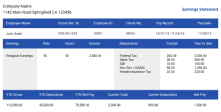
- These dates appear on every pay stub for verification
What Is a Pay Period?
A pay period is the recurring timeframe an employer uses to calculate and distribute employee wages. The four standard types are weekly, biweekly, semimonthly, and monthly, each producing a different number of paychecks per year. The terms "pay cycle" and "paycycle" describe this same process.
The pay period definition is simple. It's the window of time when you track hours, calculate gross pay, and process payroll deductions. Employers use this schedule to stay consistent with tax withholding, benefits enrollment, and compliance deadlines.
What does pay period mean for daily operations? It sets the rhythm of your entire payroll. Your choice directly affects costs, cash flow, and employee satisfaction.
So, what is pay period in practice? It's the foundation of your compensation workflow. The payroll cycle also determines how prorated pay is handled when employees join or leave mid-schedule.
Pay Period vs Payday
The tracking window covers the date range when employee work hours and wages are recorded. Payday is the date wages go out. Most employers run payroll 3-7 business days after the window ends. The two dates never match exactly.
This matters for planning. The pay date is when direct deposit hits accounts or checks go out. Knowing "When is pay day?" can help you plan cash reserves. Most payroll calendars show the start and end dates, along with the paydate, for easy tracking.
Types of Pay Periods
So, how do pay periods work? It comes down to four types. The Bureau of Labor Statistics (BLS) shows biweekly as the most common paycheck frequency, at 43% of private firms. Weekly comes next at 33%. The split varies by industry. Construction and manufacturing favor weekly for easier overtime tracking. Service firms tend to use semimonthly pay for salaried employees.
Some companies now also offer on-demand pay options. These let workers access earned wages before the scheduled payday. However, the four standard types below remain the norm for most employers.
Weekly Pay Period
A weekly schedule produces 52 cycles per year. On a $50,000 annual salary, each paycheck equals roughly $961.54 before deductions.
This works best for hourly workers in construction, retail, or food service. Overtime math is simpler on a weekly basis. The weekly pay period usually starts and ends on Monday to Sunday or Saturday to Friday. The trade-off is higher processing costs. Use a weekly paycheck calculator to estimate your employees' take-home amounts.
Biweekly Pay Period
A biweekly schedule produces 26 cycles per year, with each paycheck at $1,923.08 on a $50,000 salary. This is the most popular option in the U.S.
How long is a pay period on a biweekly schedule? Exactly 14 days. One note for employers is that every 5-6 years, the calendar produces 27 cycles instead of 26. That happens because 52 weeks times 2 equals 364 days, but a year has 365. Ensure you plan your payroll budget for this.
Biweekly is not the same as semimonthly. Biweekly means every two weeks on a fixed day (e.g., every other Friday). Semimonthly means twice per month on fixed dates. This confusion costs HR departments hours of employee questions each year.
Semimonthly Pay Period
A semimonthly schedule produces exactly 24 cycles per year, with each paycheck at $2,083.33 on a $50,000 salary.
These schedules usually pay on the 1st and 15th (or 15th and last day of the month). This works well for salaried roles. It also keeps benefit deductions the same each period. The downside is harder overtime math for hourly workers. These windows don't line up neatly with work weeks.
Monthly Pay Period
A monthly schedule produces 12 cycles per year at $4,166.67 per paycheck on a $50,000 salary.
Monthly payroll has the lowest costs and the simplest setup. It's the least common in the U.S. and mostly used for senior salaried roles. Most workers prefer more frequent paydays. Some states ban monthly pay for certain worker types. Under the Fair Labor Standards Act (FLSA), there is no federal rule on frequency. Many states set their own.
How Many Pay Periods Are in a Year?
The total pay periods in a year depend on frequency.
- Weekly produces 52
- Biweekly produces 26 (occasionally 27)
- Semimonthly produces exactly 24
- Monthly produces 12.
Here's a quick comparison for budgeting purposes:
| Pay Frequency | Periods/Year | Paycheck ($50K Salary) |
|---|---|---|
| Weekly | 52 | $961.54 |
| Biweekly | 26 | $1,923.08 |
| Semimonthly | 24 | $2,083.33 |
| Monthly | 12 | $4,166.67 |
The fixed payment amount for each pay period is calculated by dividing the annual salary by the total number of periods. For employers, "How many pay days in a year?" directly impacts payroll costs and administrative workload.
How To Choose a Pay Period for Your Business
Pick your schedule based on four factors: workforce type, cash flow, costs, and state law. California requires semimonthly pay for most workers. New York requires weekly pay for manual workers. Check your state's Department of Labor website to ensure compliance with all employer payroll obligations.
Here's a practical framework:
Workforce type: If most employees are hourly, weekly, or biweekly, it simplifies overtime calculations. For mostly salaried teams, semimonthly reduces processing runs.
Cash flow: Monthly or semimonthly pay gives you longer to collect receivables before payroll hits. Weekly pay requires tighter cash management.
Payroll costs: Each run costs money in processing fees and staff time. Fewer runs per year means lower costs.
- State payroll laws: The FLSA doesn't mandate a specific frequency, but many states do. The Department of Labor provides a state-by-state list of payday requirements. Verify compliance before setting your schedule.
What Does Per Pay Period Mean?
"Per pay period" refers to the amount deducted or earned during each cycle. For example, if health insurance costs $200 on a biweekly schedule, you pay $200 every two weeks, totaling $5,200 annually. This figure appears on pay stubs alongside each deduction line item.
Understanding per pay period meaning is key to managing employee benefits enrollment. Each deduction line on a pay stub shows the recurring cost of health insurance, retirement contributions, and tax withholding.
When employees ask, "What does per pay period mean on their stub?", the answer is simple. It's the amount taken from each paycheck for those benefits. For a deeper look, see our guide on understanding pay stub deductions.
The amount changes with your frequency. A $400/month benefits package breaks down to $200 on semimonthly, $184.62 on biweekly, or $92.31 on weekly. Clear pay stubs prevent confusion and reduce HR inquiries. Generate accurate stubs with proper breakdowns at PayStubCreator.net.
You Might Also Like
- How to Calculate W-2 Wages from a Pay Stub
- Year to Date Earnings on Pay Stub Explained
- How to Find Your Employee ID on a Pay Stub
- What Does a 1099 Pay Stub Look Like?
- What Are Payroll Warrants?
- All You Need To Know About Radius Global Solutions
In Closing
Selecting the right schedule for your business comes down to balancing payroll costs, cash flow requirements, state compliance, and employee preferences. Accurate pay documentation is non-negotiable regardless of frequency.
Streamline your payroll documentation. Generate professional pay stubs at PayStubCreator.net.