Our customer support is available 24/7:


Social Security On Pay Stub: Employer Compliance Guide (2026)

Managing how Social Security information appears on your employees' pay stubs requires balancing legal compliance with data protection. Getting this right matters regardless of company size. Incorrect SSN handling exposes your business to IRS penalties, state labor violations, and identity theft liability.
This guide covers what employers need to know about Social Security on pay stub documentation. You'll learn which states require it, how FICA deductions appear, and how to configure SSN display using a paystub generator.
Key Takeaways
Most pay stubs display only the last four digits of an employee's Social Security number for privacy compliance.
California (Labor Code §226) and Colorado explicitly require SSNs or employee IDs on pay stubs.
Employers face IRS penalties of $60 to $660 per return for incorrect SSN reporting.
Major payroll providers (ADP, QuickBooks, Workday) mask SSNs to show only the last four digits by default.
No federal law mandates SSN on pay stubs, but FLSA requires employers to maintain SSN records.
- Key Takeaways
- Do Pay Stubs Have Social Security Numbers on Them?
- What Is a Social Security Number on a Pay Stub?
- Where Does Social Security on a Pay Stub Appear?
- Does Every Pay Stub Have Social Security?
- FICA and Social Security on Pay Stub Deductions
- State Laws Governing Social Security on Pay Stubs
- Employer SSN Compliance Obligations
- Protecting Social Security on Pay Stub Documents
- You Might Also Like
- To Sum Up
Do Pay Stubs Have Social Security Numbers on Them?
Yes, most pay stubs include the employee's Social Security number, though typically only the last four digits. No federal law mandates SSN on pay stubs, but states like California (Labor Code §226) and Colorado require it. Employers control SSN display through their payroll software settings.
Do pay stubs have Social Security number data in every case? The answer depends on your state and your payroll configuration. Federal law, specifically the Fair Labor Standards Act (FLSA), requires employers to keep SSN records for each employee. However, it does not require printing that number on the pay stub itself.
States take different approaches. California and Colorado mandate SSN or employee ID on every pay statement. Most other states leave the decision to employers. As a business owner, your obligation is to maintain accurate SSN records internally while minimizing exposure on employee-facing documents. The distinction matters for liability.
Do pay stubs have Social Security number information that could be compromised? Yes, and that is exactly why printing full SSNs creates unnecessary risk. If a pay stub with Social Security number data is lost, stolen, or improperly disposed of, your business could face liability for any resulting identity theft.
Many employers ask, "Do pay stubs have SSN displayed by default?" In most payroll systems, yes. For employers generating pay documentation, the safest approach is to display only the last four digits unless your state explicitly requires the full number. Understanding Social Security on pay stub requirements helps you configure this correctly.
What Is a Social Security Number on a Pay Stub?
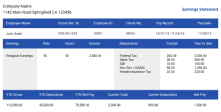
A Social Security number on a pay stub is the nine-digit identifier issued by the Social Security Administration (SSA) used to track tax withholdings and benefit contributions. It appears in the employee information header and as "Social Security" or "OASDI" in the deductions section.
On pay stubs, the SSN serves two distinct functions.
- It identifies the employee for tax reporting purposes. The IRS uses this number to match withholdings reported on Form W-2 to individual tax returns.
- The Social Security deduction line (labeled OASDI, FICA-SS, or simply "Social Security") shows the amount withheld for year-to-date earnings and retirement benefits.
Employees who need to obtain an SSN can apply through the SSA using Form SS-5. For employers, the critical task is ensuring the SSN on file matches what the SSA has on record. Every pay stub with SSN data must reflect the correct number to avoid IRS reporting errors.
Where Does Social Security on a Pay Stub Appear?
Social Security appears in two locations on a pay stub:
- The employee header section (displaying the SSN, usually masked as XXX-XX-1234)
- The deductions section (showing the Social Security tax withheld, labeled "SS Tax," "OASDI," or "FICA-SS").
The exact placement varies by payroll provider.
In the employee information header, you'll find the SSN alongside the employee's name, address, and employee ID. Most payroll systems default to a masked format. ADP and Workday display XXX-XX-1234. QuickBooks shows the full or partial number based on admin settings.
In the deductions section, the Social Security tax line shows the dollar amount withheld from gross wages. This is how Social Security is listed on a pay stub as a financial deduction, separate from the identifier in the header. Do pay stubs show Social Security number and deduction in the same area? Typically, no. They appear in different sections of the document.
Does Every Pay Stub Have Social Security?
The answer to this question is no. Do paystubs have SSN on every single one? Not necessarily. Whether a pay stub displays the Social Security number depends on state law, employer policy, and payroll software configuration. Major providers like ADP and Workday mask SSNs to the last four digits by default. QuickBooks and Paychex let administrators choose between full display, partial masking, or hidden.
Here's how leading payroll platforms handle SSN display in 2026:
ADP: Last four digits by default on employee-facing stubs
QuickBooks Payroll: Admin configurable. Full or last four digits
Workday: Last four digits in the employee self-service portal
Gusto: Last four digits for all employee-facing documents
Paychex: Employer configurable in payroll settings
If you're generating pay stubs for employees and need to control SSN visibility, tools like PayStubCreator.net let you configure display options, including full number, last four digits, or completely hidden. A pay stub with a full SSN is increasingly rare outside states that mandate it.
Do paystubs have Social Security number displayed in full? Only if your state requires it or your payroll admin has not changed the default. If your employees receive a paystub with full SSN and your state does not require it, consider updating your payroll settings to mask the number. Employees often ask, "Do pay stubs have your Social Security number visible?" The answer depends entirely on your employer's configuration.
FICA and Social Security on Pay Stub Deductions
The Social Security deduction on a pay stub represents the employee's share of FICA (Federal Insurance Contributions Act) taxes. The current rate is 6.2% of gross wages, up to the annual wage base limit. Medicare adds another 1.45%, bringing the total FICA to 7.65%.
On pay stubs, you'll see these deductions labeled as:
SS Tax or Social Security: The 6.2% employee contribution
OASDI: Old-Age, Survivors, and Disability Insurance (same as Social Security)
FICA-SS: Explicitly identified as the FICA Social Security portion
Medicare/FICA-Med: The 1.45% Medicare contribution
Employers must match the employee's 6.2% Social Security contribution and remit both shares to the IRS. This employer matching obligation is separate from what appears on the employee's pay stub. Understanding Social Security on pay stub deductions helps ensure accurate withholding.
State Laws Governing Social Security on Pay Stubs
State requirements for Social Security on pay stub documentation vary significantly. Here are the key compliance points for employers:
California (Labor Code §226): Requires employers to provide an itemized pay statement including either the employee's SSN or an employee identification number. Most California employers use employee ID to minimize SSN exposure.
Colorado (SB 21-176): Mandates that if an SSN appears on pay documentation, it must be masked to the last 4 digits. Display of the full SSN is prohibited on employee-facing documents.
Illinois (Public Act 103-0953): Effective January 1, 2025, employers must provide itemized pay stubs for each pay period. Records must be retained for three years. Employees can request copies up to twice per year.
Maryland (Chapter 305, SB 38): Effective October 2024, requires detailed pay statements. Noncompliance penalties run up to $500 per instance.
No-Requirement States
These states have no pay stub provisions. They include:
- Alabama
- Arkansas
- Florida
- Georgia
- Louisiana
- Mississippi
- Ohio
- South Dakota
- Tennessee
The FLSA requires employers to maintain payroll records, including employees' SSNs, for at least 3 years from the date of payment. The Department of Labor can audit these records at any time.
Employer SSN Compliance Obligations
Beyond state pay stub laws, the IRS imposes penalties for incorrect SSN reporting on tax documents. The 2025 penalty schedule for incorrect SSN on information returns (including Form W-2):
| Filing Timeline | Penalty Per Return |
|---|---|
| Corrected within 30 days | $60 |
| Corrected by August 1 | $130 |
| After August 1, or not filed | $330 |
| Intentional disregard | $660 |
Reference: IRS Publication 1586, Reasonable Cause Regulations.
To verify employee SSNs before filing, employers can use the SSA's Social Security Number Verification Service (SSNVS). This free service lets you verify up to 10 names and SSNs online or submit batch files for larger verifications.
SSNVS differs from E-Verify, which confirms employment eligibility via Form I-9. Both are important compliance tools, but SSNVS specifically addresses SSN accuracy for tax reporting. Getting Social Security on pay stub documentation right starts with verification. For new hires, collecting accurate SSN information through Form W-4 and verifying it through SSNVS reduces the risk of costly IRS penalties.
Protecting Social Security on Pay Stub Documents
As an employer, safeguarding Social Security on pay stub documents is both a legal obligation and a business risk management practice.
Display practices:
Configure payroll software to show only the last four digits
Use employee ID numbers as an alternative identifier where state law permits
Audit existing pay stub templates annually for unnecessary SSN exposure
Digital security:
Encrypt all digital pay stubs before distribution
Require password-protected PDFs for emailed pay statements
Use secure employee self-service portals rather than email delivery
Physical security:
Store paper pay stubs in locked filing cabinets with restricted access
Shred outdated paper stubs using a cross-cut shredder
Establish a document retention and destruction schedule
When it comes to Social Security on pay stub privacy, employees should know that a pay stub showing only the last four digits of their SSN is sufficient for most applications, including apartment rentals and loan verifications. For situations requiring full SSN proof, direct employees to their Social Security card or Form W-2 instead.
If an employee reports potential SSN misuse from a compromised pay stub, direct them to the SSA and the Federal Trade Commission (FTC) to report identity theft.
You Might Also Like
To Sum Up
Correctly handling Social Security on pay stub documentation protects both your business and your employees. The key compliance steps are to verify SSNs through SSNVS before filing, configure payroll software to mask SSNs to the last 4 digits, and stay current with your state's pay stub requirements.
For employers who need to generate professional, compliant pay documentation, streamline the process with a pay stub generator that handles SSN display, FICA calculations, and state-specific formatting automatically.