Our customer support is available 24/7:


Monthly Salary Meaning: How It Works For Employers (2026)

Pay frequency is one of the first payroll choices a business owner makes. The monthly salary meaning matters because it shapes your budget, workforce planning, and state compliance.
Whether you use a paystub generator or a full payroll service, this guide covers what monthly salary means and how to calculate it. You'll also be able to decide whether monthly pay fits your organization.
Key Takeaways
- Monthly salary is a fixed compensation amount paid once per month, producing 12 paychecks per year
- Calculate the monthly salary by dividing the annual salary by 12
- Monthly payroll reduces administrative costs, but some states restrict pay frequency for hourly workers
- Employers should verify state labor laws before implementing a monthly pay schedule
- Review each pay stub monthly to confirm gross pay matches the stated annual salary divided by 12
- Key Takeaways
- What Does Monthly Salary Meaning Refer To?
- Monthly Salary vs. Hourly Pay
- How Monthly Pay Works for Your Business
- Monthly Salary Meaning in Practice: How To Calculate It
- Benefits of Getting Paid Monthly
- Disadvantages of Getting Paid Monthly
- Why Do Some Companies Pay Monthly?
- You Might Also Like
- Summary
What Does Monthly Salary Meaning Refer To?
Monthly salary meaning refers to the fixed pay an employer gives an employee each month. You get it by dividing the annual salary by 12. An employee earning $60,000 per year gets $5,000 per month before taxes.
In an employment contract, a monthly salary is the base pay set at the time of hire. It excludes bonuses, overtime pay, and commissions. For HR managers running monthly payroll, this figure sets the gross pay on each pay stub. It's also the baseline for tax withholdings, retirement, and insurance.
When someone asks, "What is monthly pay?" they typically mean this gross figure before any deductions are applied. Understanding pay stub abbreviations helps verify these amounts.
Monthly Salary vs. Hourly Pay

Once you grasp the monthly salary meaning, compare it to hourly pay. This shapes how you manage your team. Salaried workers receive the same fixed amount each pay period, regardless of how many hours they work. Hourly workers earn based on the time logged. FLSA requires 1.5x overtime pay for non-exempt staff who work over 40 hours per week.
For businesses on a monthly payroll, salaried exempt workers are easy to process. Their base salary stays the same. Hourly staff need hour tracking, overtime math, and paycheck adjustments. You can use a weekly paycheck calculator to compare costs across pay frequencies.
| Factor | Monthly Salary | Hourly Pay |
| Pay consistency | Same amount each month | Varies by hours worked |
| Overtime eligibility | Typically exempt | Required over 40 hrs/week |
| Payroll complexity | Lower | Higher |
| FLSA classification | Usually exempt | Usually non-exempt |
| Budgeting (employer) | Predictable labor costs | Variable labor costs |
How Monthly Pay Works for Your Business
On a monthly pay schedule, employees get one paycheck per month. That's 12 pay periods per year, versus 26 for biweekly or 24 for semimonthly. The pay period runs from the first to the last day of the month, with direct deposit on a set date.
Set up monthly pay frequency by configuring your payroll software. Each period, the system runs gross pay, tax withholdings, and deductions.
For salaried employees getting paid monthly, the math is simple. The annual salary should be divided by 12.
For hourly workers, total the month's hours and multiply by the rate. If you need to get pay stubs from direct deposit, check with your payroll provider.
Monthly Salary Meaning in Practice: How To Calculate It

Annual to Monthly:
- $60,000/year / 12 = $5,000/month (gross pay)
- $72,000/year / 12 = $6,000/month (gross pay)
- $84,000/year / 12 = $7,000/month (gross pay)
Hourly to Monthly:
Multiply the hourly rate by 173.33 (average monthly work hours at 40 hours per week).
- $25/hour x 173.33 = $4,333/month
- $35/hour x 173.33 = $6,067/month
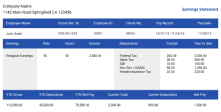
Subtract taxes, health insurance, and retirement from gross pay to get net pay. Your monthly pay stub should show these figures clearly. Check that the gross amount matches the annual salary divided by 12 and that deductions look correct. For a full breakdown, see our guide on understanding pay stub deductions.
Benefits of Getting Paid Monthly
For employers, monthly pay offers clear efficiency gains. Processing payroll once per month instead of biweekly cuts your runs from 26 to 12 per year. If your payroll provider charges per run, that directly reduces costs.
Monthly payroll also simplifies accounting. Revenue and expenses align with monthly reports, enabling faster reconciliation. For employees, a single larger paycheck each month can simplify rent and mortgage payments by providing a predictable compensation package.
Disadvantages of Getting Paid Monthly
The primary drawback of monthly pay falls on employees. A four-week gap between paychecks can strain workers with tight cash flow, particularly those with variable expenses. For hourly employees, getting paid monthly can feel inconsistent when hours fluctuate.
From an HR perspective, workers typically prefer more frequent pay. Offering monthly pay when competitors offer biweekly can hurt recruitment. Weigh employee experience against administrative savings before committing.
For contractors, understanding independent contractor pay stubs can clarify documentation needs.
Why Do Some Companies Pay Monthly?
Companies pay monthly to cut payroll costs and align with standard accounting cycles. Government agencies, law firms, consulting firms, nonprofits, and finance roles commonly use monthly payroll. Many school districts pay teachers on a 12-month cycle tied to their annual contract.
State compliance is a factor. California and New York require more frequent pay for most hourly employees. Monthly schedules work mainly for salaried exempt staff in those states.
Texas and Illinois allow monthly pay for certain employee types. Always verify your state's rules before choosing this schedule.
Why do companies pay once a month? Primarily for the cost and simplicity advantages, provided state law permits it. Learn more about the FWT meaning in the federal withholding context.
You Might Also Like
- How to Calculate W-2 Wages from a Pay Stub
- Year-to-Date Earnings on Your Pay Stub Explained
- OASDI Tax Meaning: What It Is and How It Works
- FUTA Meaning: Federal Unemployment Tax Explained
- Are Employers Required to Provide Pay Stubs in Texas?
- What Is a Check Number on a Pay Stub?
Summary
The monthly salary meaning comes down to fixed pay once per month, calculated by dividing the annual salary by 12. Employers gain admin savings. Employees need to budget across longer pay gaps.
Streamline your payroll documentation with a professional paystub generator and create accurate pay stubs in under two minutes.