Our customer support is available 24/7:


Time And A Half: Employer’s Guide To Calculating Overtime Pay (2026)

Miscalculating time and a half is one of the most expensive payroll errors a business can make. The Department of Labor recovered over $274 million in back wages for overtime violations in a single year.
If you're running payroll for non-exempt staff, you need to get these calculations right. A reliable pay stub generator can help you document overtime earnings accurately from the start.
This guide covers the overtime premium, who qualifies, and how to calculate it for hourly and salaried employees in 2026.
Key Takeaways
- Time and a half equals 1.5 times an employee's regular hourly rate for overtime hours
- Non-exempt employees working over 40 hours per week must receive this premium under the FLSA
- The 2025 exempt salary threshold is $1,128 per week ($58,656 annually)
- Formula: Regular Hourly Rate x 1.5 = Overtime Rate
- Nondiscretionary bonuses must be included when calculating the regular rate of pay
- Key Takeaways
- What Does Time and a Half Mean?
- Who Qualifies for Time and a Half Pay?
- How To Calculate Time and a Half
- Calculating Time and a Half for Hourly Employees
- Calculating Time and a Half for Salaried Employees
- Time and a Half for Common Hourly Rates
- How Time and a Half Appears on Pay Stubs
- You Might Also Like
- Final Thoughts
What Does Time and a Half Mean?
Time and a half is a pay rate equal to 1.5 times an employee's regular hourly wage. Under the Fair Labor Standards Act (FLSA), employers must pay non-exempt employees this premium rate for every hour worked beyond 40 in a single workweek.
For employers, time and a half pay isn't optional. It's a federal mandate. The FLSA defines a workweek as any fixed, recurring period of 168 hours (seven consecutive 24-hour periods). Any hours your non-exempt staff works beyond the 40-hour threshold trigger the overtime obligation.
You might see people search for "What's time and a half?" The time and half meaning is the same regardless of phrasing. The term "Time in a half" also refers to this concept. So what is time in a half? It's the 1.5x overtime rate. Similarly, time in half and time in a half pay describe this same premium.
Who Qualifies for Time and a Half Pay?
Non-exempt employees earning below the FLSA salary threshold of $1,128 per week ($58,656 annually, effective January 2025) qualify. To be exempt, an employee must meet three tests. Misclassification exposes employers to back-wage liability.
As an employer, correctly classifying your workforce is your responsibility. Here's the three-part exemption test:
Salary basis test: The employee receives a predetermined, fixed salary that isn't reduced based on quality or quantity of work.
Salary level test: The employee earns at least $1,128 per week ($58,656 per year) as of January 1, 2025. The previous threshold was $844 per week, effective July 1, 2024.
Duties test: The employee's primary duties fall under executive, administrative, or professional categories as defined by the FLSA.
All three tests must be met for an exemption. If anyone fails, the employee is non-exempt and qualifies for overtime. Some states add their own rules. California mandates the 1.5x rate after 8 hours in a single workday.
Is overtime time and a half in every case? Under federal law, yes, for non-exempt workers. But is overtime always time and a half? Not always. Some states require double time in certain situations.
Understanding what is paid time and a half versus double time matters for multi-state compliance. If you need help understanding pay stub abbreviations, our guide breaks down common codes, including overtime designations.
How To Calculate Time and a Half
The core formula is straightforward:
- Overtime Rate = Regular Hourly Rate x 1.5
- Total Overtime Pay = Overtime Rate x Overtime Hours
One critical detail most employers miss is that nondiscretionary bonuses must be factored into the regular rate before applying the 1.5 multiplier. These include attendance bonuses, productivity bonuses, and shift premiums. Calculating overtime on base pay alone is the most common FLSA violation.
Time and half pay must always reflect the true regular rate. For a deeper dive on paycheck math, see our guide on how to calculate W-2 wages from a paystub.
Calculating Time and a Half for Hourly Employees
Here's the answer to "How does time and a half work for an hourly employee?" This example uses a $20/hour rate with 45 hours worked:
Step 1: Identify the regular rate.
Regular rate = $20/hour
Step 2: Calculate the overtime rate.
$20 x 1.5 = $30/hour
Step 3: Separate regular and overtime hours.
Regular hours = 40 and Overtime hours = 5
Step 4: Calculate total gross pay.
Regular pay: 40 x $20 = $800
Overtime pay: 5 x $30 = $150
Total: $950
So, time and a half for 20 an hour equals $30. For an employee earning $16.50 per hour, 16.50 time and a half equals $24.75 per hour. These calculations follow the same formula regardless of base rate. You can also use our weekly paycheck calculator to verify totals, including overtime.
Need accurate pay documentation for your hourly staff? Generate professional pay stubs in under 2 minutes with PayStubCreator.net.
Calculating Time and a Half for Salaried Employees
For salaried non-exempt employees, convert the salary to an hourly rate first. Here's an example using $52,000 annually with 45 hours worked:
Step 1: Convert the annual salary to weekly.
$52,000 / 52 weeks = $1,000/week
Step 2: Convert weekly salary to hourly rate.
$1,000 / 40 hours = $25/hour (regular rate)
Step 3: Calculate the overtime rate.
$25 x 1.5 = $37.50/hour
Step 4: Calculate total weekly compensation.
Base salary: $1,000 (covers first 40 hours)
Overtime pay: 5 x $37.50 = $187.50
Total: $1,187.50
What is time and a half pay for salaried workers with bonuses? Add the bonus to the base salary before calculating the regular rate. A $100 weekly production bonus added to the $1,000 salary changes the regular rate to $1,100 / 40 = $27.50/hour. The overtime rate becomes $41.25/hour.
Time and a Half for Common Hourly Rates
Use this quick-reference table when processing payroll:
| Regular Hourly Rate | Overtime Rate (1.5x) | OT Pay (5 extra hours) |
|---|---|---|
| $15.00 | $22.50 | $112.50 |
| $16.50 | $24.75 | $123.75 |
| $18.00 | $27.00 | $135.00 |
| $20.00 | $30.00 | $150.00 |
| $21.00 | $31.50 | $157.50 |
| $22.00 | $33.00 | $165.00 |
What is time and a half for $20 an hour? It's $30. What is time and a half for $21 an hour? It's $31.50. What's time and a half for $22 an hour? Same answer: $33. Whether you search 22 an hour time and a half, 22 time and a half, or time and a half for 22 an hour, the result is $33.
How Time and a Half Appears on Pay Stubs
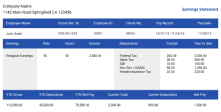
When you generate pay stubs for employees who worked overtime, OT earnings should appear as a separate line item. Standard labels include "OT Pay," "Overtime," or the 1.5x premium. Keeping regular and overtime earnings distinct on pay documentation is essential for audit readiness.
Employees can verify their OT pay with a simple check. Regular hours times the standard rate should equal base pay. Overtime hours times 1.5x the rate should equal OT pay. If the numbers don't match, they'll contact HR. Paystub generators like PayStubCreator.net automatically separate regular and overtime earnings. Understanding FWT and other tax deductions on your pay stub also helps verify that withholdings are correct.
You Might Also Like
- Year-to-Date Earnings on Your Pay Stub Explained
- Understanding Pay Stub Deductions
- What Does FIT Mean on Your Paycheck?
- How Many Pay Stubs Do You Need for an Apartment?
- What Does a 1099 Pay Stub Look Like?
- Can You Get a Voided Check Online?
Final Thoughts
Correct overtime calculations protect your business from FLSA violations. Audit your employee classifications against 2025 salary thresholds. Verify that bonuses are included in regular rate calculations. Document everything on clear, professional pay stubs.
Streamline your payroll documentation. Generate professional pay stubs at PayStubCreator.net.