Our customer support is available 24/7:

Generate a professional 1040-ES in minutes, with the formatting done for you.
Rated 4.4/5 (770+ reviews) 35+ tax forms No subscription required
Nobody is taking tax out of your pay anymore. That is what catches people off guard when they go freelance, start driving, or pick up contract work, and it is why Form 1040 ES exists. Instead of one painful bill in April, you estimate what you owe and send it in four times a year. When you are ready, you can create your form at PayStubCreator.net in a couple of minutes.
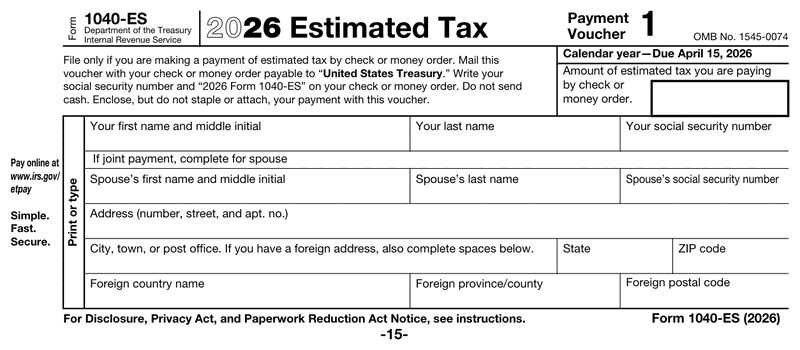
Form 1040-ES is the IRS worksheet and payment voucher you use to pay estimated tax four times a year. It is for income nobody withholds tax from, like freelance, contractor, or gig work. You estimate what you will owe, then send a portion each quarter instead of one lump sum in April.
The form does two jobs. The worksheet is where you estimate your income, deductions, and tax for the year. The vouchers are the four slips you send with each payment so the IRS credits the right account.
You will see the name written several ways, and they all mean the same document: 1040-es, 1040es, form 1040-es, and form 1040 es. Some accounting tools drop the hyphen, which is why the 1040 es form shows up under different spellings.
One thing worth being clear about: this form is not proof of income, and it is not your tax return. It is a payment schedule.
Self-employed people, investors, landlords and retirees - anyone expecting to owe $1,000 or more beyond what withholding covers.
The IRS, one voucher with each quarterly payment.
A real-world example: Freelance income is on track to owe about $8,000 in tax this year. Four $2,000 payments with 1040-ES vouchers keep April calm and penalties away.
Enter your
information
Preview
your form
Download
your form
Estimated payments run quarterly - roughly mid-April, mid-June, mid-September and mid-January of the following year. Miss a quarter and the underpayment accrues from that date, so catching up early beats waiting for April.
You generally need to pay estimated taxes if you expect to owe $1,000 or more when you file, after subtracting any withholding and refundable credits. That catches most freelancers, contractors, and gig workers. If you also have a W-2 job, extra withholding there can cover it instead.
Run this quick checklist:
That second point catches people who never received a form at all. Starting in 2026 clients only have to issue a 1099-NEC once they have paid you $2,000 or more for the year, up from the old $600 threshold, so even more of your smaller jobs now arrive with no paperwork at all. The income still counts, and reporting freelance income without a 1099 is still required.
A rideshare driver clearing $30,000 with no withholding is squarely in, and so is a freelance consultant invoicing clients directly. Someone with a day job and a small weekend side hustle often is not, because raising withholding at work can absorb it. This walkthrough of self-employed taxes covers what else changes when you work for yourself.
Quarterly does not mean every three months on the dot. The IRS payment periods are uneven, which trips up almost everyone in their first year. Here are the estimated tax payment dates for 2026:
| Payment | Income earned | Due date | Status |
|---|---|---|---|
| Q1 | Jan 1 to Mar 31, 2026 | April 15, 2026 | Passed |
| Q2 | Apr 1 to May 31, 2026 | June 15, 2026 | Passed |
| Q3 | Jun 1 to Aug 31, 2026 | September 15, 2026 | Upcoming |
| Q4 | Sep 1 to Dec 31, 2026 | January 15, 2027 | Upcoming |
Notice that Q2 covers two months and Q3 covers three. That is not a typo, it is how the IRS splits the year, and your four 1040 es vouchers come pre-labeled with these dates so you are not matching them up by hand.
All four quarterly tax dates 2026 brings land on weekdays, so none of the estimated tax payments dates shifted. The first two have already passed; Q3 is the next one due. As a general rule, when a due date falls on a weekend or federal holiday, it moves to the next business day.
If a payment period has already closed by the time you are reading this, you have not lost the chance to fix it. Send that payment as soon as you can rather than folding it into the next quarter, for the reason set out under missed payments below.
2027 Estimated Tax Due Dates
The same uneven pattern repeats the following year, with one shift at the end:
| Payment | Income earned | Due date |
|---|---|---|
| Q1 | Jan 1 to Mar 31, 2027 | Thursday, April 15, 2027 |
| Q2 | Apr 1 to May 31, 2027 | Tuesday, June 15, 2027 |
| Q3 | Jun 1 to Aug 31, 2027 | Wednesday, September 15, 2027 |
| Q4 | Sep 1 to Dec 31, 2027 | Tuesday, January 18, 2028 |
The final payment is the exception. January 15, 2028 falls on a Saturday, and the Monday after it is Martin Luther King Jr. Day, so it rolls forward to the next business day, Tuesday, January 18.
Here is the tip nobody acts on: put the remaining estimated tax payment deadlines in your phone calendar right now, with a reminder a week ahead. Most penalties start with someone simply forgetting.
This is the part tax calculators skip. They tell you what you owe and stop, leaving you with a number and no document. A 1040 es generator takes you the rest of the way in four steps:
Keep a copy of every 1040 es voucher you submit. At filing time you report the total already paid, and reconstructing that from bank records in April is miserable. A year end paystub serves the same purpose if you also draw a paycheck.
Setting aside 25% to 30% of what you earn is a solid starting point for most self-employed people. That covers income tax plus the 15.3% self-employment tax. Your real number depends on your bracket, deductions, and state, so treat it as a floor rather than a promise.
That 15.3% is the piece people forget, and it is what makes independent contractor taxes feel heavier than a W-2 job paying the same money. It is 12.4% for Social Security plus 2.9% for Medicare, the half an employer would normally cover. On your own, you pay both halves, which is why an independent contractor pay stub looks so different from an employee's.
The safe harbor rule protects you against guessing wrong. Pay 90% of this year's tax, or 100% of last year's, and the IRS will not penalize you for underpaying. If your prior-year adjusted gross income was over $150,000, that second figure rises to 110%.
The practical way to use it: if last year was slower than this year is shaping up to be, pay 100% of last year's smaller number. You stay protected and keep more cash during the year. Your deductions matter here too, since every 1099 tax deduction you claim lowers the income your estimate is built on.
Once you have your vouchers, there are five ways to make your estimated tax payments:
Only mail physically needs the voucher, but its figures are what you enter either way. Save every confirmation, since that record is what proves a quarterly tax payment landed if the IRS ever disagrees. If you run a business and already have an EFTPS login, the same account covers your quarterly tax payments alongside your payroll tax deposits.
Most guides assume income arrives in four tidy pieces. Freelance and gig work does not. A wedding photographer earns most of the year in summer, and a delivery driver peaks in December.
Paying four equal installments on lumpy income means overpaying in slow quarters and handing the IRS an interest-free loan. The annualized income installment method lets you pay based on what you actually earned in each period, so a thin quarter means a smaller payment.
The tradeoff is paperwork: you file Schedule AI with Form 2210 at year end to show the math. If your income swings hard, that is usually worth it. If it is steady, stick with equal payments.
Missing a deadline triggers an underpayment penalty, which the IRS calculates as interest on what you should have paid, charged from the due date until you pay. It is not a flat fine, and paying late still beats skipping, because the charge stops growing once the money is in.
So if you realize in July that you missed April, pay it now rather than rolling it into the next quarter. The penalty can also be reduced or waived in some cases, including retirement after 62 or disability, so it is worth asking.
Form 1040-ES is reissued every year, so "1040 es 2025" and "1040 es 2026" really are two different documents. Pick the one for the year you are paying tax on, not the year you happen to be sitting in. If you are catching up on 2025, you need the 2025 edition even though you are filling it out now.
Two traps, one in each edition:
| Paying tax for | Edition to use | What to double-check |
|---|---|---|
| 2025 | 2025 Form 1040-ES (12 pages) | Its printed standard deduction chart is stale. It shows $30,000, $22,500, and $15,000, but the amounts that actually apply are $31,500 married filing jointly, $23,625 head of household, and $15,750 single or married filing separately. |
| 2026 | 2026 Form 1040-ES (16 pages) | It still prints a $40,000 state and local tax cap. The corrected figure is $40,400 ($20,200 if married filing separately), reduced once MAGI passes $505,000 ($252,500 MFS), and never cut below $10,000 ($5,000 MFS). |
Your 2025 installments are all behind you: April 15, 2025, June 16, 2025, September 15, 2025, and January 15, 2026. And one habit worth changing if you mail: the postmark is the date USPS processes your envelope at a facility, which can land later than the day you dropped it in the box.

4.4 out of 5.0 stars on 717 reviews
For the 2026 tax year the four payment deadlines are April 15, June 15, September 15, and January 15, 2027, and all four land on weekdays, so nothing shifts. For the 2027 tax year they are April 15, June 15, September 15, and January 18, 2028. That last one moves twice: January 15, 2028 falls on a Saturday, and the Monday after it is Martin Luther King Jr. Day, so the deadline lands on Tuesday. When a due date lands on a weekend or federal holiday, it moves to the next business day.
Yes, you can pay the full year upfront, and the IRS will not penalize you for paying early. The catch is guessing your income before you have earned it. Most people pay quarterly instead, so each payment reflects what actually came in during that period.
If you genuinely earned no income that quarter, you may owe nothing for it. Skipping a payment is only safe when your income was actually that low, not when it is simply inconvenient to pay. The annualized income installment method exists for exactly this uneven-income situation.
Yes. Your 1040 es payments are deposits toward your final bill, not a replacement for your return. You still file a Form 1040 after the year ends, and everything you paid through the year gets credited against what you owe. Overpay and you get the difference back as a refund.
Safe harbor protects you from underpayment penalties even if you guess low. Pay 90% of this year's tax, or 100% of last year's, and you are covered. If your prior-year adjusted gross income was over $150,000, that second figure rises to 110%.
Fill out our contact form, and we will get back to you as soon as we can!
Contact us
Hi! How can I help you? Kris