Our customer support is available 24/7:

Make your 1099-OID in minutes. Simple to use, accurate and ready to download.
Rated 4.4/5 (770+ reviews) 35+ tax forms No subscription required
If a 1099 OID showed up in your tax package and you have no idea what it is, you're in the right place. Form 1099-OID reports something called original issue discount, and it tends to confuse people because it taxes you on interest you have not actually been paid yet. Nothing has gone wrong. It is a routine form. And if you turn out to be the one who has to issue it rather than read it, PayStubCreator puts the right figures in the right boxes for you.
You'll usually see one if you hold zero-coupon bonds, Treasury STRIPS, discounted certificates of deposit, or similar investments in a taxable account. Brokerages like Fidelity, Charles Schwab, and Vanguard send these out every year as a normal part of their tax packages, so receiving one does not mean you're being audited or that you did anything unusual.
We have checked every figure here against the IRS instructions and the form itself rather than copying it from somewhere else, and we link to the IRS pages so you can confirm anything yourself.
Here's the 1099 OID meaning in one line: it is the IRS form that reports interest you earned by buying a debt instrument for less than it pays back later.
So what is OID exactly? OID stands for original issue discount. When a bond, note, or CD is issued for less than the amount it will pay at maturity, that built-in gap is the discount. What does OID mean in practice? It means the profit is baked into the purchase price instead of arriving as a regular interest check.
A simple example makes this clearer. Say you buy a bond for $8,000 and it pays $10,000 when it matures. That $2,000 difference is your original issue discount. You never receive an interest payment along the way, but you still earned $2,000 of interest, and the IRS treats it that way.
This is why OID bonds work differently from ordinary bonds. A normal bond pays you interest twice a year and reports it on a 1099-INT. A zero-coupon bond pays nothing until maturity, so the interest has to be reported another way, and that way is Form 1099-OID.
People arrive at this topic from a dozen different search phrases, and they all point at the same thing. Whether you looked up what is 1099 OID, what is a 1099 OID, what is 1099-OID, or just what is an OID after the term showed up on a statement with no explanation, here is the 1099 OID explained in one sentence: it is the form that tells you and the IRS how much of a debt instrument's built-in interest counts as your income for the tax year that just ended.
Bond issuers and brokers holding OID instruments for customers, whenever the year's OID reaches $10.
The holder of the bond or note, who reports the OID as interest income.
A real-world example: Your company issued a $10,000 note for $9,200. That $800 discount accrues as income to the holder over the note's life - each year's slice goes on a 1099-OID.
Enter your
information
Preview
your form
Download
your form
Recipient copies are due by January 31, 2027; the IRS copy follows on the information-return schedule.
This is the part that frustrates almost everyone, and it is worth understanding because it is not a mistake.
OID does not wait until maturity to become taxable. It accrues a little at a time over the life of the instrument, and each year's slice is taxable in that year. Tax professionals call this phantom income, because you owe tax on earnings you can't spend yet.
Going back to the $8,000 bond that pays $10,000 in ten years: you don't report $2,000 of income in year ten. You report a portion of it every year for ten years. The amount is not simply the total divided by ten, either. It is calculated using a constant yield method, which front-loads slightly less and grows over time, similar to how a mortgage amortizes. Your payer does this math for you and prints the year's figure in Box 1.
Two things make this easier to accept. First, you're not taxed twice. Every dollar of OID you report over the years increases your basis in the instrument, so when it finally matures you're not taxed on that same money again. Second, if the investment sits in a tax-deferred account like an IRA or a 401(k), you generally will not see a 1099-OID for it at all, because the account itself defers the tax.
Most individual investors never receive a standalone 1099-OID document, which is exactly why people think theirs is missing.
Brokerages bundle everything into a single year-end package usually called a Consolidated 1099. Inside that one PDF you'll find the 1099-DIV section, the 1099-INT section, the 1099-B section, and, if it applies to you, the 1099-OID section. It is one form among several, not its own envelope.
Rather than scrolling through forty pages looking for it, open the PDF and use the bookmarks panel or the table of contents on the first page or two. You can also search the document for "OID" directly. The section usually sits a few pages after the interest and dividend summaries.
One more thing worth knowing: the detail pages near the back often break the OID down by individual security, which is useful if you hold several discounted bonds and need to see which one produced which number.
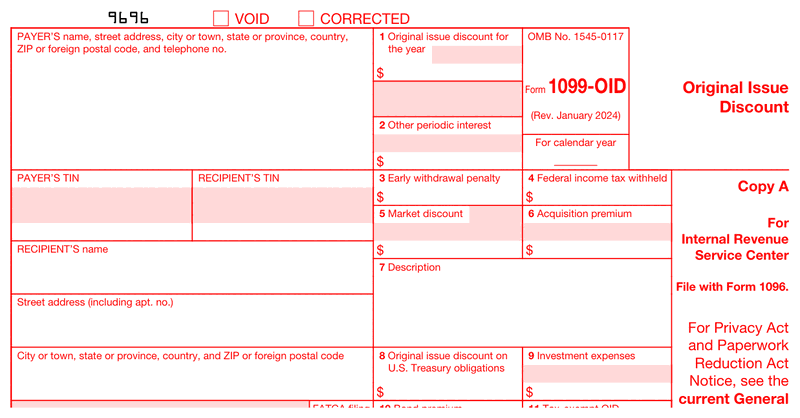
This is the section most people actually need, because the form arrives with numbers in boxes and very little explanation. Below is every box on the current version of the form, using the exact labels the IRS prints, plus what each one means for you as the person who received it.
| Box | Official Label | What It Means for You |
|---|---|---|
| 1 | Original issue discount | The taxable OID that accrued while you owned the instrument this year. Report it as interest income. |
| 2 | Other periodic interest | Regular stated interest actually paid on the same instrument during the year, separate from the OID. |
| 3 | Early withdrawal penalty | Interest or principal you forfeited by cashing out a time deposit early. You may be able to deduct this as an adjustment to income. |
| 4 | Federal income tax withheld | Backup withholding already sent to the IRS on your behalf, at the 24% rate. Claim it as tax you have already paid. |
| 5 | Market discount | Accrued market discount on a covered security, which applies when you bought the instrument on the secondary market below its adjusted issue price. |
| 6 | Acquisition premium | An amount that reduces your taxable OID, because you paid more than the adjusted issue price when you acquired it. |
| 7 | Description | The identifying details of the instrument, typically the CUSIP number, so you can match the figure to a specific holding. |
| 8 | Original issue discount on U.S. Treasury obligations | OID from Treasury instruments. Federally taxable, but treated differently at the state level. |
| 9 | Investment expenses | For single-class REMICs, your pro rata share of investment expenses. Most individual investors will see this blank. |
| 10 | Bond premium | Amortized bond premium on a covered security bought above its face value, which reduces the interest you report. |
| 11 | Tax-exempt OID | OID on a tax-exempt obligation acquired after January 1, 2017. Generally not federally taxable, but still reportable. |
| 12 | State | The state associated with any state tax reporting on the form. |
| 13 | State identification no. | The payer's state ID number, which matters only if you're entering the form into tax software. |
| 14 | State tax withheld | Any state income tax already withheld on your behalf. |
This trips up more people than any other part of the 1099 OID instructions, so it is worth a moment.
Box 1 and Box 8 both report original issue discount, and both are taxable on your federal return. The reason they sit in different boxes is state tax. Interest from U.S. Treasury obligations is exempt from state and local income tax under longstanding federal law, and interest from a corporate zero-coupon bond is not.
By splitting them, the form lets you report both amounts as federal interest income while still identifying the portion your state should not tax. If you lump Box 8 in with Box 1 and forget where it came from, you can end up paying state tax you did not owe. The IRS also points Box 8 recipients to Publication 1212 for figuring any adjustments to the amount shown.
Boxes 5, 6, 9, 10, and 11 are the ones most guides skip entirely, and they're the ones that adjust your taxable amount up or down. If any of them have figures in them, don't ignore them just because the label is unfamiliar. Box 6 in particular reduces what you owe, so overlooking it costs you money.
OID is interest income. That single fact answers most reporting questions.
The recipient instructions printed on the form state that you must report the net amount of OID on Schedule B of Form 1040. Schedule B is the interest and ordinary dividends schedule, the same place your savings account and bond interest go.
The word "net" is doing real work in that sentence. The figure you report is not always just whatever appears in Box 1. If Box 6 shows acquisition premium, that amount reduces the OID you include in income. Box 10 bond premium works similarly for the interest you report. Tax software handles these adjustments once you enter the boxes as they appear, which is the safest approach for most people.
A few specifics worth keeping straight:
If your situation involves several discounted instruments, a mid-year sale, or a bond bought on the secondary market, this is a reasonable point to ask a tax professional rather than guess. The boxes are simple to enter, but the adjustments behind them are not always simple.
Deadlines shift by a day or two each year, so here's the rule rather than a single year's calendar.
Payers generally must get recipient statements out by January 31. There is an important exception that applies to most people reading this: when the 1099-OID arrives as part of a broker's consolidated reporting statement, the deadline extends to February 15. That is why brokerage tax packages routinely land in mid-February rather than January, and it is usually the reason yours feels late.
On the IRS side, payers file by February 28 on paper or March 31 electronically, and anyone filing 10 or more information returns in total must file electronically. Corrected forms run on their own separate schedule, much like corrected W-2 deadlines do.
If any of these dates falls on a Saturday, Sunday, or legal holiday, it moves to the next business day. In the most recent cycle, for example, the recipient deadline landed on February 17 because February 15 fell on a weekend and the following Monday was a federal holiday.
One current note worth flagging: the IRS has posted a Recent Developments item stating that the 2025 Original Issue Discount tables were delayed. If you rely on the published OID tables to verify figures, check the IRS page for Form 1099-OID for the current status before assuming the tables are available.
These are the errors that actually cost people money or trigger IRS notices.
If a figure looks incorrect, don't cross it out and write in your own number, and don't simply report what you think it should say.
Contact the payer that issued the form, which is usually your broker or the lender holding the note. Ask them to review it and issue a corrected form if it is genuinely wrong. Payers file a copy with the IRS, so a correction has to come from them for the two records to agree. Corrected forms follow their own timelines, so start the conversation early rather than close to the filing date.
A few situations look like errors but usually are not. A figure can seem too small simply because you only owned the instrument part of the year. Box 2 is often blank on a zero-coupon bond that genuinely pays no periodic interest. And an amount may not match your own estimate because of the constant yield calculation. Check those before assuming a mistake.
If the form never arrives at all, you still owe tax on the accrued OID. Waiting for a document that is not coming does not remove the obligation, and the same principle applies when you need to report income without a 1099. Skipping it entirely is a different problem, and what happens if you don't file taxes is worth understanding before it gets that far.
Most people reading this received a 1099-OID. Some of you need to issue one instead, and that is a different job entirely.
If you issued a debt instrument at a discount, or you are a broker or middleman holding an OID obligation as nominee for the real owner, you are the party the IRS expects to file, and you need an accurate form with the right figures in the right boxes. If you merely HOLD a note and receive OID, you do not issue this form: you report the income on your own return instead. The process is much like issuing a 1099-MISC, just with different boxes to fill. That is what our 1099 OID generator is built for. You fill in the details, it handles the layout and the math formatting, and you get a clean, correctly structured form you can send to the recipient and keep for your records.
No subscription, no account setup marathon, and no wrestling with a blank PDF at eleven at night. Most people finish in a couple of minutes.
If you went looking for a "1099-OID 2025 form" or a "1099-OID 2026 form" and came up empty, your search was fine. There is no annual Form 1099-OID. The IRS made it a continuous-use form, and the current revision is January 2024. That one document covers the OID that accrued in 2025, the OID accruing in 2026, and later years too, until the IRS issues a superseding revision. (The instructions work the same way: one combined document covers both 1099-INT and 1099-OID.)
So the year in your search refers to the tax year of the accrued discount, not to a separate piece of paper. A form stamped Rev. January 2024 reporting your 2025 OID is the current form, not a stale one. It is the only version there is.
That also means the boxes above do not shift on you from one year to the next. The $10 reporting threshold is unchanged, and nothing material changed between the two tax years.
What does move is the calendar. For tax year 2025, the consolidated statement date was February 17, 2026. For tax year 2026, it is February 16, 2027. Same rule, different calendar date.

4.4 out of 5.0 stars on 717 reviews
A 1099-OID reports original issue discount: the built-in interest you earn when you buy a bond or note for less than it pays back at maturity. Your broker or lender sends it when that discount reaches $10 or more for the year.
Yes. OID is taxed as it accrues each year, not when the bond matures and pays out. That is why people call it phantom income. Report the amount shown even though no cash reached your account, unless the instrument is held in a tax-deferred account like an IRA.
OID is interest income, so it goes on Schedule B of Form 1040. The form's own instructions tell recipients to report the net amount of OID there. Box 1 and Box 8 amounts are both reported as interest, though Box 8 Treasury OID is handled separately for state tax.
Box 1 shows OID on a regular taxable obligation, like a corporate zero-coupon bond. Box 8 shows OID on a U.S. Treasury obligation. Both are federally taxable interest, but Treasury interest is exempt from state and local income tax, which is why it gets its own box.
Check your broker's consolidated 1099 package first, since 1099-OID usually appears as a section inside it rather than as a separate document. If it is genuinely missing, contact the payer. You still owe tax on accrued OID even if no form arrives, so don't skip it.
Fill out our contact form, and we will get back to you as soon as we can!
Contact us
Hi! How can I help you? Kris