Our customer support is available 24/7:

Create your 1099-DIV online in minutes. Accurate, print ready and hassle free.
Rated 4.4/5 (770+ reviews) 35+ tax forms No subscription required
You paid out dividends this year, and now someone is waiting on a 1099 DIV form from you. Or one just arrived in your mail and you need to know what the boxes actually mean.
Our 1099 div generator handles the layout, so you download a clean, IRS-ready PDF. Preview free, pay only at download.
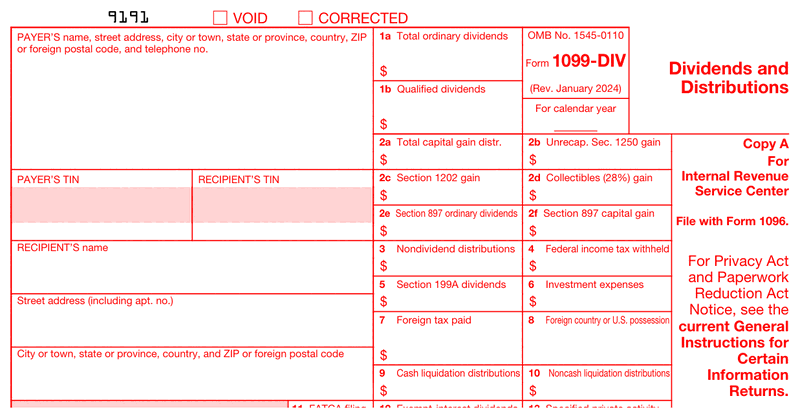
A 1099 DIV form is the IRS document titled Dividends and Distributions. A company, fund, or broker sends it when it pays you at least $10 in dividends during the year. One copy goes to you and one goes to the IRS, so both sides report the same numbers.
That $10 floor is lower than most people expect. A single modest holding can trigger the form. Liquidation distributions follow a separate rule, and they get reported once they reach $600.
1099 DIV Meaning in Plain Terms
Think of it as a receipt for investment income. Wages show up on a W-2. Contractor pay shows up on a 1099-NEC. Dividends get their own document, and this is it. The 1099 dividend form doesn't calculate anyone's tax bill. It reports what was paid, so the recipient can carry the right figures onto a tax return.
What Is a 1099-DIV Used For?
The recipient uses it to report investment income. The IRS uses it to check that the reported amount matches what the payer said it paid. When those two numbers disagree, that's what generates a letter months later.
You must file if you paid $10 or more in dividends or other distributions during the tax year. That includes corporations paying shareholders, mutual funds, REITs, and small investment partnerships. If you run an S corporation, distributions to your shareholders can put you in this group. Liquidation distributions follow the higher $600 threshold.
Some payments are exempt. You generally don't file a 1099-DIV form for payments to corporations or tax-exempt organizations. The same goes for IRAs, Archer MSAs, health savings accounts, US government agencies, states, and registered dealers. Retirement account contributions stay outside this form entirely.
One rule catches small filers off guard. If you file 10 or more information returns in total, counting every W-2 and 1099 you issue together, you have to file electronically. That threshold used to be 250. It dropped to 10 for returns filed starting in 2024, and the combined count is what matters.
Enter your
information
Preview
your form
Download
your form
Recipient copies are due by January 31, 2027; the IRS copy follows on the information-return schedule.
Both roles land on this page. If your corporation, LLC, or fund paid out dividends, you are the issuer and you need to produce the form. If one showed up in your mailbox, you are the recipient. You just need to read it correctly before you file your tax return.
The distinction matters. The two roles face different deadlines and different risks. Issuers have filing dates and per-form penalties. Recipients just need accurate numbers at tax time. Partnerships and S-corp owners have a separate wrinkle, because profit distributions usually travel on a Schedule K-1 rather than this form.
Plenty of people are both. Take a self-employed contractor who runs a small S-corp and also holds a brokerage account. In January she might issue a Form 1099 DIV to a co-owner, while waiting on one from her broker for her own account. Same form, two directions.
Numerical order tells you what each field is called, not what it does. So here the boxes are grouped by what actually happens to the tax bill.
Form 1099-DIV Instructions for the Payer, Recipient, and State Boxes
The top of the form holds the payer's name, address, and TIN, then the recipient's. If you're filing as a business, look up your employer identification number before you start. These identity fields cause more rejected filings than the dollar boxes do. Boxes 14 through 16 carry state tax information when a state requires its own reporting.
Yes. Reinvested dividends are taxable in the year they are paid, even though no cash ever reaches your bank account. The IRS is explicit about it: Box 1a of the form includes reinvested dividends alongside the ones paid in cash. Buying more shares automatically does not delay or reduce the tax.
This surprises a lot of first-time investors, and it's the single most common misunderstanding about this form. If you reinvest dividends are they taxable anyway? Yes, every time. Enroll in a dividend reinvestment plan, watch the share count climb, never touch a dollar of it, and there's still tax owed. The dividend reinvestment tax question comes down to one idea. The IRS treats the payment as received the moment it's credited, and what happens next is just a purchase.
There's a practical upside worth tracking. Every reinvested dividend buys shares at a real price, and that amount gets added to the cost basis. Recipients who keep those records pay less capital gains tax when they sell. Recipients who don't often pay tax twice on the same money.
Three dates matter, and they're not the same date.
| What | Deadline | Tax year 2026 |
|---|---|---|
| Recipient copy | January 31 | Monday, February 1, 2027 |
| IRS copy, paper | February 28 | Monday, March 1, 2027 |
| IRS copy, electronic | March 31 | Wednesday, March 31, 2027 |
When a deadline lands on a weekend or legal holiday, it moves to the next business day. That's why the first two dates shift in the 2027 filing season.
One nuance explains a lot of confusion online. A standalone 1099-DIV recipient copy is due January 31. But a broker may deliver it inside a consolidated reporting statement. Then the later February furnishing date applies, which is why investors often don't see theirs until mid-February. Both facts are correct. They just describe different situations.
Late filing penalties are charged per form, and they climb with time:
Those tiers are the ones the current instructions describe. Penalty amounts are indexed, so check the General Instructions for Certain Information Returns for the year you are filing before you size your exposure. They sit apart from what happens if you don't file your own return. If you catch an error after filing, file a corrected return. A prompt correction is treated far better than a wrong figure left alone.
One habit saves real time. Gather every recipient's legal name, address, TIN, and dividend total in a single spreadsheet pass before you open the generator. Filling forms one at a time, hunting for each TIN as you go, is how transposed digits happen.
Then it's four steps:
The generator handles the layout and formatting, so the result is a clean, IRS-ready document. You preview it free and pay only when you download, with no subscription.
There's only one. Form 1099-DIV is a continuous-use form, so the IRS doesn't reissue it every January. The current revision is January 2024, and that same document covers dividends paid in 2025, 2026, and after, until a superseding revision is issued.
So when you search for a 1099-DIV 2025 form or a 1099-DIV 2026 form, the year you're typing is the tax year of the dividends, not a different document. You enter that year on the form itself. If one arrived in your mail, the year printed at the top tells you which return it belongs on.
Nothing material separates the two tax years. The $10 reporting floor is unchanged, the $600 liquidating distribution figure is unchanged, and the address fields were not split into separate entry boxes the way they were on some other 1099s. The $2,000 threshold increase you may have read about applies to other payments and does not reach dividends.
Only the calendar moves. Recipient copies for tax year 2025 dividends were due February 2, 2026, and copies for tax year 2026 dividends are due February 1, 2027. That's the same January 31 rule, rolling forward off a weekend both times.

4.4 out of 5.0 stars on 717 reviews
Yes. Reinvesting doesn't change when income is taxed, only what happens to the money afterward. The dividend is taxed in the year it's credited to the account, and it appears in Box 1a. Keep a record of each reinvestment, because it raises your cost basis and lowers future capital gains.
No. Dividends you receive are income, not a deduction, so they increase what you owe rather than reduce it. Corporations paying dividends can't deduct them either, unlike interest payments. Qualified dividends in Box 1b are taxed at lower capital gains rates, which softens the rate but isn't a deduction.
You'll generally need to amend the return using Form 1040-X. The IRS receives its own copy either way, so leaving the income off tends to generate a notice months later. Amending on your own initiative is a much cheaper fix than answering a mismatch letter.
Yes. File a corrected return with the corrected box checked, and send the recipient an updated copy too. Fix the error as soon as you spot it, since penalties scale with how long a wrong or missing form sits unresolved.
That's normal, and every one of them counts. Separate brokers, funds, and companies each issue their own. The $10 threshold applies per payer, not across your whole portfolio. Report every form on your return, because the IRS matches each one individually.
Fill out our contact form, and we will get back to you as soon as we can!
Contact us
Hi! How can I help you? Kris