Our customer support is available 24/7:

Generate your 1099-G in an instant. Fast, easy to use and eliminates errors.
Rated 4.4/5 (770+ reviews) 35+ tax forms No subscription required
A form shows up from your state, not your employer, and it says 1099-G across the top. If unemployment benefits or a state tax refund came your way last year, that is the form reporting it. Most people searching for a 1099 G already have one in hand and simply want to know what the numbers mean and whether they owe tax on them. Others land here for the opposite reason: they are the ones who have to issue the form, and they can create one at PayStubCreator.net in a few minutes. We will go through what a 1099-G form reports box by box, where to find yours if it never showed up, the 2026 deadlines, and how to fix an amount that looks wrong.
Form 1099-G is a tax form a government agency sends you to report money it paid you during the year. The most common amounts are unemployment compensation in Box 1 and a state or local tax refund in Box 2. Your state agency issues it, not your employer.
That single difference explains most of the confusion around this form. A W-2 comes from the company you work for. A 1099-G comes from a government body, which is why it often arrives separately, later, and from an address you do not recognize.
You will see the name written several ways. Some people search for a 1099g form without the hyphen, others type Form 1099 G with a space, and plenty land here after searching form 1099g or 1099g what is it. They all point to the same document. If you are wondering what is 1099-G in plain terms, it is the government's receipt for money it paid you, and a copy of that same information goes to the IRS. People also call it an unemployment tax form, though that only describes one of the things it reports.
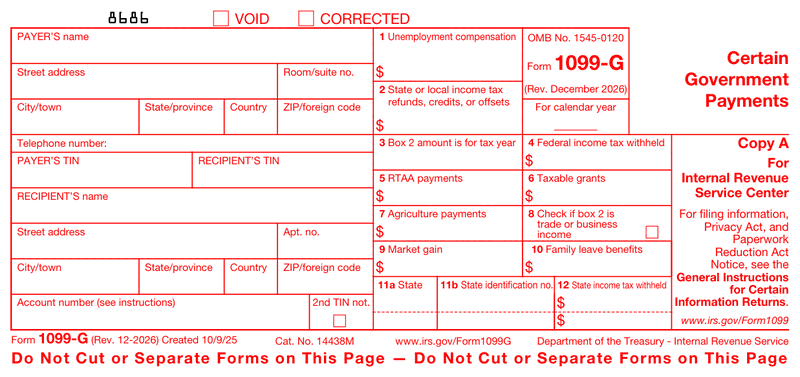
Most readers land here because of this box. It shows unemployment benefits paid to you during the year, and agencies report amounts of $10 or more. That money is taxable on your federal return, so the number carries over to your tax filing even if nothing was withheld from the payments as they arrived. Box numbering is not consistent across forms, so do not assume it lines up with Box 1 on a W-2, which reports taxable wages instead.
Getting money back from your state does not feel like income, which is exactly why this box catches people out. Box 2 covers a state or local income tax refund, credit, or offset, and it generally counts as income only if you itemized deductions on last year's federal tax return and deducted those state taxes. If you took the standard deduction, that refund typically is not taxable at all. Box 3 tells you which tax year the Box 2 amount relates to, which matters when a refund arrives a year late.
Box 4 shows any federal income tax withheld from your payments. Box 5 covers RTAA payments under a trade adjustment program, Box 6 covers taxable grants from a government program, and Box 7 covers USDA agricultural payments. Box 8 is a checkbox flagging that the amount came from a trade or business, and Box 9 reports market gain on a CCC loan repayment. Box 10 covers family leave benefits paid under a state paid family and medical leave program. Boxes 11a through 12 carry the state identification details. The IRS 1099-G instructions spell out every box in full if you need the exact wording.
Government agencies issue the official form; taxpayers and preparers often recreate a copy for records or filing support.
The person who received the government payment - most commonly unemployment benefits or a state tax refund.
A real-world example: Tax season arrives and the 1099-G for last spring's unemployment benefits never made it to your new address. Rebuild it from your benefits statement and keep your filing on schedule.
Enter your
information
Preview
your form
Download
your form
Official 1099-G copies go to recipients by January 31, 2027. If you're recreating one for your records, the only deadline that matters is your own return's.
Here is the part most pages skip. When people ask what is a 1099-G, the answer they usually need is not a definition but a name: who sent this to me? A 1099 G is issued by a government agency, such as a state unemployment office, a state tax department, or the USDA. Government agencies at every level use it, which is why state governments and federal programs both show up as senders. You do not create your own 1099-G to file your taxes, and no generated copy replaces the official one your state sent to you and to the IRS.
That matters because the two audiences searching for this form need opposite things. If you received government payments, your job is to find your form and read it correctly. If you are an agency or organization that made qualifying payments, your job is to issue accurate forms on time. The sections below handle each path in turn.
If your form never arrived in the mail, that is usually not a mistake. Most states moved to electronic delivery, which means your 1099-G is sitting behind a login rather than travelling through the postal system.
Start with the agency that paid you. For unemployment benefits, that is your state unemployment or labor department. California residents use the myEDD portal, where 1099-G statements sit alongside the other EDD forms tied to a claim. New York residents can retrieve theirs through New York State Online Services. Oregon's Employment Department and Delaware's Division of Unemployment Insurance run comparable portals, and nearly every other state offers something similar.
For a state or local tax refund reported in Box 2, the issuer is your state tax or revenue department instead, so that is where the copy lives.
A few practical notes. You may need to opt in to electronic delivery, or opt out to receive paper. The form is usually posted in January for the prior year. And if you moved, update your address with the agency directly, because an old address on file is the most common reason an unemployment tax form goes missing.
Check the online portal first, since a reprint is normally available on demand and costs you nothing but a login.
If it genuinely is not there, contact the issuing agency and request a duplicate. Do not call the IRS for a replacement, because the IRS did not create the form and cannot reissue it. The agency that paid you is the only source for a corrected or duplicate 1099-G form.
You are also not stuck if the deadline is closing in. You can file using your own records of what you received, such as bank deposits or payment history in the agency portal. It is the same approach you would take to get a copy of a missing W-2. Just make sure the total you report lines up with what the agency sent to the IRS, because a mismatch is what triggers a notice later.
This section is for the other audience: an agency or organization that has to issue the form, or anyone who needs a clean, readable copy of the information for their own records. The 1099 G generator walks you through the fields in order so nothing gets missed.
The whole thing takes a few minutes because the fields are guided and the layout matches the official form.
Gathering these first makes the process quick and prevents the errors that lead to corrections later.
The general trigger is $10 or more. Agencies report unemployment compensation of $10 or more in Box 1, and state or local income tax refunds of $10 or more in Box 2.
There is an important exception. If any federal income tax was withheld from a payment, a form is required regardless of how small the payment was, because that withholding has to be reported. The IRS overview of who must file Form 1099-G sets out the categories in full.
One more rule affects issuers. The IRS requires electronic filing once you file 10 or more information returns in total, counted by aggregating all types you file rather than 1099-G forms alone. That threshold has been in place since the 2023 tax year and still applies for 2026.
The rule is easier to remember than the dates, because the dates shift slightly each year. Recipient copies are due by January 31. Paper filings to the IRS are due by February 28, and electronic filings are due by March 31. When a due date lands on a weekend or legal holiday, it moves to the next business day.
Applied to payments made during the 2026 tax year, that means recipient copies of the 1099-G go out by January 31, 2027, with IRS e-filing due by March 31, 2027. If you are the recipient rather than the issuer, the date that matters to you is that first one, since that is when your form should be available.
If an amount looks wrong, do not simply enter a different number on your return. The IRS already has the agency's version, and a mismatch will surface.
Contact the issuing agency and ask for a corrected form. This comes up often with unemployment identity fraud, where a form reports benefits someone else claimed in your name. Agencies have a process for exactly this, and they will investigate and reissue the 1099-G with the correct amount.
Corrected forms are routine across the 1099 and W-2 families, and the timing rules for a corrected W-2 follow the same logic. Once resolved, keep the form with your tax records. The general guidance is to hold supporting tax documents for at least three years from the filing date.
First, the reassuring part: these penalties fall on the issuer, not on you as the recipient. If your agency sent your form late, you are not the one being fined.
For issuers, the penalty per return rises the longer a correct form goes unfiled. The 2026 amounts are $60 per return if you correct it within 30 days of the due date, $130 if you file by August 1, and $340 if you file after August 1 or not at all. Intentional disregard carries a $680 penalty per return, with no annual cap. Filing on time with accurate figures is considerably cheaper than fixing it later, and the same holds on the individual side, where skipping a return entirely carries its own consequences.
The 1099 family is large, and mixing up which form reports what is a common source of filing errors.
| Form | What It Reports | Who Sends It |
|---|---|---|
| 1099-G | Unemployment, state tax refunds, government grants | Government agency |
| 1099-NEC | Payments to independent contractors | Business that hired you |
| 1099-MISC | Rent, prizes, awards, other income | Business making the payment |
| 1099-INT | Interest income | Bank or financial institution |
The quick test: if the payer is a government body, you are looking at a 1099-G. If a company paid you for work, that is a 1099-NEC.
If you are on the other side of one of those forms, it helps to know how to issue a 1099-MISC and what a 1099 pay stub looks like.
There is no annual Form 1099-G. The IRS moved this form to continuous use, so there is no 2025 edition and no 2026 edition of the form itself, and no form face stamped with the year you searched for. The year in your search refers to the tax year of the payments being reported.
What the year does point you to is a revision, and the revisions are not interchangeable. The current one is Rev. December 2026, and it is the one used to file 2026 information in early 2027. Use the earlier revision for tax year 2025, and do not reach for the December 2026 revision on an earlier year, because the box layout is not the same. The December 2026 revision added box 10 for family leave benefits, and that shifted the state information boxes: former boxes 10a, 10b and 11 became 11a, 11b and 12.
That distinction matters most when you are reading the copy your agency sent you. If your form reports 2025 payments, the state income and state tax withheld figures sit in the older box numbers, so a box-by-box guide written for the December 2026 revision will send you to the wrong line. Check the revision date printed on your form before you match any box number to a figure.

4.4 out of 5.0 stars on 717 reviews
Yes, they are the same form. 1099g is just the unhyphenated spelling of 1099-G, and you may also see it written as a 1099g form or Form 1099 G. If you are asking what is 1099g, it reports government payments such as unemployment benefits or a state tax refund.
Usually yes for Box 1, because unemployment compensation is taxable on your federal return. Box 2, a state or local tax refund, is only taxable if you itemized deductions on last year's federal return. If you took the standard deduction, that refund generally is not taxable.
That often means someone filed a fraudulent claim in your name. Contact the state agency that issued the form right away and ask for a corrected 1099-G. Do not report income you never got. The agency investigates and reissues the form with the correct amount.
Yes. The form is a record of what you were paid, so you can file using your own records of benefits or refunds received. Still request a copy from the issuing agency, because the amount it reported to the IRS needs to match what you file.
State agencies use it to report payments they made and to tell the IRS the same figures. Unemployment offices report benefits paid, and state tax departments report refunds issued. It is also how any federal income tax withheld from those payments gets reported.
Fill out our contact form, and we will get back to you as soon as we can!
Contact us
Hi! How can I help you? Kris