Our customer support is available 24/7:

Make your Form 4868 in minutes. Simple to use, accurate and ready to download.
Rated 4.4/5 (770+ reviews) 35+ tax forms No subscription required
Your return isn't ready and the April deadline is days away. That's exactly the situation Form 4868 was built for. It's the IRS form that buys you six more months to file, no explanation required, and it takes only a few minutes to fill out.
Our 4868 generator at PayStubCreator.net fills in the boxes and gives you a clean PDF. Preview free, pay only when you download, no subscription.
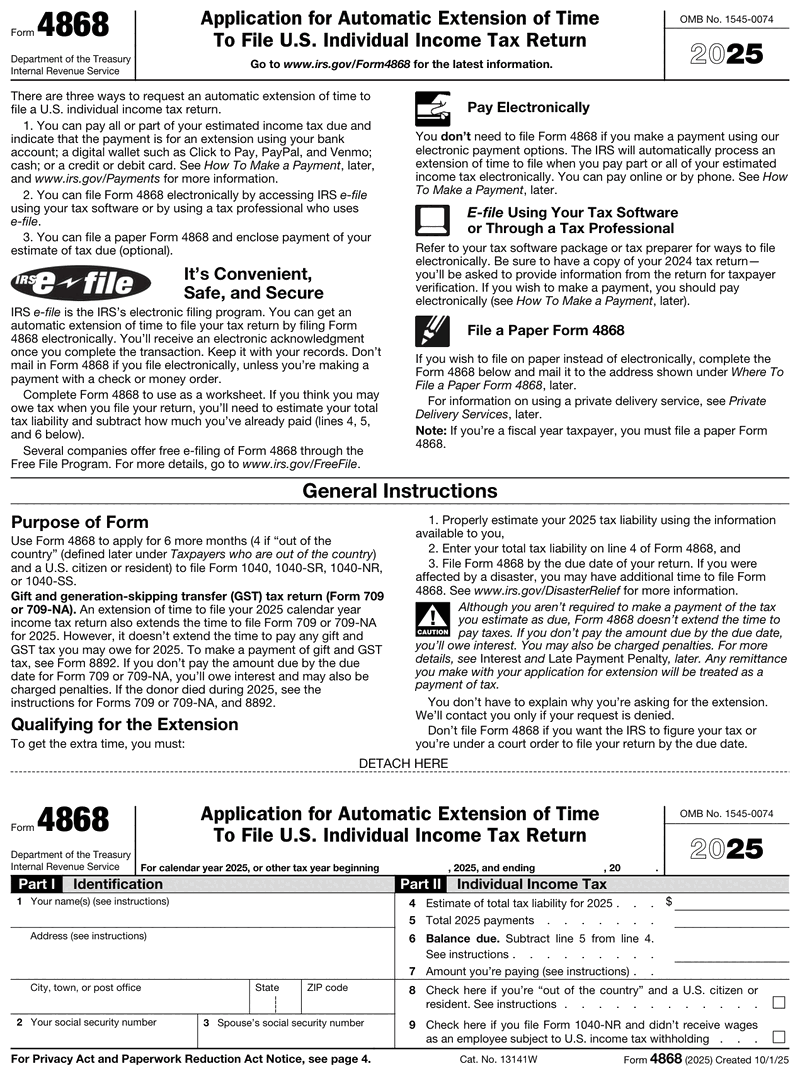
Form 4868 is the IRS Application for Automatic Extension of Time To File U.S. Individual Income Tax Return. Filing it by April 15, 2027 moves your filing deadline to October 15, 2027. The extension is automatic, so you do not need to give the IRS a reason.
Already filed an extension for your 2025 return? That one runs to October 15, 2026, and this page's 2027 dates apply to the return you file next spring.
That word "automatic" is the important part. You're not asking permission and nobody at the IRS reviews your excuse. As long as the tax extension form arrives on time and your numbers are a good-faith estimate, you've got until October. An IRS tax extension changes when your paperwork is due, nothing else.
This is a lifesaver if you drive for Uber, deliver for DoorDash, or pick up Instacart batches, the same crowd that often needs an independent contractor pay stub to document what they earned. Nobody withheld tax from those payments all year, and if a 1099 shows up late or your estimated payments came up short, the extra time gives you room to sort out the real number instead of guessing on your income tax return.
Individual taxpayers who need more time to prepare their 1040 - waiting on documents, mid-life-event, or simply out of runway before April.
The IRS. The extension is automatic on timely filing - no confirmation letter to wait for.
A real-world example: It's early April and a corrected brokerage statement still hasn't arrived. Ten minutes on a 4868 turns a looming deadline into an October one.
Enter your
information
Preview
your form
Download
your form
| What | When | Worth knowing |
|---|---|---|
| File Form 4868 | April 15, 2027 | On time = the extension is automatic |
| Pay your estimated balance | April 15, 2027 | Payment is not extended |
| File your extended 1040 | October 15, 2027 | No second extension after this |
Dates falling on a weekend or legal holiday shift to the next business day.
Most of the confusion around this form comes down to dates, so here they are in one place. Below is the full tax extension 2027 schedule.
| Your situation | Original deadline | With an extension |
|---|---|---|
| Most filers in the U.S. | April 15, 2027 | October 15, 2027 |
| U.S. citizens living outside the country | June 15, 2027 (automatic 2-month extension) | October 15, 2027 |
| Federally declared disaster areas | Varies by IRS declaration | Varies by IRS declaration |
For most people the deadline to file taxes 2027 is April 15, and the extension moves it to October 15. That's six extra months. Both dates fall on weekdays, April 15 on a Thursday and October 15 on a Friday, so neither one shifts.
If you're a U.S. citizen or resident alien living abroad on the regular due date, you already get two extra months without filing anything. The tax filing deadline 2027 moves to June 15 on its own. Filing the extension on top of that pushes you to October 15.
Disaster relief works differently. When the IRS declares a disaster area, it postpones deadlines for people in that area automatically, and the new dates depend on the declaration. Check the IRS disaster relief page if a storm or fire hit your county.
So when is the last day to file taxes once you've filed the extension? October 15, 2027. That's the real tax extension deadline, and there's no second one after it. And when is the deadline to file taxes using the form itself? That same April 15. Asking in May doesn't work.
The form itself is short, but it stalls people who start it without their numbers ready. Gather these first:
The estimate doesn't have to be perfect, just reasonable and made in good faith. Not sure what your yearly total looks like? Working out your monthly income first makes it easier.
If you've been putting off figuring out how to file an extension for taxes, here's the good news: it's genuinely a 10-minute job. There are four ways to do it, and one of them doesn't involve the form at all. They're ranked below by how little work each takes.
1. Pay Online and Check the Box
This one skips the form entirely, which is why it's the fastest route. Make a payment through an IRS online payment option, then tick the box flagging it as an extension request. The IRS treats that as your request, you get a confirmation number for your records, and you never touch the paperwork. If you owe money and plan to pay anyway, use this one.
2. IRS Free File
No cost, and no income limit. Extensions are exempt from the usual eligibility cap, so IRS Free File will electronically file tax extension requests even for high earners who can't use the program for their actual return.
3. Paid Software or a Tax Professional
Most tax software can file an extension for taxes as part of its normal flow, and any preparer can submit one for you. Worth it if someone's already handling your return, though it helps to know what tax preparation usually costs before you commit.
4. Fill Out the Form and Send It In
Fill out the form, then either e-file it through an IRS e-file partner or mail the paper copy. Mailing works fine, but postmark timing matters, so don't leave it until the April deadline itself.
All four routes produce the same IRS extension, so pick whichever fits your week. Still working out how to file tax extension paperwork? Option 1 clears in minutes.
This is the part that costs people money, so read it twice. Form 4868 extends your time to file. It does not extend your time to pay. Whatever you owe for 2026 is still due April 15, 2027, extension or not.
Say you owe $3,000 and you file the extension on time but send no payment. You've avoided the failure-to-file penalty completely. What you haven't avoided is the failure-to-pay penalty, which runs at 0.5% of the unpaid balance per month. Six months of that, from April to October, is about $90, plus interest.
That's the whole argument for filing the extension even when you're broke. You can shrink it further: pay whatever you can by the April deadline. The penalty is calculated on the unpaid balance, so a partial payment cuts the base.
Skip the extension and skip the return, and the failure-to-file penalty kicks in at 5% of your unpaid tax per month, capped at 25%. The full picture of what happens if you don't file taxes goes further, but the penalty is the part that bites first.
Same $3,000 balance: that's $150 a month instead of $15. After five months it hits the 25% ceiling at $750, and it stops growing there. The failure-to-pay penalty keeps running after that.
When both penalties land in the same month, the IRS reduces the failure-to-file penalty by the failure-to-pay amount, so the combined hit is 5% per month rather than 5.5%.
Someone who files on time but pays late ends up in far better shape than someone who does neither. Compare the two numbers: $750 for filing nothing versus $90 for filing the extension and paying late. That gap is why the extension is worth the ten minutes even if you can't pay a cent right now.
If you'd rather see the finished document before you send anything, our generator handles the form itself. You enter your details, it does the arithmetic on your balance due, and it outputs a clean, print-ready PDF you can e-file or mail.
The 4868 generator is built around the checklist above, so if you've gathered those seven items you'll be done in a couple of minutes. Preview the completed form free, and pay only when you download.
Still weighing how to file for tax extension requests versus paying online? The generator makes sense when you're not making a payment right now, or when you want a copy of the actual form for your records rather than just a confirmation number.
Need pay records to back up the income figures you're estimating? Our pay stub templates make that straightforward, and this guide on proof of income covers what else counts.
Form 4868 is one of the few IRS forms that really is reissued every tax year, so the version you grab has to match the return you're extending. "Form 4868 2025" and "form 4868 2026" are the same form reissued for two different tax years, and the year on the form points at the return you're behind on, not at the year you're sitting in.
So a 2025 return you're still finishing needs the 2025 form, even though you're filing it in 2026. One heads up on the newer one: the 2026 form was not published as of July 21, 2026, so the 2026 row below is drawn from the standing April 15 rule rather than from a printed IRS calendar. Reliable, but not yet official.
| Tax year you're extending | File Form 4868 by | New filing deadline |
|---|---|---|
| 2025 | April 15, 2026 (June 15, 2026 if you're out of the country) | October 15, 2026 |
| 2026 | April 15, 2027 (June 15, 2027 if you're out of the country) | October 15, 2027 |
The reassuring part: the 2025 form is structurally identical to the ones before it, right down to the out-of-country box and the 1040-NR box. If you filled one out in a past year, nothing on this one will trip you up.

4.4 out of 5.0 stars on 717 reviews
No. Filing the form costs you nothing and carries no IRS penalty, even if you end up not needing the extra time. Penalties only apply to tax you owe and have not paid, or to a return you never file at all.
None at all. The word automatic in the form's title means exactly that: the IRS grants the extension as long as you file on time and estimate your tax liability honestly. You do not explain yourself, and no signature is needed on the form.
Usually not automatically. It covers your federal return only. Some states accept the federal extension and need nothing extra, others require their own form, and a few have no income tax at all. Check your state's revenue department before assuming you are covered.
It will not be honored. The form has to reach the IRS by the April filing deadline, so a late request does not buy you anything. If you have already missed it, file your actual return as soon as possible to stop the failure-to-file penalty from growing.
An extension does not affect your refund, but it does delay it, since the IRS cannot process a refund until your return arrives. There is no late penalty when you are owed money, but you have only three years to claim it before it is gone.
Fill out our contact form, and we will get back to you as soon as we can!
Contact us
Hi! How can I help you? Kris