Our customer support is available 24/7:

Create your Form 8995 online in minutes. Accurate, print ready and hassle free.
Rated 4.4/5 (770+ reviews) 35+ tax forms No subscription required
You qualify for the qualified business income deduction and need Form 8995 to claim it. Our Form 8995 generator fills it out fast.
Preview it free, pay only when you download, and there's no subscription. You keep a clean copy for your 1040.
Create Your Form 8995 Now
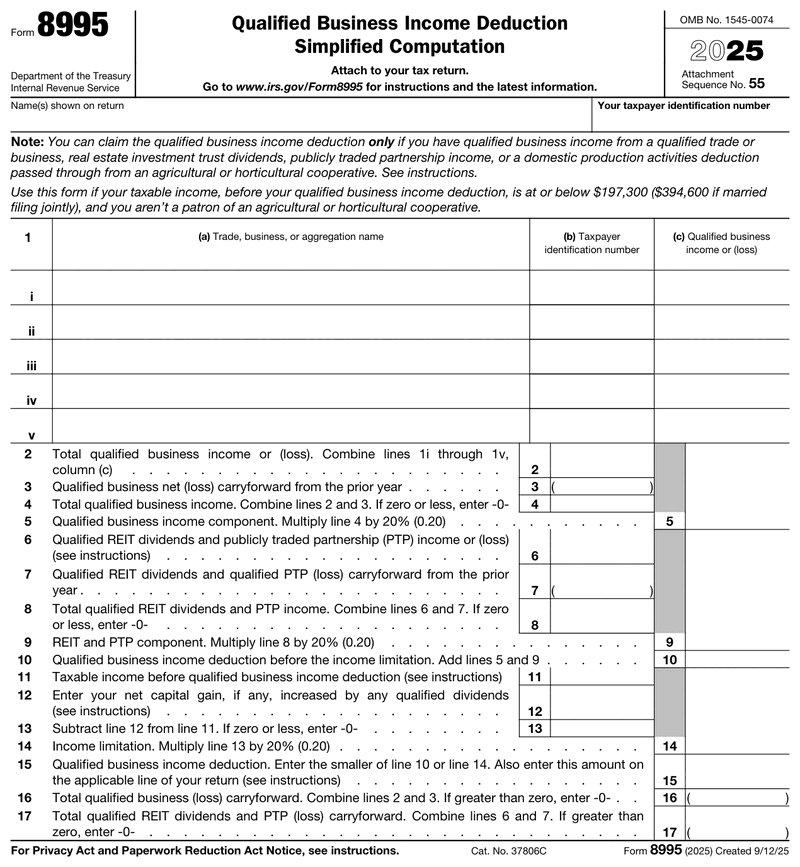
Form 8995 is the Internal Revenue Service (IRS) form you use to figure your qualified business income deduction, usually just called the QBI deduction. It's the short, simplified version of that calculation, created under Section 199A of the tax code. If you searched what is form 8995, or typed form 8895 by mistake, this is the one you want. It lets eligible business owners take up to 20% off their qualified business income before tax. So what is qualified business income? It's your net business profit, and it leaves out wages you earn as an employee, along with capital gains and investment income.
You don't file tax form 8995 on its own. You attach the finished 8995 form to your Form 1040 and send them together. Think of it as a worksheet that lowers your taxable income: it doesn't change what you earned, only what you're taxed on. The qualified business income (QBI) deduction is one of the largest breaks available to self-employed people, and it lets eligible taxpayers cut their income tax without itemizing, so it pays to get it right. If taxes feel new to you, our guide to self-employed taxes is a good place to start.
You file Form 8995 if you have pass-through business income and want the qualified business income deduction. That covers freelancers, sole proprietors, 1099 contractors, and small business owners whose taxable income stays under the year's threshold. You attach it to your Form 1040.
In practice, that's the person who files a Schedule C for a side gig or a full-time solo business, plus partners in a partnership and S corporation shareholders. Qualified REIT dividends and PTP income count too. Some people call it the QBI form, since it's where the deduction actually gets calculated. If you already generate your 1099-NEC forms, your QBI usually starts from that same net business income.
Enter your
information
Preview
your form
Download
your form
The 8995 follows your 1040: mid-April 2027 for the 2026 tax year, or October with a 4868 extension.
Take 20% of your qualified business income. Then compare it to 20% of your taxable income minus any net capital gains. Your deduction is the smaller of the two numbers. Form 8995 walks you through both figures so you land on the correct amount.
Here's how to calculate QBI in real numbers. Say you're a freelancer with $60,000 of qualified business income and $70,000 of taxable income before the deduction, with no capital gains.
That $12,000 comes straight off your taxable income, so you're taxed on $58,000 instead of $70,000. Those three steps are the whole of how to calculate qualified business income and turn it into a deduction. It's worth learning how to calculate QBI deduction figures by hand anyway, since it lets you catch a bad entry before you file.
The whole form fits on one page, and it follows the order of your income. Here's how to fill it out, top to bottom, matching the official Form 8995 instructions:
The 8995 instructions on IRS.gov spell out each line, and you can pull the blank IRS Form 8995 PDF there too. Our generator handles the line references and the math for you, so you're not flipping between the worksheet and a calculator. The result carries straight to your Form 1040.
Use the simplified Form 8995 when your taxable income before the deduction is at or below the year's threshold. For 2026, that's $201,750 (single) or $403,500 (married filing jointly). For 2025, the figures were $197,300 and $394,600, which are the ones you want if you're still filing or amending that year. Above those limits, or for a specified service trade or business over the line, you use the longer Form 8995-A instead.
This trips up a lot of people, and even some form websites, because they mix up the two. Here's the clean version:
| Situation | Form to Use |
|---|---|
| Taxable income at or under the threshold | Form 8995 (simplified) |
| Taxable income over the threshold | Form 8995-A |
| Specified service trade or business (SSTB) over the limit | Form 8995-A |
| Patron of an agricultural or horticultural cooperative | Form 8995-A |
The thresholds adjust for inflation each year, so always check the current figure before you file. If your income sits under the line, you don't need the longer 8995-A at all. Plain Form 8995 does the same job in far less time.
A few slip-ups quietly cost people money on this form:
Start from your net profit on Schedule C or your K-1, and track your write-offs as 1099 tax deductions along the way. That habit alone prevents the most common QBI mistake.
Filling a static PDF by hand means retyping line references and doing the math yourself. Our 8995 generator does both for you:
Preview your form first at PayStubCreator.net, then download it when it looks right.
Form 8995 is reissued every year, so the year printed on it is the tax year of the profit you are reporting, not the year you happen to be filing in. Pick the revision that matches the income, then attach it to the Form 1040 for that same year. If you are going back to fix an older return, you still use that year's version of the form.
Because it is an attachment, Form 8995 has no deadline of its own. It is due when your 1040 is due: April 15, 2026 for tax year 2025, and April 15, 2027 for tax year 2026. On extension with Form 4868, that moves to October 15, 2026 and October 15, 2027.
Three things genuinely differ between the two years:
| Tax year 2025 | Tax year 2026 | |
|---|---|---|
| Income limit to use the short Form 8995 | $197,300 ($394,600 MFJ) | $201,750 ($201,775 MFS; $403,500 MFJ) |
| Phase-in range above that limit | $50,000 / $100,000 MFJ | $75,000 / $150,000 MFJ, topping out at $276,750 ($276,775 MFS; $553,500 MFJ) |
| Minimum deduction | Not available | $400, if you have at least $1,000 of QBI from an active qualified business |
That last row is the one worth catching. The $400 minimum is effective for tax years beginning after December 31, 2025, so it does nothing for a 2025 return you may still be filing.

4.4 out of 5.0 stars on 717 reviews
Form 8995 calculates your qualified business income deduction, worth up to 20% of your QBI. It's the simplified version of the QBI worksheet, so eligible freelancers and small business owners can claim the deduction without the longer Form 8995-A. You file it with your 1040.
You run two numbers and keep the smaller one: 20% of your qualified business income, and 20% of your taxable income after net capital gains come out. On $60,000 of QBI with $70,000 of taxable income, that's $12,000 against $14,000, so you'd claim $12,000. The form's line order walks you to the same answer without the scratch paper.
No, it's an attachment rather than a standalone return. You complete it, carry the deduction to your Form 1040, and file both together. You don't mail it to the IRS on its own, and you keep a copy with your own tax records.
QBI is the net profit from your pass-through business: sole proprietorship, partnership, S corporation, or LLC income. It leaves out wages you earn as an employee, capital gains, interest, and dividends. In short, it's your business earnings, not your gross revenue or investment income.
The blank IRS Form 8995 PDF is available on IRS.gov. If you'd rather not fill a static PDF by hand, our Form 8995 generator formats every line for you and produces a clean, ready-to-file copy in a couple of minutes.
Fill out our contact form, and we will get back to you as soon as we can!
Contact us
Hi! How can I help you? Kris