Our customer support is available 24/7:

Make your Form 8809 in minutes. Simple to use, accurate and ready to download.
Rated 4.4/5 (770+ reviews) 35+ tax forms No subscription required
It usually hits at the same time every year. The deadline for your 1099s or W-2s is days away, a contractor's details are still missing, and there is no realistic way you are filing on time. That is what form 8809 is for, and if you would rather not start from a blank PDF you can prepare your tax documents at PayStubCreator.net. The form buys you an automatic 30 days on most information returns, the IRS does not charge to process it, and it takes about ten minutes once you know which boxes to check.
Form 8809 is the IRS application for extra time to file information returns. Filing it gives you an automatic 30-day extension on forms like 1099, W-2G, 1042-S, and 5498. It extends your deadline with the IRS only. It does not give you more time to send copies to the people named on those forms.
That distinction is the most expensive misunderstanding on this page. Every filing season carries two separate obligations: getting forms to the IRS, and getting copies to your recipients. The 8809 form moves the first deadline. The second stays exactly where it was.
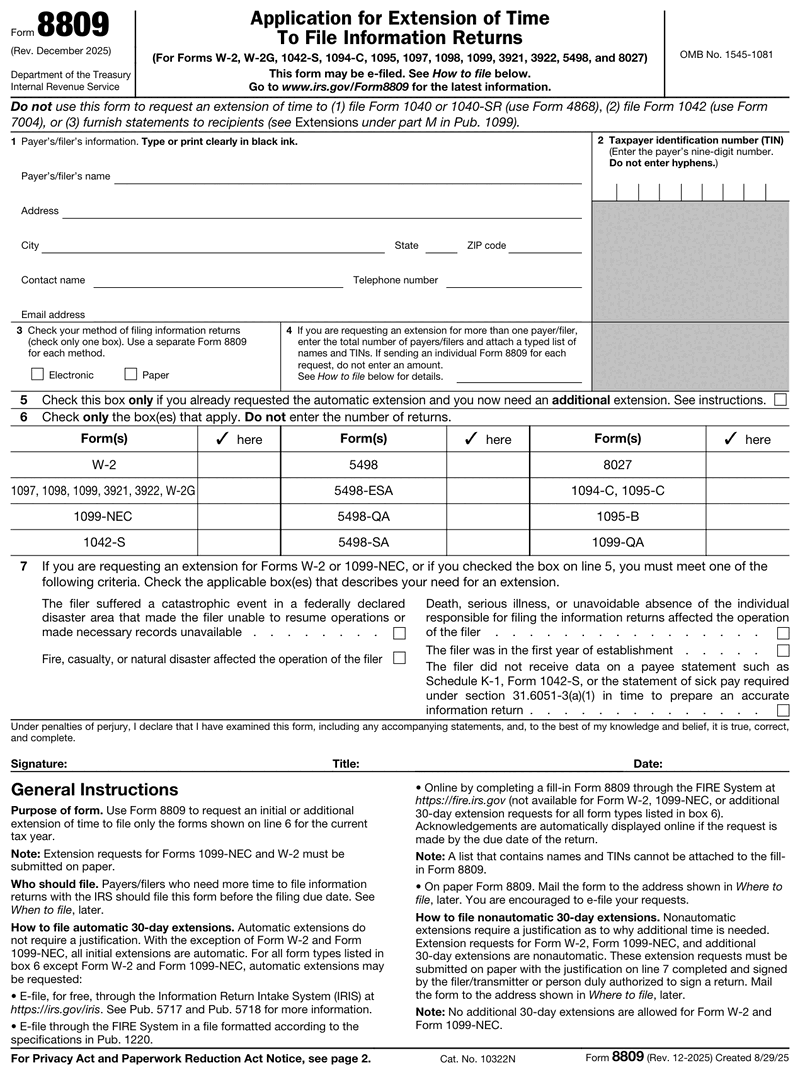
The current version is Rev. December 2025. The blank IRS 8809 form sits on IRS.gov, and that IRS Form 8809 PDF is the same document whether you print it and write on it or type into it on screen. The IRS accepts the request electronically or by mail and charges nothing to process it either way.
Businesses and payers who need more time to file information returns with the IRS - typically 1099 and 1098 filers in a crowded January.
The IRS. File it by the return's original due date to get the extension.
A real-world example: Thirty 1099-MISCs to prepare and the books close late. An 8809 filed before the deadline turns the crunch into an extra month.
Enter your
information
Preview
your form
Download
your form
File the 8809 by the original due date of the returns being extended - for most 1099s, that means during January 2027 or shortly after, depending on filing method. Recipient-copy deadlines are not extended.
It covers Forms W-2, W-2G, 1042-S, 1094-C, 1095, 1097, 1098, 1099, 3921, 3922, 5498, and 8027. That includes every 1099 variant and the 5498 sub-forms. If your form is not on that list, a different extension form applies, and box 6 on the form itself is the definitive checklist.
Box 6 groups them like this:
Tick the boxes that apply. Do not write in how many returns you are filing.
You file it if you are the payer or filer who owes the IRS an information return and you will not make the deadline. That means the business or person issuing the forms, not the contractors or employees receiving them. Bookkeepers and accountants can file it on a client's behalf.
The people reaching for this form are usually in one of a few situations: a staffing agency with dozens of 1099-NECs and incomplete contractor records, a small seller waiting on a delayed Schedule K-1, a business that switched payroll providers mid-year and is still reconciling W-2 data, or a first-year business that has never done any of this before. That last one matters, because being in your first year of operation is itself an accepted hardship reason on the form.
If this is your first season issuing contractor paperwork, our guides on how to issue a 1099-MISC and independent contractor pay documentation cover the upstream side of what you are extending.
Your form 8809 due date is the same as the due date of the returns you are extending. For 2027 that means February 1 for W-2 and 1099-NEC, March 1 on paper or March 31 by e-file for most 1099s, March 15 for 1042-S, and June 1 for Form 5498.
| If you file | Paper deadline | E-file deadline |
|---|---|---|
| W-2 | February 1, 2027 | February 1, 2027 |
| 1099-NEC | February 1, 2027 | February 1, 2027 |
| W-2G | March 1, 2027 | March 31, 2027 |
| 1097, 1098, 1099 (other) | March 1, 2027 | March 31, 2027 |
| 3921, 3922 | March 1, 2027 | March 31, 2027 |
| 1094-C, 1095 | March 1, 2027 | March 31, 2027 |
| 1042-S | March 15, 2027 | March 15, 2027 |
| 5498 | June 1, 2027 | June 1, 2027 |
| 8027 | March 1, 2027 | March 31, 2027 |
Several of those deadlines have shifted, and the rule behind it is simple: when a deadline lands on a Saturday, Sunday, or legal holiday, it rolls to the next business day. January 31, 2027 is a Sunday, so W-2 and 1099-NEC move to Monday February 1. February 28 is also a Sunday, so those move to Monday March 1. May 31 is Memorial Day, a federal holiday, so Form 5498 moves to Tuesday June 1. The March 31 e-file date needs no adjustment, because it falls on a Wednesday. Knowing the rule means you can work out any future year yourself instead of trusting a date you found online.
Note that correcting a form you already filed runs on its own clock, which is why the corrected W-2 deadline is a separate thing to track.
Two hard limits are worth memorising. You cannot file before January 1 of the year the return is due, and you cannot file after the due date has passed. A late request is not granted, so there is no value in submitting one after the fact.
Everything above assumes an automatic extension. Forms W-2 and 1099-NEC do not get one:
To qualify, you check at least one of five criteria on line 7:
Being busy or short-staffed is not on that list. If none of the five apply, the honest answer is to file the returns as fast as you can and accept the late penalty rather than submitting a request that will not hold up.
The form is one page and mostly checkboxes. Here is what each part wants, following the form 8809 instructions in order.
Line 1: your details. Name, address, contact name, phone, and email. Use the address where you want IRS correspondence sent. Preparers handling this for a client enter the client's name, then c/o your firm, then your address.
Line 2: your TIN. Your nine-digit EIN, no hyphens. If you are not required to have an EIN, use your Social Security number. Your legal name and TIN must match your SS-4 exactly. A transposed digit or an abbreviated business name is the most common reason a request fails to match an account, so it is worth confirming how to find your employer identification number before you start.
Line 3: filing method. Electronic or paper. If you file some returns electronically and others on paper, you need a separate form for each method.
Line 4: multiple payers. Only if you are covering more than one payer. Enter the total and attach a typed list of names and TINs. That list cannot be attached to the fill-in PDF, so multi-payer requests go on paper.
Line 5: additional extension. Leave blank on a first request. Tick it only if you already have the automatic 30 days and need more.
Line 6: which forms. Check the boxes matching the returns you are extending.
Line 7: hardship reason. Required for W-2, 1099-NEC, or any additional extension. Otherwise skip it.
Signature. Sign, add your title, and date it. This is signed under penalties of perjury, and an unsigned form is not a filed form.
If you are wondering how to file form 8809 electronically, the route is the IRS Information Return Intake System (IRIS), which takes the request at no charge. W-2 and 1099-NEC requests must go on paper.
You can cover several form types with a single request. The catch is that you must file by the earliest deadline among them, not the latest.
The IRS uses this example: requesting an extension for both Form 1098 and Form 5498 means filing by the 1098 deadline, which for 2027 is March 1 on paper or March 31 by e-file. The 5498 deadline at the start of June does not buy you any extra time on the request.
This is easy to get wrong, because the instinct is to work backwards from whichever form worries you most. Set your reminder for the earliest deadline in your stack, or file separate requests and remove the risk entirely.
Paper filing is required for W-2 and 1099-NEC requests and for any additional 30-day extension. Otherwise it is optional, and e-filing is faster.
If you are mailing it, send the completed 8809 form to:
Department of the Treasury Internal Revenue Service Center Ogden, UT 84201-0209
Post it early enough to arrive by the due date. One quirk worth knowing: if you file Form 8027 on paper, attach a copy of your timely filed Form 8809 to that return.
This is what makes ten minutes on an extension request worthwhile. The IRS charges per return, not per filing, so the numbers scale fast when you are issuing a stack of 1099s.
| How late | Penalty per return (returns due in 2026) |
|---|---|
| Up to 30 days late | $60 |
| 31 days late through August 1 | $130 |
| After August 1, or not filed | $340 |
| Intentional disregard | $680 |
The IRS adjusts these amounts for inflation every year, so confirm the current figures in the Form 8809 instructions before relying on them for a return due in a later year.
Put that against a realistic case. Forty late 1099-NECs filed two months past the deadline is $130 each, or $5,200. The same forty returns filed inside an approved 30-day extension cost nothing extra. Interest accrues on penalties too, and there is no maximum at all for intentional disregard.
Separate penalties apply for failing to get correct statements to recipients on time, and the consequences compound in much the same way as not filing your taxes at all.
A few forms get confused with this one often enough to name directly.
Hand-filling a blank PDF works, but the failure modes here are mechanical rather than conceptual: a hyphen in the TIN, a name that does not match the SS-4, the wrong box on line 6, a missing signature. None of those are misunderstandings of tax law. They are transcription errors, and preventing them is exactly what an 8809 generator is for.
A form 8809 fillable tool catches that whole class of problem. Your details go in once and come out formatted the way the IRS expects, you get a print-ready copy for mailing plus a digital copy for your records, and changing one entry does not mean re-typing the page.
There is an upstream point too. If you are filing this because your underlying 1099s or W-2s are not ready, the extension solves the symptom. Producing that paperwork properly in the first place is what stops next January feeling the same way. Our W-2 form creator handles employee wage statements, and if you are paying subcontractors it helps to know what a 1099 pay stub looks like before year-end.
There is no annual Form 8809. Unlike the W-2s you are extending, it is not reissued each January with a new year printed at the top, so there is no "2026 Form 8809" and no "2027 Form 8809" to hunt down. The current revision is December 2025, and the revision before it was August 2020, which tells you how rarely this one changes. When you search with a year attached, that year belongs to the information returns you are filing late, not to the extension form. Pull whatever version IRS.gov is serving today and you have the right one.
Nothing about the deadlines changed with the new revision either. The due-date chart in Rev. December 2025 is identical line for line to the chart in Rev. August 2020, and the 30-day extension structure is the same. The differences are procedural: IRIS was added as a free e-file channel alongside FIRE, the header changed from "This form may be filled out online" to "This form may be e-filed," and the instructions now spell out that extension requests for Forms 1099-NEC and W-2 must be submitted on paper.
So the only thing that genuinely moves from one year to the next is the deadline table above. The form itself sits still.

4.4 out of 5.0 stars on 717 reviews
For most forms, yes. You request 30 days, and you do not have to explain why. The exceptions are Forms W-2 and 1099-NEC, which are never automatic. Those two require you to check one of five hardship reasons on line 7 and file the request on paper.
If you e-file through IRIS, acknowledgement appears online automatically as long as you filed by the due date. Paper requests take longer and you will hear back by mail. There is no separate approval step for automatic extensions, so a timely filed request is generally granted on submission.
Sometimes, and the conditions tighten considerably. Everything other than W-2 and 1099-NEC qualifies for one more 30 days, but the request has to go on paper, it needs a hardship reason on line 7, and it must reach the IRS before your first extension expires. Miss that window and there is no second chance.
No, and this catches people out every year. It only moves your filing deadline with the IRS. Getting more time to furnish statements to recipients is a completely separate request, sent by fax to the IRS, with its own rules. Your recipient deadline does not move on its own.
If you spot the error before your deadline, simply file a corrected Form 8809 with the right information. If the deadline has passed, you cannot fix it with a new request, because an extension cannot be granted after the return's due date. Contact the IRS directly at that point.
Fill out our contact form, and we will get back to you as soon as we can!
Contact us
Hi! How can I help you? Kris