Our customer support is available 24/7:

Make your 944 form in minutes. Simple to use, accurate and ready to download.
Rated 4.4/5 (770+ reviews) 35+ tax forms No subscription required
Getting a letter from the IRS telling you to file something new is never a fun morning. If yours said to file Form 944 instead of the quarterly Form 941 you were expecting, here's the good news: you've just been handed less paperwork, not more. A 944 form gets filed once a year, not four times. Our 944 form generator handles the Social Security and Medicare math so you don't have to. You preview free, pay only when you download, and there's no subscription.
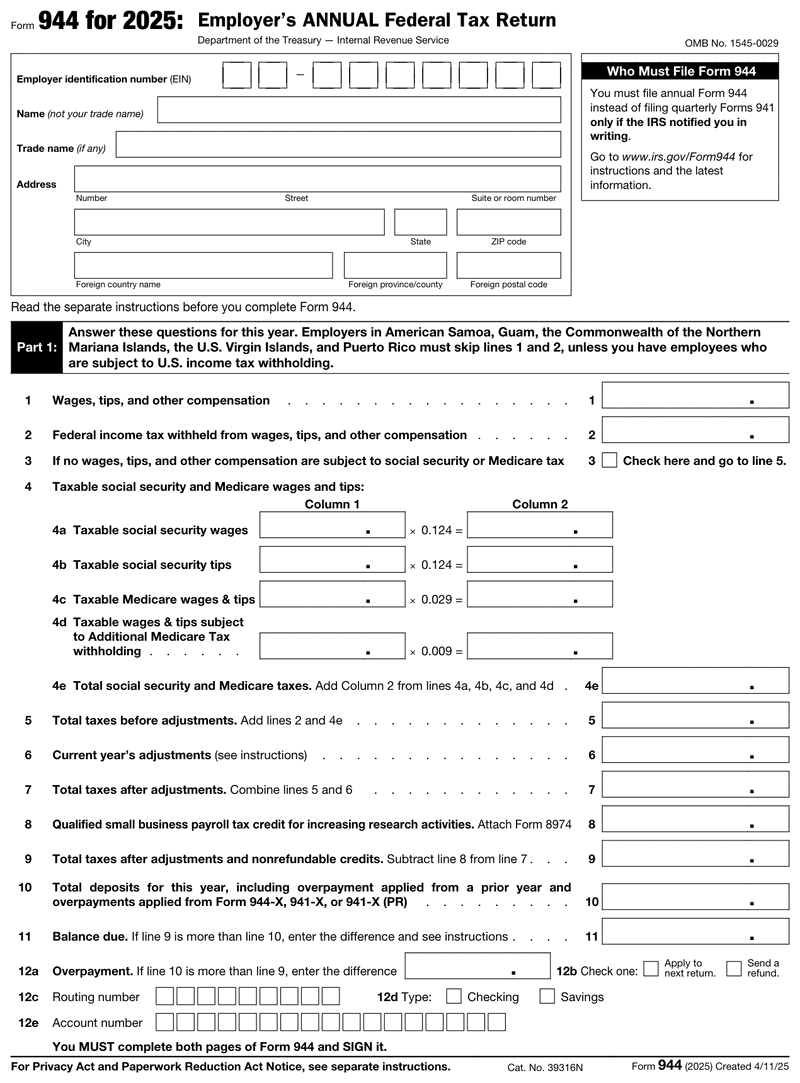
Form 944 is the Employer's Annual Federal Tax Return. It reports the federal income tax you withheld from employees, plus Social Security and Medicare taxes, once a year instead of quarterly. The IRS created the 944 tax form to reduce paperwork for the smallest employers, who file one return each year.
So what is Form 944 doing in practical terms? It's a year-end summary of your payroll taxes. Every dollar you withheld from your team's paychecks, plus both the employee and employer share of Social Security and Medicare, lands on this single employment tax return. You'll sometimes see it written as IRS Form 944, and the employment tax form 944 exists for a simple reason: if you only owe a small amount across twelve months, four separate quarterly returns is a lot of work for very little tax.
Very small employers the IRS has notified to file annually instead of quarterly - typically $1,000 or less in annual employment tax liability.
The IRS, once per year.
A real-world example: One part-time employee, a few thousand dollars of annual wages: the IRS letter says file the 944, and the whole year's payroll reporting is one form.
Enter your
information
Preview
your form
Download
your form
The 944 is due January 31, 2027, for the prior year - with a short extension to mid-February if all deposits were made on time.
You file Form 944 only if the IRS has sent you written notice telling you to. That notice generally goes to employers whose annual employment tax liability is $1,000 or less, which works out to roughly $5,000 or less in total wages. You cannot choose this status on your own.
New employers can request 944 status when applying for an EIN. Everyone else gets assigned it based on filing history. Two things trip people up here. First, the notice isn't a suggestion, so you can't keep filing quarterly because that's what you're used to. Second, the federal Form 944 covers a full calendar year, which means your first one isn't due until that year has finished.
Two groups can't use this form no matter how little they owe. Household employers report domestic help on Schedule H instead, and agricultural employers file Form 943.
The difference is frequency. Form 944 is filed once a year by the smallest employers, while Form 941 is filed every quarter by everyone else. You do not pick between them yourself: the IRS assigns your filing type in writing, and you need written approval to switch either direction.
| Form 944 | Form 941 | |
|---|---|---|
| How often | Once a year | Every quarter |
| Who files it | Smallest employers, roughly $1,000 or less in annual liability | Most employers |
| When it's due | January 31 following the tax year | End of the month after each quarter |
| Switching | Written IRS notice required | Written IRS notice required |
People searching 941 vs 944 are usually trying to work out which one applies to them. The honest answer is that it isn't your call to make. Your filing type comes from the IRS, and weighing up form 941 vs 944 on your own won't change the one you've been assigned. If you've been filing quarterly and need to correct an earlier return, that's a separate form altogether.
Pulling five things together before you open the 944 form saves you from stalling halfway through:
That last item matters more than people expect. Your deposits get subtracted from what you owe at the end, so if you can't locate them, you can't tell whether you owe a balance or you're due a refund.
You don't need to understand all thirty-plus lines. Most small employers touch fewer than a dozen, and the official Form 944 instructions cover the rest.
Lines 1 through 3 are straight totals: wages, tips and other compensation, then the federal income tax you withheld. Nothing tricky there, just accurate bookkeeping.
Lines 4a through 4d are where the arithmetic starts. For each one you enter the total taxable wages in the first column, multiply by a fixed rate, then write the result in the second. Social Security runs at 0.124, Medicare at 0.029, and Additional Medicare withholding at 0.009. One slip cascades into every total below it, which is exactly the part our generator removes.
Older Form 944 revisions carried lines for qualified sick and family leave wages, the employee retention credit, COBRA premium assistance and recovery startup business amounts. Those pandemic-era lines were removed from the form for later tax periods. If the form in front of you is still asking about them, you have an out-of-date PDF: download the current revision from IRS.gov before you fill anything in.
Part 2 asks about your deposit schedule and your tax liability for the year. Part 3 covers whether the business has closed. Part 4 is the third-party designee box, where you name anyone allowed to discuss the return with the IRS. Part 5 is your signature, and a payment voucher sits at the bottom if you're mailing a balance due.
Our 944 generator is built around the part people actually get stuck on, which is the math.
Enter your wage totals, your withholding, and your deposits. The tool applies the rates, runs the totals, and fills the form as you go. You'll see your figures calculated before you commit to anything, and you don't need an account to get that far.
When you're done, you pay once and download a clean, print-ready copy for your records or for mailing. One payment, no subscription. The template matches the current form revision, so every line sits where the IRS expects to find it. Filing 944 online through an IRS-authorized e-file provider is the other route, and it's a solid one when you want transmission confirmation. Either way, start with the generator above and let the tool handle the arithmetic.
Form 944 is due January 31 following the tax year it covers. If January 31 lands on a weekend or legal holiday, you get the next business day. January 31, 2027 is a Sunday, so the upcoming deadline is Monday, February 1, 2027, or February 10 if your deposits were timely and paid in full.
That weekend rule is where a lot of published guidance goes wrong, because January 31 doesn't always fall on a business day. Check the date each year instead of assuming. Miss both dates and penalties accrue from the original deadline, not the extended one. The IRS publishes current dates on its employment tax due dates page.
You've got two options for getting your 944 filing to the IRS. E-filing through an IRS-authorized provider gets you confirmation the return arrived, which is worth a lot when a deadline is close. Mailing works too, though the correct address depends on your state and on whether you're enclosing a payment.
Those addresses shift between filing seasons, so pull the current Form 944 instructions rather than reusing an envelope from last year. IRS 944 filers who send a return to a retired address can spend months untangling where it went.
An unsigned return counts as unfiled, which is a painful way to earn a late penalty.
Who signs depends on how you're set up. A sole proprietor signs personally. A corporation needs its president, vice president, or another principal officer. A partnership or LLC needs a responsible partner or member, and a trust or estate needs the fiduciary.
If you e-file, you'll sign electronically with a PIN. If you mail it, sign in ink, and remember the payment voucher is a separate slip needing your details too.
Four errors account for most of the correction notices small employers receive:
The IRS charges separately for filing late and for paying late, and interest runs on top of both. Failure-to-file is the more expensive of the two, which leads to advice that surprises people: if you can't cover the full balance, file anyway and pay what you can.
Penalties accrue monthly, so a return that's a week late costs far less than one six months late. If you've blown past the deadline, file immediately rather than waiting until you've saved the whole amount.
Form 944 does get a new edition each year, and the year printed on it is the year of the wages, not the year you file. So "944 form 2025" means the return covering wages you paid in 2025, which was filed in early 2026, and "944 form 2026" means the one covering the wages you're paying right now.
| Tax year (the wages) | File by | If every deposit was timely and in full |
|---|---|---|
| 2025 | February 2, 2026 (already passed) | February 10, 2026 |
| 2026 | February 1, 2027 | February 10, 2027 |
One thing worth knowing before you go hunting for a form: as of July 2026 the 2026 Form 944 and its instructions had not been published, and irs.gov still showed the 2025 revision as current. If you're preparing early, that 2025 edition is what you'll find, and the February 1, 2027 date follows the standing January 31 rule rather than a printed 2026 instruction. Check once the new edition posts.
Very little else moved between the two years. The $1,000-or-less liability threshold is unchanged. What the 2025 instructions did add: direct deposit is now available for a Form 944 refund, balance due payments must be made electronically, and return transcripts are available electronically.

4.4 out of 5.0 stars on 717 reviews
Both report the same payroll taxes; only the schedule differs. Form 941 is filed four times a year, after each quarter. Form 944 is filed once, after the year ends. The IRS decides which one applies to you based on your expected annual employment tax liability.
Yes. Once the IRS designates you a 944 filer, you file every year, even a year with zero wages and zero tax. You simply report zeros. The only exceptions are formally closing the business, which you indicate on Line 14, or the IRS removing your 944 status in writing.
Small employers use it to report withheld federal income tax plus both halves of Social Security and Medicare, once a year. IRS Form 944 replaces four quarterly Form 941 filings with a single annual one, and only employers who receive written notice file it.
Yes, but not unilaterally. The IRS takes requests early in the year, generally by phone up to April 1 or by mail postmarked by mid-March; check the current instructions for exact dates. Keep filing Form 944 until the IRS confirms the switch in writing, because filing quarterly without confirmation creates mismatched records.
It reports and pays a small employer's federal payroll taxes for an entire calendar year in one filing. That covers income tax withheld from paychecks, Social Security and Medicare, and any balance still owed once your deposits for the year are subtracted.
Fill out our contact form, and we will get back to you as soon as we can!
Contact us
Hi! How can I help you? Kris