Our customer support is available 24/7:

A simple way to create your 940 form online. Generate, print and use.
Rated 4.4/5 (770+ reviews) 35+ tax forms No subscription required
If you have employees, there is one federal return that sneaks up on a lot of small business owners: the 940 form. It only comes around once a year, so it is easy to forget it exists until a deadline notice shows up. The good news is that Form 940 is simpler than it looks, and you can fill it in online at PayStubCreator.net instead of wrestling with a blank PDF.
Form 940 is the employer's annual federal unemployment (FUTA) tax return. You file it once a year to report the unemployment tax you owe on employee wages. That money funds unemployment benefits for workers who lose their jobs. It is filed by the business, not by employees, and it reports no personal income.
FUTA stands for the Federal Unemployment Tax Act, which is the law behind the whole thing. If the acronym is new to you, our breakdown of what FUTA means covers it in more detail. Here is the part that surprises first-time filers: FUTA is an employer-only tax. You do not withhold it from anyone's paycheck, and your employees will never see it on their pay stubs. It comes out of your pocket.
Search for it and you will find it written half a dozen ways: the 940 tax form, tax form 940, or just the annual FUTA return. Same single-page document every time, so do not worry that you are looking at the wrong thing. The 940 form works alongside your state unemployment insurance filings, not instead of them. Most employers pay into a state unemployment fund too, and the IRS gives you credit for those state payments, which is why the federal bill usually ends up much smaller than the headline rate suggests. If you want the official line-by-line rules, the IRS Form 940 instructions are published on IRS.gov each year.
Employers who paid $1,500 or more in wages in any quarter, or had an employee for part of a day in 20 or more weeks of the year.
The IRS. Deposits during the year are reconciled on this one annual return.
A real-world example: Six employees all year: FUTA applies to the first $7,000 each earned, the state credit applies, and the 940 reports the reconciled annual figure.
Enter your
information
Preview
your form
Download
your form
The 940 is due January 31, 2027, for the prior year - with a short extension to mid-February if all FUTA deposits were made on time. Quarterly deposits apply during the year whenever accumulated FUTA tax passes $500.
You generally file Form 940 if you paid $1,500 or more in wages during any calendar quarter, or if you had at least one employee for any part of a day in 20 or more different weeks of the year. Household and farm employers follow separate tests.
A few things worth knowing:
FUTA tax is 6% on the first $7,000 you pay each employee per year. Most employers get a state credit of up to 5.4%, which drops the effective rate to 0.6%, or about $42 per employee. Wages above $7,000 per person are not taxed at all.
Here is the formula:
Taxable wages (first $7,000 per employee) x 6.0% = FUTA before credit minus state credit (up to 5.4%) = What you actually owe (as low as 0.6%)
Now a real example. Say you run a four-person shop and you paid each employee $9,500 over the year, so $38,000 in total wages. Only the first $7,000 per person counts, so your taxable FUTA wage base is $7,000 x 4 = $28,000, not $38,000. At the 0.6% effective rate, that is $168 for the year. The $2,500 you paid each employee above the $7,000 line is simply not part of this calculation.
That wage base cap is the single most misunderstood part of FUTA taxes, and it is why the final number is usually far smaller than owners brace for.
Gather these in one place before you open the 940 form and the whole thing takes minutes instead of an afternoon:
That last one catches people out, so check it before you start rather than halfway through.
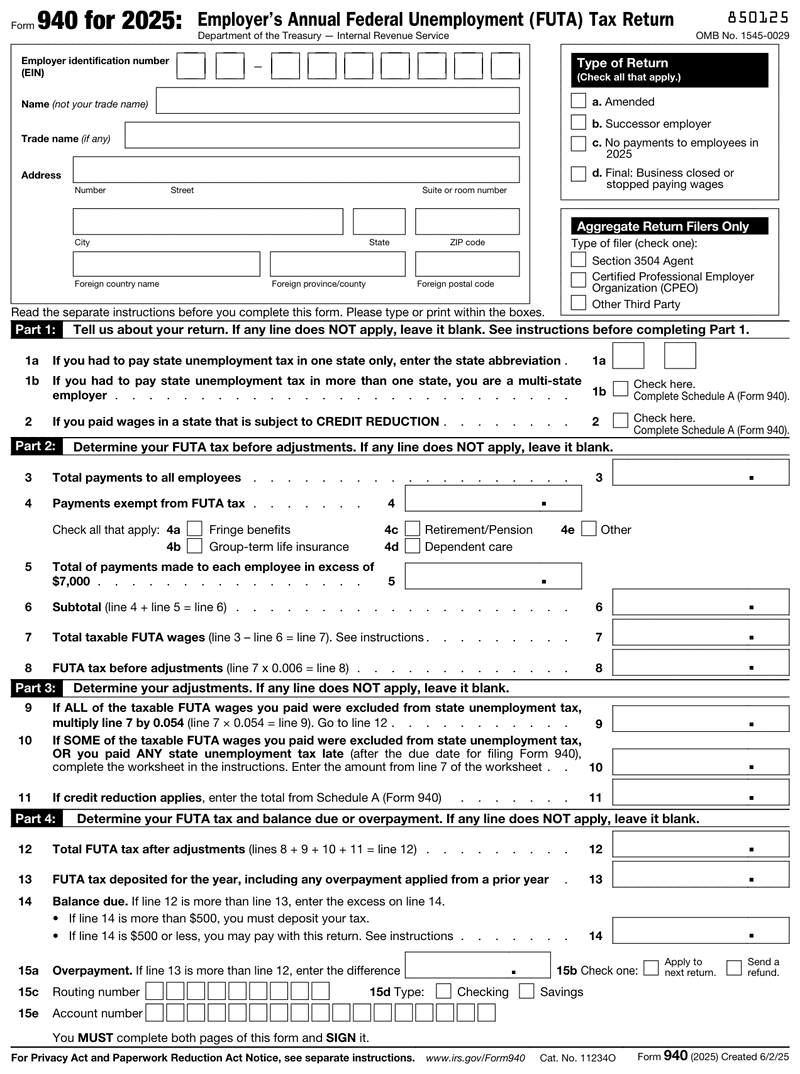
The 940 form is one page split into seven parts. Most of the middle is arithmetic, which is exactly the part a tool should handle for you. Here is the honest split between what gets calculated and what only you can supply.
Your state unemployment contributions go here, which means naming every state you paid into. If that is more than one state, or if you operated in a credit reduction state, Schedule A gets attached as well. No tool can guess this for you, because it depends on where your people actually worked.
Part 2 works out your FUTA tax before adjustments. You enter total payments to employees, exempt payments, and the amount paid over the $7,000 per-employee cap. From there, the taxable wage figure and the 6% calculation are pure arithmetic.
Part 3 handles adjustments, including the credit reduction figure carried over from Schedule A. Part 4 nets everything into your final FUTA tax, subtracts what you already deposited, and lands on either a balance due or an overpayment.
These three parts are where hand-filled returns go wrong, because a single mistyped figure on the wage lines flows through every line below it. Following the form 940 instructions manually means re-checking that chain yourself. A generator recalculates it every time you change a number.
Part 5 asks you to break your FUTA liability into four quarters, but only if your total tax for the year is more than $500. If you are under that threshold, you skip it entirely.
Part 6 asks whether the IRS may speak with a third-party designee, such as your accountant. Part 7 is the signature block. Your name, title, phone number, date, and signature all have to come from you. An unsigned return is treated as unfiled, which is a genuinely common reason a 940 gets rejected.
Form 940 for tax year 2026 is due February 1, 2027, because January 31 falls on a Sunday that year and the deadline rolls to the next business day. If you deposited all your FUTA tax on time during the year, you get until February 10, 2027, which is a Wednesday and needs no adjustment. Unlike Form 941, you file this one only once a year.
Because it is annual, the 940 form does not ride along with the quarterly payroll rhythm you are already used to. That is precisely why small employers miss it. Set one calendar reminder for late January every year and you will never think about it again.
Filing late costs more than most owners expect, because two separate penalties can stack.
The failure-to-file penalty runs 5% of the unpaid tax for each month or part of a month your return is late, capped at 25%. On top of that, a failure-to-pay penalty of 0.5% per month applies to tax you owe but have not paid, also capped at 25%. Interest accrues on the balance as well.
The saving grace is that FUTA bills are usually small, so the penalties are usually small in absolute terms. Still, if you owe nothing at all, file anyway. A zero-balance return filed on time costs you nothing, while an unfiled one can generate notices you then have to spend time answering.
Before you look up an address, it is worth saying: mailing is only one of your options. Many employers now e-file, and plenty of others generate a completed, print-ready copy electronically and then mail that. Either way you avoid hand-writing the form. The addresses below are the paper-filing path.
Where you send your completed 940 form depends on your state and on whether you are enclosing a payment. Ultimately, where to file Form 940 is set by the IRS service center that handles your region. Note that mailing the return is not the same as depositing your tax, which is covered further down.
| If you are in | Mail return without payment | Mail return with payment |
|---|---|---|
| Connecticut, Delaware, District of Columbia, Georgia, Illinois, Indiana, Kentucky, Maine, Maryland, Massachusetts, Michigan, New Hampshire, New Jersey, New York, North Carolina, Ohio, Pennsylvania, Rhode Island, South Carolina, Tennessee, Vermont, Virginia, West Virginia, Wisconsin | Department of the Treasury, Internal Revenue Service, Kansas City, MO 64999-0046 | Internal Revenue Service, P.O. Box 932000, Louisville, KY 40293-2000 |
| Alabama, Alaska, Arizona, Arkansas, California, Colorado, Florida, Hawaii, Idaho, Iowa, Kansas, Louisiana, Minnesota, Mississippi, Missouri, Montana, Nebraska, Nevada, New Mexico, North Dakota, Oklahoma, Oregon, South Dakota, Texas, Utah, Washington, Wyoming | Department of the Treasury, Internal Revenue Service, Ogden, UT 84201-0046 | Internal Revenue Service, P.O. Box 932000, Louisville, KY 40293-2000 |
| Puerto Rico, U.S. Virgin Islands | Internal Revenue Service, P.O. Box 409101, Ogden, UT 84409 | Internal Revenue Service, P.O. Box 932000, Louisville, KY 40293-2000 |
| Tax-exempt organizations and government entities, any location | Department of the Treasury, Internal Revenue Service, Ogden, UT 84201-0046 | Internal Revenue Service, P.O. Box 932000, Louisville, KY 40293-2000 |
If you are unsure where to mail 940 returns for your situation, or your legal residence is not listed above, use the Ogden P.O. Box 409101 address without payment. The 940 mailing address changes from time to time, so confirm it on IRS.gov before you send anything. Knowing where to file 940 forms correctly matters, because a return sent to the wrong service center can take considerably longer to post to your account.
Schedule A attaches to your 940 form in two situations: you paid unemployment tax in more than one state, or you operated in a credit reduction state.
A credit reduction state is one that borrowed from the federal government to pay unemployment benefits and has not repaid the loan. Employers there lose part of that 5.4% credit, so their effective FUTA rate goes up.
The list of affected states changes every single year, and older articles routinely quote rosters that are years out of date. Always pull the current-year list from the IRS Schedule A instructions rather than trusting a number you found in a blog post.
Filing the return and paying the tax are two separate actions.
If your FUTA liability comes to more than $500 for the year, you have to deposit it quarterly rather than paying it all at filing time. Deposits are due by the last day of the month following the end of each quarter, and they go through the Electronic Federal Tax Payment System (EFTPS).
If you owe $500 or less in a quarter, you can carry the amount forward to the next quarter. If your total for the year stays at or below $500, you can simply pay it with your return.
There is no separate 940-X. To correct a return you already filed, you fill out a new 940 form for that same year, using the form revision for the year you are correcting.
Check the "Amended" box in the top right corner of page 1, enter the corrected figures, and attach a short explanation of what changed and why. Then mail it to the "without payment" address for your state, even if you owe more, unless the current instructions tell you otherwise. Amended returns cannot be e-filed, so this one goes on paper.
Form 940 is annual and reports federal unemployment tax that you pay entirely yourself. Form 941 is quarterly and reports income tax withheld plus Social Security and Medicare, which you and your employees split. Most employers with staff end up filing both, on different schedules.
| Form 940 | Form 941 | |
|---|---|---|
| How often | Once a year | Every quarter |
| Reports | FUTA unemployment tax | Withheld income tax, Social Security, Medicare |
| Who pays | Employer only | Employer and employee share |
| Wage base | First $7,000 per employee | Social Security capped far higher, Medicare uncapped |
If you are weighing 940 vs 941, the answer for most employers with staff is that you need both. The form 940 and 941 pair covers different taxes, so filing one never satisfies the other. Correcting a quarterly return works differently too, and is handled on Form 941-X rather than on the 940.
These are the errors that generate IRS notices most often:
Most of these are arithmetic or checkbox errors rather than genuine misunderstandings of tax law, which is exactly why filling the form in electronically prevents so many of them.
Hand-filling a blank IRS 940 form PDF works, but it puts every calculation and every carried-forward figure on you. A 940 generator handles that differently: you enter your wage totals, exemptions, and state information once, and the arithmetic in Parts 2 through 4 is worked out and carried through the form for you.
What you get out of it:
For a small employer filing this once a year, the practical value is not speed alone. It is that you are not re-checking a chain of dependent line items by hand at the end of January.
The same approach covers the rest of your year-end paperwork. If you also need to issue employee wage statements, our W-2 form creator works the same way, and you can build those from our pay stub templates using the same set of payroll figures. Everything we build is aimed at owners who handle their own payroll paperwork and want it done correctly without hiring it out.
Form 940 really is reissued each year, so "form 940 2025" and "form 940 2026" are two different documents rather than one PDF relabelled. The year printed on the form is the year whose wages you are reporting, and you file it in the opening weeks of the year after. Worth knowing before you go hunting for a copy: as of July 21, 2026, the 2026 Form 940 and its instructions had not been published, and IRS.gov still showed 2025 as the current revision.
The 2025 return was due February 2, 2026, or February 10, 2026 if every FUTA deposit was made when due. The part that genuinely moves from one year to the next is the credit reduction list, because it decides whether your 0.6% net rate holds:
| Wages reported for | Credit reduction states and rates |
|---|---|
| 2024 | California 0.009 (0.9%), New York 0.009 (0.9%), U.S. Virgin Islands 0.042 (4.2%) |
| 2025 | California 0.012 (1.2%) and U.S. Virgin Islands 0.045 (4.5%), those two only |
| 2026 | Not published yet. The Department of Labor does not announce the final list until November 2026 |
New York dropped off after 2024 while California's rate went up, which is exactly why last year's list is not safe to reuse. Everything else about the math stayed put: 6.0% gross, 5.4% maximum credit, 0.6% net, $7,000 wage base.

4.4 out of 5.0 stars on 717 reviews
If you had no employees during the year and met none of the wage thresholds, you do not file. If you had employees for part of the year and then closed, you still file a final return for that year and check the box indicating the business has closed.
Yes, through the IRS e-file program or an authorized provider. Amended returns are the one exception and always have to be mailed on paper. If you would rather not e-file at all, preparing the return electronically and printing a completed copy to mail is still far less error-prone than filling in a blank PDF by hand.
FUTA is the federal unemployment tax reported on your annual 940. SUTA is the state equivalent, paid to your state agency on its own schedule. Paying SUTA on time is what earns you the federal credit that drops your FUTA rate from 6% to as low as 0.6%.
No. Independent contractors you pay on a 1099 are not employees, so their payments are not FUTA wages and do not count toward the $1,500 quarterly or 20-week thresholds. Only W-2 employee wages belong on the return.
Keep employment tax records for at least four years after the date the tax becomes due or is paid, whichever is later. That includes your filed returns, deposit confirmations, and the payroll records supporting your wage figures.
Fill out our contact form, and we will get back to you as soon as we can!
Contact us
Hi! How can I help you? Kris