Our customer support is available 24/7:

Build your Form 4797 online in a few clicks. Fast, accurate and error free.
Rated 4.4/5 (770+ reviews) 35+ tax forms No subscription required
You sold a work truck, a piece of equipment, or a rental property, and now there's a tax form in front of you that you've never seen before. That's Form 4797, Sales of Business Property, and it's how the IRS wants you to report the gain or loss.
It has a reputation for being confusing.
Our 4797 generator at PayStubCreator.net fills in the boxes for you. Below: what the form does, who files it, what each of the four parts covers, a worked example, and how it differs from Schedule D.
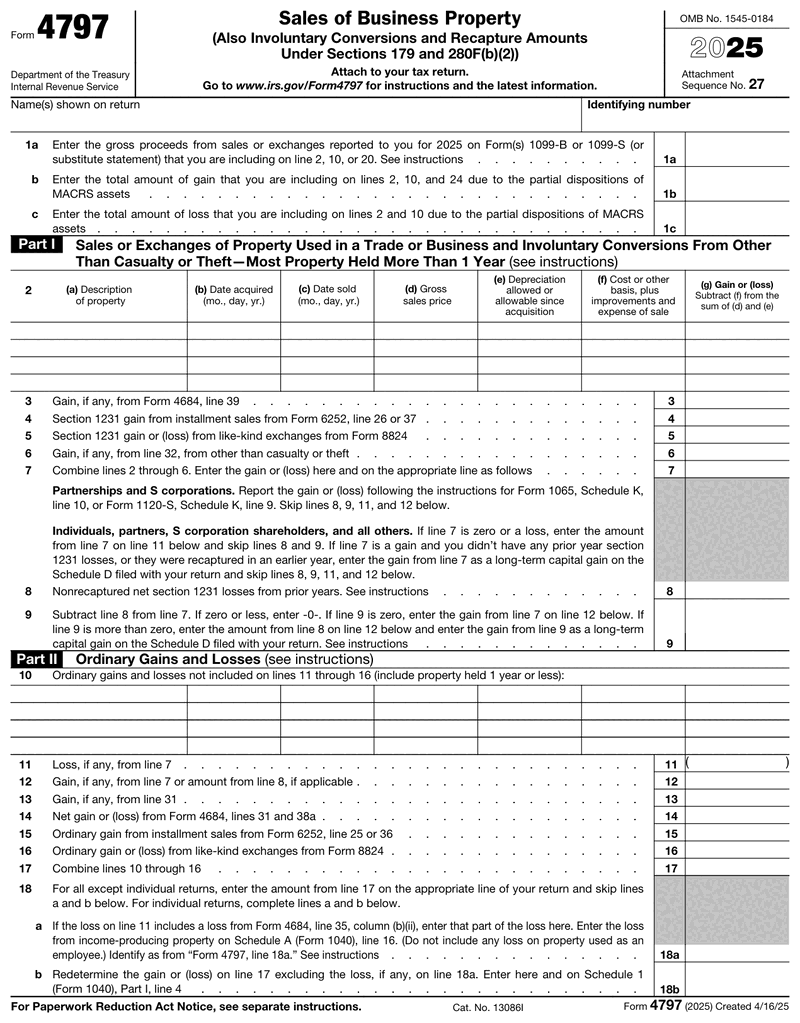
Form 4797 is the IRS form used to report the sale or exchange of business property, including equipment, vehicles, and rental real estate. You file it with your Form 1040 to report gains and losses on depreciable assets used in a trade or business, not personal investments.
Officially it's IRS Form 4797 Sales of Business Property, though plenty of people just call it the sale of business assets form. Business property means anything you used to earn money and wrote off over time: a camera body, a mower, a delivery van, a rental duplex.
Here's the mistake that costs people real money. Plenty of owners report a sale like this as ordinary business income on their Schedule C instead of on the 4797 form. That overstates your income to the IRS and usually means paying more tax than you owed, because you give up capital gains treatment on part of the gain.
Business owners, landlords and farmers who sold or disposed of business-use property during the year.
It attaches to your Form 1040 (or entity return) and files with it.
A real-world example: You sold a work truck for $14,000 after depreciating it down to $6,000. The $8,000 difference is recapture territory - exactly what the 4797 sorts out.
Enter your
information
Preview
your form
Download
your form
The 4797 follows the return it attaches to - mid-April 2027 for 1040-based filers, or later under a valid extension.
You file this form if you sold, exchanged, or disposed of property used in your business or trade. That covers freelancers selling equipment, contractors selling work vehicles, and landlords selling rental property. It also applies if business use of a Section 179 asset dropped to 50% or less.
In practice, that's a photographer offloading old camera gear, a landscaper selling a trailer, or an independent contractor selling the truck they've been depreciating for six years. Any disposition of an asset you've been depreciating can trigger it, so if you claimed depreciation and the property is gone now, this form is probably in your future. It sits alongside the rest of your self-employed tax obligations, not in place of them.
The form stalls people who open it without their paperwork ready. Pull these together first:
Selling expenses count too. Commissions and closing costs reduce your gain, so don't leave them out. If you're still sorting out which business costs you were entitled to write off in the first place, our rundown of 1099 tax deductions covers the common ones.
The 4797 instructions run long, but the structure is simpler than it looks. The form has four parts, and most filers only touch one or two of them.
Part I: Property held more than one year. This is where Section 1231 property goes, meaning real or depreciable property used in your business that you owned for over a year. It also handles involuntary conversions from something other than casualty or theft, a condemnation or eminent domain taking being the usual example. Casualty and theft losses go on Form 4684 instead. A net gain here generally gets long-term capital gains treatment, which is the favorable outcome.
Part II: Ordinary gains and losses. Property held one year or less lands here, along with other items the IRS treats as ordinary. Losses in this part are fully deductible against ordinary income.
Part III: Depreciation recapture. This covers gain on Section 1245, 1250, 1252, 1254, and 1255 property. If you depreciated the asset, this is the part that recaptures those deductions and taxes them as ordinary income. Most equipment and rental property sales run through here first, then the leftover gain carries up to Part I.
Part IV: Section 179 and 280F recapture. You only need this if business use of an asset you expensed dropped to 50% or less. It claws back part of the deduction you took.
Work Part III before Part I. The recapture figure it produces feeds the earlier part, which is the sequence that trips up first-time filers. Use the form revision that matches the tax year you are filing for, along with the IRS 4797 instructions that go with it, since line numbers move around between revisions.
Those section numbers just describe what kind of asset you sold.
| Section | What it covers | Typical example |
|---|---|---|
| 1231 | Real or depreciable business property held over a year | The umbrella category for Part I |
| 1245 | Depreciable personal property | Equipment, machinery, vehicles, computers |
| 1250 | Depreciable real property | Buildings, rental houses |
| 1252 | Farmland with soil or water conservation deductions | Farm acreage |
| 1254 | Oil, gas, and geothermal property | Mineral interests |
| 1255 | Section 126 cost-sharing property | Conservation program land |
Most freelancers and small business owners only ever deal with 1245 and 1250.
Every year you depreciated that truck, you reduced your taxable income. Recapture is the IRS collecting on that when you sell.
The rule works in a specific order. Gain up to the total depreciation you claimed is taxed as ordinary income at your regular rate. Only gain above that amount gets the friendlier long-term capital gains rate.
For Section 1245 property like equipment and vehicles, recapture is full: every dollar of depreciation you took is recaptured before any capital gain treatment kicks in. Section 1250 real property works differently, and the unrecaptured portion is capped at a 25% rate. That's how a modest-looking profit can still produce a bigger tax bill than expected.
Numbers make this concrete. Say you're a contractor:
Your total gain is $45,000 minus the $15,000 adjusted basis, so $30,000.
Now split it. The first $25,000, matching the depreciation you claimed, is recaptured under Section 1245 and taxed as ordinary income in Part III. The remaining $5,000 is a Section 1231 gain that moves to Part I and gets long-term capital gains treatment.
Had you sold for $30,000 instead, your gain would be $15,000, which is less than the $25,000 you depreciated. In that case the entire gain is ordinary income and nothing reaches Part I.
Two of the most common questions about this form are really about which form to use at all.
| Form | Use it for | Example |
|---|---|---|
| The 4797 | Property used in a business or trade | Selling your work van or a rental condo |
| Schedule D | Capital gains and losses overall | Your net gain from stock sales |
| Form 8949 | Itemizing individual capital transactions that feed Schedule D | Listing each stock lot you sold |
They connect rather than compete. A net Section 1231 gain from Part I of the 4797 form carries over to Schedule D, so plenty of filers submit both. Form 8949 handles the detail behind personal investment sales.
Rental property is the case people ask about most. Because a rental is business property, the sale goes on the 4797 tax form, not on Schedule D alone.
The form isn't filed on its own. You attach it to your Form 1040 and submit it with your regular tax return, on the same deadline, which is Thursday, April 15, 2027 for the 2026 tax year. An extension moves your tax filing date, but it doesn't move your payment due date.
You can download the blank 4797 form PDF and the official IRS 4797 instructions free from the Internal Revenue Service. Keep your purchase records, depreciation schedules, and closing statements afterward, because the basis math is what an auditor will ask about.
Skipping it isn't a good plan either. Underreporting a sale invites penalties and interest, and not filing at all costs considerably more than filing late.
Working from a blank IRS form means decoding line references and cross-checking parts in the right order. Our 4797 generator does that for you.
You answer plain questions about the sale: what you sold, when you bought and sold it, what you paid, what you received, and how much depreciation you claimed. The tool puts those figures in the correct part, applies the recapture ordering, and hands back a completed PDF to attach to your return. You can preview the finished form first and pay only when you download it, with no subscription.
If you also need income records for your return, our pay stub templates cover that side.
One honest caveat. A single equipment sale is very manageable this way. A multi-asset sale, an installment sale spread over years, or a commercial building with Section 1250 recapture deserves a tax professional's eyes before you file, and it's worth knowing what tax preparation usually costs before you decide.
Form 4797 is reissued annually, so "form 4797 2025" and "form 4797 2026" are genuinely different documents. Take the one matching the tax year of the sale, not the year you're filing in. The rules didn't change between them; the line numbering did. On the 2026 draft, line 1a cross-references lines 2, 11, or 22 where the 2025 version said lines 2, 10, or 20, with 1b moving to lines 2, 11, and 26 and 1c to lines 2 and 11.
The deadline works differently. Form 4797 has no due date of its own, it inherits whichever return it's attached to. On your Form 1040 that's April 15, 2026 for a 2025 sale and April 15, 2027 for 2026, and filing Form 4868 pushes that filing deadline six months out. If the property was held in a partnership or S corporation, the same form follows the Form 1065 or 1120-S date instead: March 16, 2026 or March 15, 2027, with Form 7004 giving the entity the same six-month extension. So the year in your search picks the form; the return it rides on picks the deadline.

4.4 out of 5.0 stars on 717 reviews
This form is used to report gains and losses from selling business property, such as equipment, work vehicles, or rental real estate. It separates ordinary income from capital gains, so depreciation you previously deducted gets taxed correctly rather than at the lower capital gains rate.
The 4797 reports sales of property used in a business; Schedule D reports capital gains and losses on personal investments like stocks. Gains from Part I often carry over to Schedule D, so many filers end up using both forms together.
Yes. Rental property is business property, so the sale is reported here. Depreciation you claimed over the years is recaptured under Section 1250 in Part III, and any remaining long-term gain typically flows through to Schedule D.
Both the blank version and the official instructions can be downloaded at no cost from irs.gov. Our generator goes a step further and fills the boxes in for you, so you don't have to decode line references on a blank form. You can preview it free, and you only pay when you download, with no subscription.
Not always. A single, straightforward equipment sale is manageable on your own. But if you sold multiple assets, used an installment sale, or are handling Section 1250 real estate recapture, a tax professional is worth the cost.
Fill out our contact form, and we will get back to you as soon as we can!
Contact us
Hi! How can I help you? Kris