Our customer support is available 24/7:

Build your 941X online in a few clicks. Fast, accurate and error free.
Rated 4.4/5 (770+ reviews) 35+ tax forms No subscription required
You filed your 941, then found a mistake in the numbers. Form 941-X is how you fix it, one quarter at a time.
This generator walks your 941x correction through field by field. Preview free, pay only when you download, and there's no subscription.
Start your correction now
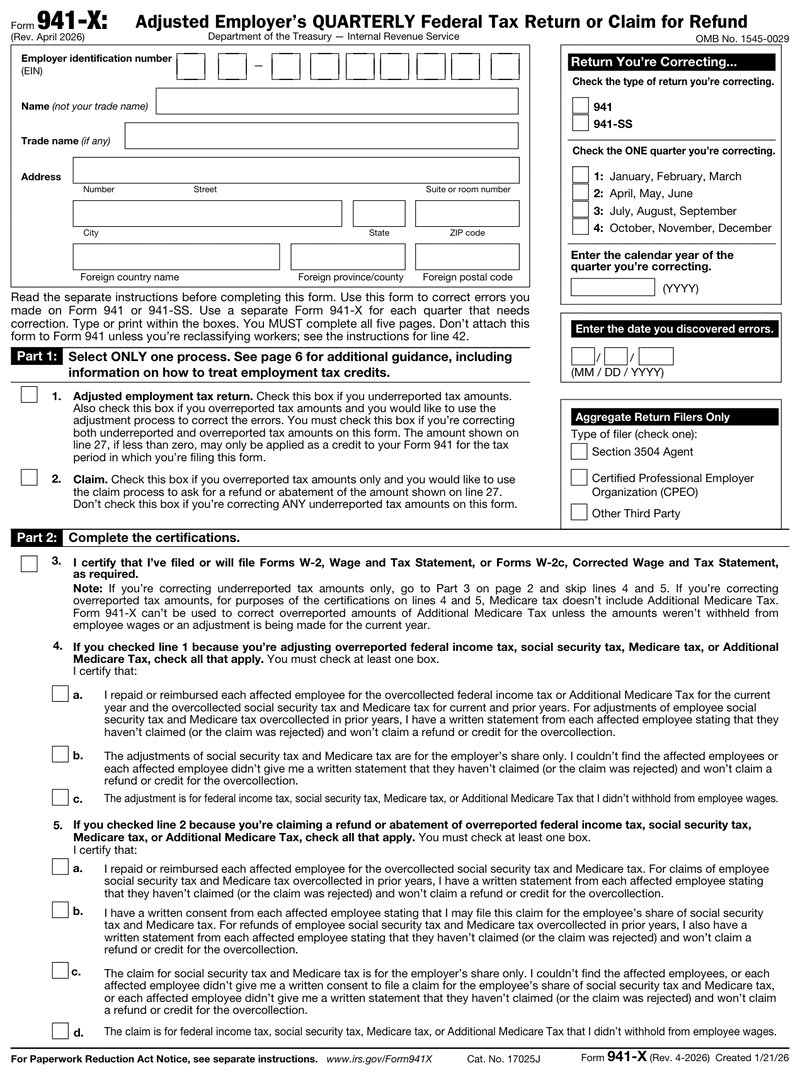
Form 941-X is the Adjusted Employer's Quarterly Federal Tax Return. You use it to correct a Form 941 you already sent in. It doesn't replace that original return. It sits alongside it and reports the difference between what you filed and what was actually true.
You'll see the IRS form 941x written both with and without the hyphen. Same document either way, so you haven't got the wrong one.
The correction covers the numbers from the original quarterly return: the wages you paid, the federal income tax you withheld, and the Social Security and Medicare tax owed on those wages. Each 941-X form applies to a single quarter of a single year.
One thing it is not. It's not a fresh Form 941. You never refile the original return. IRS 941x processing is built to adjust what's already on record, not to start over.
Want the long-form walkthrough instead of the quick version? Our full Form 941-X guide covers each line in detail.
If you filed a Form 941 and later found an error in it, you're the one who files the correction. That holds whether you have one employee or fifty. It holds even when the mistake ran in your favor.
One situation catches people out. If you treated workers as contractors when they should have been employees, you file the late Form 941 for those quarters and attach a 941-X for the correction.
Doing this yourself for the first time is normal. The form is mostly arithmetic you already have, plus an explanation in your own words.
Enter your
information
Preview
your form
Download
your form
The 941-X follows the same limitation window as most corrections: generally within three years of the original 941's filing date (or two years from paying the tax, if later). Underreported amounts are best corrected as soon as they surface - interest runs until paid.
Most of the payroll figures on the original return are correctable, including the FICA taxes. The usual ones:
There are limits worth knowing before you start. You generally can't correct federal income tax withholding from a prior calendar year, unless it was an administrative error, meaning the amount you reported isn't the amount you actually withheld. Rounding differences of a few cents aren't worth a correction either.
If the error is in your deposit schedule rather than your reported figures, that's a Schedule B amendment, not a 941-X.
The form has five parts, and only one of them involves real math. Here's the shape of it.
The header. Your EIN, business name, trade name, and address, plus checkboxes for the quarter and year you're correcting. Check one quarter only. A mismatched EIN is a common rejection reason, so if you can't put your hands on yours, here's how to find your EIN.
Part 1: pick one process. You choose between an adjusted employment tax return and a claim for refund. This is the single choice people get wrong most often. If you underreported and owe money, you file an adjusted return. If you overreported, you get a choice: take it as a credit against the Form 941 for the quarter in which you file the correction (the adjustment process), or ask for a refund or abatement (the claim process). The credit route is faster if you are still running payroll.
Part 2: certifications. These confirm you've repaid or reimbursed your employees where required, or that you have their written consent. Overreported Social Security and Medicare corrections need this because part of that tax came out of employee paychecks.
Part 3: the corrections. Four columns per line: Column 1 is the corrected figure, Column 2 is what you originally reported, Column 3 is the difference, and Column 4 is the tax correction. On the wage lines, Column 4 is Column 3 multiplied by the rate printed on that line, so leaving it blank files a correction that moves no money.
Part 4: Line 43. You explain each correction in plain sentences. Don't skip this or write "correction." Something like "Q2 2026 Social Security wages were understated by $8,400 because a bonus run was omitted from the original filing" is what the IRS wants.
Part 5: sign it. An unsigned correction is treated as never filed.
Run into an edge case your payroll doesn't match? The official Form 941-X instructions cover the unusual situations line by line.
Our 941x generator handles the layout and the column arithmetic, so you're entering your figures rather than lining up boxes on a PDF.
One note on the Employee Retention Credit. The One Big Beautiful Bill Act, signed July 4, 2025, blocked new ERC refund claims for Q3 and Q4 2021 filed after January 31, 2024. On the April 2026 revision, those ERC lines are marked reserved.
This is the part almost nobody explains, and it trips people up because the 941-X mailing address is not the address you used for your Form 941. Deciding where to file 941x returns comes down to one thing: where your business is located.
Below is where to mail Form 941-X based on your state. There's no separate "with payment" address, so this applies either way.
| Your Situation | Mailing Address |
|---|---|
| CT, DE, DC, FL, GA, IL, IN, KY, ME, MD, MA, MI, NH, NJ, NY, NC, OH, PA, RI, SC, TN, VT, VA, WV, WI | Department of the Treasury, Internal Revenue Service, Cincinnati, OH 45999-0005 |
| AL, AK, AZ, AR, CA, CO, HI, ID, IA, KS, LA, MN, MS, MO, MT, NE, NV, NM, ND, OK, OR, SD, TX, UT, WA, WY | Department of the Treasury, Internal Revenue Service, Ogden, UT 84201-0005 |
| No legal residence or principal place of business in any state | Internal Revenue Service, P.O. Box 409101, Ogden, UT 84409 |
| Exempt organizations and federal, state, local, or tribal government entities (any location) | Department of the Treasury, Internal Revenue Service, Ogden, UT 84201-0005 |
That table is where to mail 941-X returns by USPS. If you're sending it by FedEx or UPS instead, you need a different address, because those service center addresses have no street line for a private carrier to deliver to. Use the Ogden Internal Revenue Submission Processing Center, 1973 Rulon White Blvd., Ogden, UT 84201, even if your state would normally file in Cincinnati.
There are two clocks, and which one applies depends on the direction of your error.
| If You | Your Deadline |
|---|---|
| Overreported (you paid too much and want it back) | 3 years from the date you filed the original Form 941, or 2 years from the date you paid the tax, whichever is later |
| Underreported (you owe more) | The due date of the quarter in which you discovered the error |
For underreported amounts, the practical deadlines for 2026 are the regular quarterly due dates:
| Quarter You Discover the Error | Correction Due |
|---|---|
| Q1 2026 | April 30, 2026 |
| Q2 2026 | July 31, 2026 |
| Q3 2026 | November 2, 2026 |
| Q4 2026 | February 1, 2027 |
Correcting an underreported amount by that date, and paying what you owe when you file, is what keeps you out of the failure-to-pay penalty. Overreported corrections don't carry that pressure, but the three-year window is firm, and it closes quietly.
Make sure you're working from the April 2026 revision of IRS Form 941-X. If you saved a blank copy in a previous year, download a current one.
Yes. The IRS accepts Form 941-X electronically through its Modernized e-File system, using an authorized e-file provider. You can still mail a paper copy if you prefer. The advantage of filing electronically is simple: you get a confirmation that it arrived, which paper never gives you.
Interest runs on underreported tax from the original due date of that quarter, not from the date you noticed the problem. That's why finding an error and sitting on it costs more than fixing it.
Penalties are a separate question from interest. The IRS can waive them for reasonable cause, and a voluntary correction you filed on your own initiative is a much better position than a correction you filed after receiving a notice.
If you can't pay the full balance, file the correction anyway. Filing and paying late are two different penalties, and the filing one is the one worth avoiding.
Corrections also ripple into year end, because your four quarterly returns need to agree with your W-3 totals. Clean year-end pay records and accurate W-2 forms keep that reconciliation from turning into a second project.
Every payroll return in the 94X family has its own correction form, and they aren't interchangeable. Using the wrong one is a common and avoidable mistake.
| Form | Corrects | Filed By |
|---|---|---|
| 941-X | Form 941, quarterly | Most employers with employees |
| 943-X | Form 943, annual | Agricultural employers |
| 944-X | Form 944, annual | Very small employers assigned to Form 944 by the IRS |
| 945-X | Form 945, annual | Filers reporting nonpayroll withholding |
| CT-1 X | Form CT-1, annual | Railroad employers |
If you filed a 944 and need to fix it, a 941-X won't work. Match the correction form to the return you actually filed.
Form 940 is the exception to the pattern. Federal unemployment tax has no separate X version, so you amend it by filing a new Form 940 with the amended-return box checked.
There is no annual Form 941-X. Searching for a 2025 or a 2026 version won't turn up two different documents, because one continuous-use form covers every year. The current revision is April 2026, and the IRS states it can be used for all years for which the period of limitations on corrections hasn't expired.
The year in that search is really the year of the quarter you're fixing, not the year of the form. You set it with the checkboxes in the header. A quarter from two years back and a quarter from this year both get corrected on the same April 2026 form, checked to different quarters.
What limits how far back you can reach is the limitations period, not the version. For overreported tax you have 3 years from the date you filed the original Form 941, or 2 years from the date you paid the tax, whichever is later. One wrinkle worth knowing: Forms 941 for a calendar year are treated as filed on April 15 of the following year, so that three-year clock often starts later than the day you actually sent the return. And if you're inside the last 90 days of that window, you must use the claim process instead of the adjustment process.

4.4 out of 5.0 stars on 717 reviews
For most employers, you no longer can. The OBBBA, signed July 4, 2025, blocked new ERC refund claims for Q3 and Q4 2021 filed after January 31, 2024. On the April 2026 revision, the old ERC lines are marked reserved, so there is nowhere left to enter the claim.
Form 941-X goes to one of two IRS centers based on your state: Cincinnati, Ohio for most eastern states, or Ogden, Utah for most western ones. Unlike Form 941, there is no separate payment address, so the same address applies whether or not you enclose a check.
Plan on several months. The IRS processes corrected returns by hand, so a 941-X refund typically runs longer than a regular return, and complex corrections take longer still. Filing electronically and writing a clear Line 43 explanation are the two things that genuinely speed it up.
Yes. Each Form 941-X corrects exactly one quarter of one year. If the same payroll error ran across three quarters, you file three separate corrections, each one checked to its own quarter. Bundling several quarters onto a single form is one of the most common reasons a correction gets rejected.
For 2021 quarters, generally no. The filing window for those claims closed, and the corresponding lines on the current form are reserved. Form 941-X still works normally for every other kind of correction, including wages, withholding, Social Security, and Medicare adjustments.
Fill out our contact form, and we will get back to you as soon as we can!
Contact us
Hi! How can I help you? Kris