Our customer support is available 24/7:

Build your Form 8829 online in a few clicks. Fast, accurate and error free.
Rated 4.4/5 (770+ reviews) 35+ tax forms No subscription required
You've been working out of your spare bedroom all year, and someone mentioned you can write off part of your rent. That write-off lives on Form 8829. The first time you open it, the four parts and the depreciation table make it look like something you need an accountant for.
You don't. The form is mostly arithmetic. Once you know two numbers, your office square footage and your total home square footage, most of it fills itself in, and you can fill it out online in a few minutes.
Plenty of people shouldn't. Freelance designers, real estate agents, Etsy sellers, and rideshare drivers all land here, and the process works the same for every one of them.
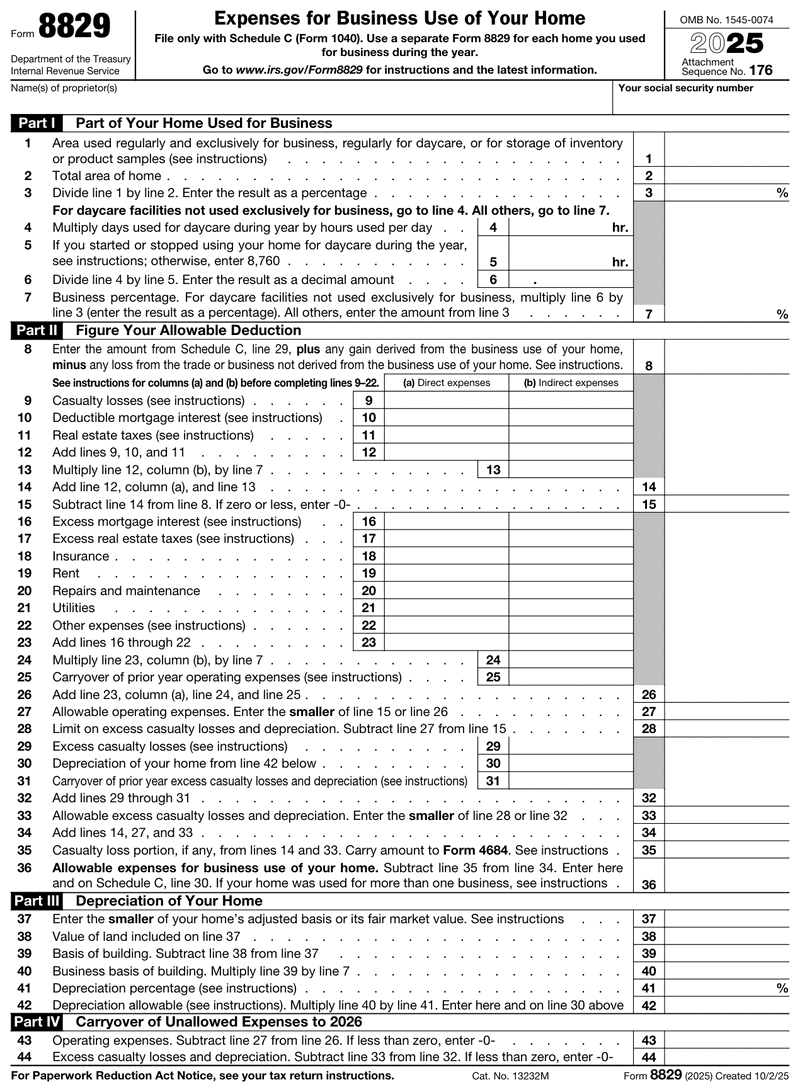
Form 8829, officially titled Expenses for Business Use of Your Home, calculates your home office deduction. Self-employed filers attach it to Schedule C (Form 1040). It converts the part of your home used for business into a percentage, applies that percentage to your home expenses, and carries unused amounts forward.
You'll see it referred to as IRS Form 8829 on tax software menus. Some people call it the business use of home form, which is closer to its actual title. Whatever you call it, the 8829 form does exactly one job, and reporting income isn't part of it.
Here's the whole concept in one example. Say your home office takes up 10% of your floor space. You can generally deduct 10% of your utilities, insurance, and mortgage interest as a business cost. The form is just the structured way the IRS wants you to show that math.
Self-employed people using part of their home regularly and exclusively for business - the form pairs with Schedule C.
It attaches to your Schedule C / Form 1040 and files with them.
A real-world example: A 150 sq ft office in a 1,500 sq ft apartment: 10% of rent and utilities become a business deduction, computed on the 8829.
Enter your
information
Preview
your form
Download
your form
The 8829 follows your Schedule C and 1040: mid-April 2027 for 2026, or October with a 4868 extension.
Only self-employed people who file Schedule C can use Form 8829: freelancers, consultants, real estate agents, e-commerce sellers, and gig drivers. Your space must pass two tests, exclusive use and regular use, meaning that area is used only for business. W-2 employees no longer qualify.
The exclusive use test is where most people get tripped up. "Exclusive" means the space isn't doing double duty. A desk in the corner of your bedroom fails, because the room is also where you sleep. A dining table you clear off every evening fails. A converted closet, a finished attic, or a spare room with a door that holds nothing but your work setup passes.
"Regular" means you use it consistently, not twice a quarter when you're behind on invoices.
Real people who qualify:
The space also generally needs to be your principal place of business, meaning it's where you do your administrative work. A contractor who works on job sites all day but does every invoice, estimate, and tax record from a home office still qualifies.
The simplified method deducts $5 per square foot, up to 300 square feet, capping your deduction at $1,500 with no receipts. The regular method uses your actual costs and usually deducts more if your mortgage interest, utilities, and insurance are high, but it requires records and depreciation.
Read this section before you start filling anything in, because you might not need this form at all. The simplified method is calculated right on Schedule C. If you pick it, you're done, and this form never enters the picture.
| Simplified Method | Regular Method (Form 8829) | |
|---|---|---|
| Rate | $5 per square foot | Your actual home costs |
| Maximum | 300 sq ft, so $1,500 | No cap |
| Receipts | Not needed | Required |
| Depreciation | Not allowed | Allowed |
| Recapture when you sell | None | Yes |
| Unused amounts | Lost | Carry forward |
| Time to complete | Minutes | Longer |
Those figures come straight from the IRS and haven't moved since the simplified option launched in 2013.
How Much Can I Deduct for Business Use of Home?
Say you're a freelance graphic designer with a 200 square foot office in a 1,600 square foot home. That's 12.5% business use.
The simplified method gives you 200 × $5 = $1,000 flat. No receipts, no depreciation schedule.
The regular method gives you 12.5% of everything your home costs: mortgage interest, insurance, utilities, repairs, plus depreciation on the office portion. If your annual housing costs run $24,000, that's roughly $3,000 before depreciation. Triple the deduction, for the price of keeping records.
The honest tradeoff: the simplified method is faster, the regular method is usually worth more. Higher housing costs tilt the answer toward the regular method. You can also switch methods from year to year.
The form has four parts, and they run in a logical order: figure your percentage, apply it, handle depreciation, then park anything you couldn't use. Here's what each one actually does. The official IRS instructions cover the edge cases if your situation gets unusual.
This is the only part where you'll need a tape measure. Enter your office square footage and your total home square footage. Divide the first by the second and you have the number every later calculation depends on.
Measure honestly. Claim a 400 square foot office in a 900 square foot apartment and you're saying 44% of your home is exclusively business. That's the kind of figure that invites questions.
Daycare providers get an exception here. They can count space used for both business and family, adjusted by the hours it's in service. The exclusive use test doesn't fit that business model.
This is the heart of the 8829 instructions. Your direct and indirect expenses go here, each treated differently (the next section explains the split).
Part II also enforces the gross income limit. Your home office deduction can't create or deepen a business loss. If your Schedule C profit is $2,000 and your calculated home office deduction is $3,200, you deduct $2,000 this year. The other $1,200 isn't gone, it moves to Part IV.
Depreciation covers the wear and tear on the business portion of your home. You'll need your home's adjusted basis and its fair market value when you started using it for business. You'll also need the value of the land, which gets excluded since land doesn't depreciate.
The result flows back up into Part II.
Worth knowing before you claim it: depreciation gets recaptured when you sell your home. You'll owe tax on the depreciation you took. It's still usually worth claiming, but it isn't free money, and it's the single biggest reason some filers choose the simplified method instead.
Remember that $1,200 the gross income limit blocked? Part IV is where it goes. It carries forward to next year, when a more profitable year can absorb it.
This is a genuine advantage over the simplified method, where anything above the income limit simply disappears. If your business income swings year to year, that difference adds up.
The form splits your costs into two buckets, and mixing them up is the most common error on this form.
Direct expenses apply only to the office itself. Repainting the office, repairing its window, a dedicated business phone line. These come off in full, at 100%.
Indirect expenses apply to the whole house and get shared. Mortgage interest, rent, homeowners insurance, electricity, water, general repairs. These are deducted at your business use percentage.
The sorting rule: ask whether you'd still have paid the expense if you didn't have a home office. If yes, it's indirect. Your electric bill exists either way, so it's indirect. Painting the office wouldn't have happened otherwise, so it's direct.
The expensive mistake is deducting an indirect cost at full value. Think writing off your entire mortgage interest instead of the 12.5% share your office earns. That inflates your deduction and it's easy to spot.
On Form 8829 you can claim mortgage interest or rent, real estate taxes, homeowners or renters insurance, utilities, repairs, maintenance, security systems, and HOA fees. Whole-home costs are deducted at your business-use percentage, while office-only costs are deducted in full. Lawn care generally does not qualify.
What belongs on the form:
What doesn't:
People searching for home based business tax deductions usually mean exactly this list. Note what this is: an expenses form tied specifically to your home. It isn't a general business expense form. Your laptop, software, mileage, and supplies are real deductions, but they go directly on Schedule C, not here. Our guide to 1099 tax deductions covers that side.
No. W-2 employees cannot claim the home office deduction, even if your employer requires remote work. The One Big Beautiful Bill made that suspension permanent rather than temporary. Narrow exceptions exist for qualified performing artists, fee-basis government officials, and impairment-related expenses. Some states still allow it on state returns.
This deserves its own section because it's the most common wasted afternoon in home office tax questions. Employees lost this deduction starting in 2018, when unreimbursed employee expenses were suspended. If you're an employee, your W-2 is where your income gets reported, not Schedule C. Many people assumed the suspension would lapse. It won't. Recent legislation made it permanent, so there's no future year to wait for.
Two things still worth doing:
One more source of confusion. If your employer asked you to sign a home office form, that's an internal company record. It confirms your remote setup, equipment, or safety compliance. It has no tax effect and has nothing to do with the IRS document on this page.
Not every self-employed business owner uses this particular form. Your business structure decides where the deduction goes.
Partners in a partnership don't file it. If your partnership agreement requires you to cover your own office costs, those unreimbursed partnership expenses flow through Schedule E instead, alongside the Schedule K-1 your partnership issues you.
Farmers filing Schedule F use the worksheet in IRS Publication 587 instead, even though the underlying calculation is nearly identical.
S-corp owners are technically employees of their own corporation, which means the employee rules above apply to them. The standard route is an accountable plan: the corporation reimburses you for the home office, deducts it, and the reimbursement isn't taxable income to you.
Single-member LLC owners taxed as sole proprietors file Schedule C, so the form works normally.
If you're in the S-corp or partnership category, a short conversation with a tax professional usually pays for itself. The setup matters more than the arithmetic.
Gather four things before you start and this takes minutes:
From there, the 8829 generator takes on the arithmetic that causes most errors: turning your two measurements into a business use percentage, keeping direct expenses at full value while indirect ones get that percentage applied, and checking your total against the gross income limit. Whatever that limit blocks is what belongs in Part IV, so hold onto the number for next year's return.
Then review, download, and attach it to your Schedule C when you file.
Ready to skip the manual math? Start with the 8829 generator on this page and work from your two measurements.
Here's what experience shows: when a home office deduction gets questioned, it's almost never the arithmetic. It's whether the space really qualifies. Your percentage is easy to defend. "Exclusive use" is a claim about a room you'll need to describe years later.
So document it now, while it's true:
Five minutes of work today, filed alongside your return, is worth more than any argument you can reconstruct three years from now.
You can download the blank Form 8829 PDF directly from the IRS. Searching for IRS forms 8829 instructions brings you to the matching instruction booklet on the same site.
Two things to check before you fill anything in. Make sure the tax form 8829 you downloaded matches the year you're filing. The current revision is the 2025 form, and the IRS posted instruction updates in March 2026. Watch out for third-party sites hosting outdated copies; several still link to instructions from several years back.
Or skip the blank PDF and let the generator fill it in for you.
Form 8829 gets reissued every year, so the year printed at the top of the form has to match the tax year you are reporting. A 2025 return needs the 2025 form, not whichever revision the IRS has posted most recently. Searches for "form 8829 2025" and "form 8829 2026" are asking for two genuinely different documents, and pulling the wrong one is the easiest way to redo an afternoon of work.
The due date is not really the form's own. Form 8829 only travels attached to Schedule C, so it goes in when your Form 1040 goes in.
| Tax year you are reporting | Form and Schedule C due | If you extend with Form 4868 |
|---|---|---|
| 2025 | April 15, 2026 | October 15, 2026 |
| 2026 | April 15, 2027 | October 15, 2027 |
One figure does move between the two years, and it lands on line 11. The real estate taxes you carry into the form are limited first by the state and local tax cap, before your business percentage touches them: $40,000 for 2025 ($20,000 if you are married filing separately), and $40,400 for 2026 ($20,200 MFS). The 2026 amount shrinks if your modified AGI passes $505,000 ($252,500 MFS), though it never drops below $10,000 ($5,000 MFS). Everything else looks familiar: the 2026 draft keeps the same Part I and Part II line structure.

4.4 out of 5.0 stars on 717 reviews
Form 8829 is used to figure the allowable expenses for business use of your home on Schedule C. It also handles any carryover to next year of amounts you could not deduct. The form covers the calculation only, it does not report income and is never filed by itself.
No. The simplified method is calculated directly on Schedule C, so you skip the form entirely. You give up depreciation and cannot carry unused amounts forward, but you also avoid tracking receipts. You may switch methods from year to year as your costs change.
Download the official Form 8829 PDF from irs.gov/pub/irs-pdf/f8829.pdf and the instructions from irs.gov/instructions/i8829. The current revision is the 2025 form, and the IRS posted instruction updates in March 2026. Always match the form year to the tax year you are filing.
No. Form 8829 flows to Schedule C, which W-2 employees do not file. Employees lost the unreimbursed home office deduction in 2018, and that change is now permanent. If your employer requires a home office, ask about an expense reimbursement or stipend instead.
A home office form from your employer is an internal record, often confirming your remote work setup, equipment, or safety compliance. It stays with your company and has no tax effect. Form 8829 is an IRS tax form that calculates a deduction on your self-employed return.
Fill out our contact form, and we will get back to you as soon as we can!
Contact us
Hi! How can I help you? Kris