Our customer support is available 24/7:

A simple way to create your 941 form online. Generate, print and use.
Rated 4.4/5 (770+ reviews) 35+ tax forms No subscription required
If you have employees and you just realized you are responsible for the 941 form, take a breath. This is one of those tax forms that looks intimidating and turns out to be mostly arithmetic you already have sitting in your payroll records. You are reporting what you paid your team last quarter and what you withheld from their checks, and if you keep consistent pay stub templates for your team, those totals are largely done already.
The 941 form, officially the Employer's Quarterly Federal Tax Return, is how you tell the IRS three things every three months: how much you paid your employees, how much federal income tax you withheld from them, and how much Social Security and Medicare tax is owed on those wages.
You will see it called a few different things. IRS Form 941, the 941 tax form, tax form 941, or just IRS 941 all refer to this same quarterly return, so do not worry that you are looking at the wrong document.
Because Social Security and Medicare are split between you and your employee, the 941 tax form covers both halves. You withhold the employee's share from their paycheck, you match it out of your own pocket, and the form reconciles the total against what you already deposited with the IRS during the quarter.
It is worth knowing what IRS Form 941 is not. It is not your business income tax return, and it has nothing to do with unemployment tax. Unemployment goes on Form 940. If you have ever wondered what FUTA actually means on your payroll reports, that is the other form entirely.
Most employers who withhold income tax, Social Security or Medicare from wages - quarterly, whether or not wages were paid that quarter (until the IRS says otherwise).
The IRS. Keep a copy with your payroll records for each quarter.
A real-world example: Five employees, a normal quarter of payroll: the 941 reports roughly $60,000 of wages, the income tax you withheld, and the FICA both sides owe - reconciled against your deposits.
Enter your
information
Preview
your form
Download
your form
| What | When | Worth knowing |
|---|---|---|
| Q1 return (January - March) | April 30 | File every quarter once you start - even one with no wages |
| Q2 return (April - June) | July 31 | Deposits run on their own schedule; the return reports them |
| Q3 return (July - September) | October 31 | Semiweekly depositors attach Schedule B |
| Q4 return (October - December) | January 31, 2027 | Ten extra days if all deposits were made on time |
Dates falling on a weekend or legal holiday shift to the next business day.
If you pay wages and withhold federal income tax, Social Security, or Medicare from your employees, you file Form 941 every quarter. That applies even if you only have one employee, and even for a quarter where you paid nothing, unless the IRS has moved you to the annual Form 944.
A few situations work differently. Household employers report household employee wages on Schedule H with their personal return instead. Farm employers use Form 943. And very small employers whose annual payroll tax liability runs under $1,000 may be assigned Form 944, which is filed once a year rather than four times. The IRS tells you in writing if you belong in that group, so do not switch on your own.
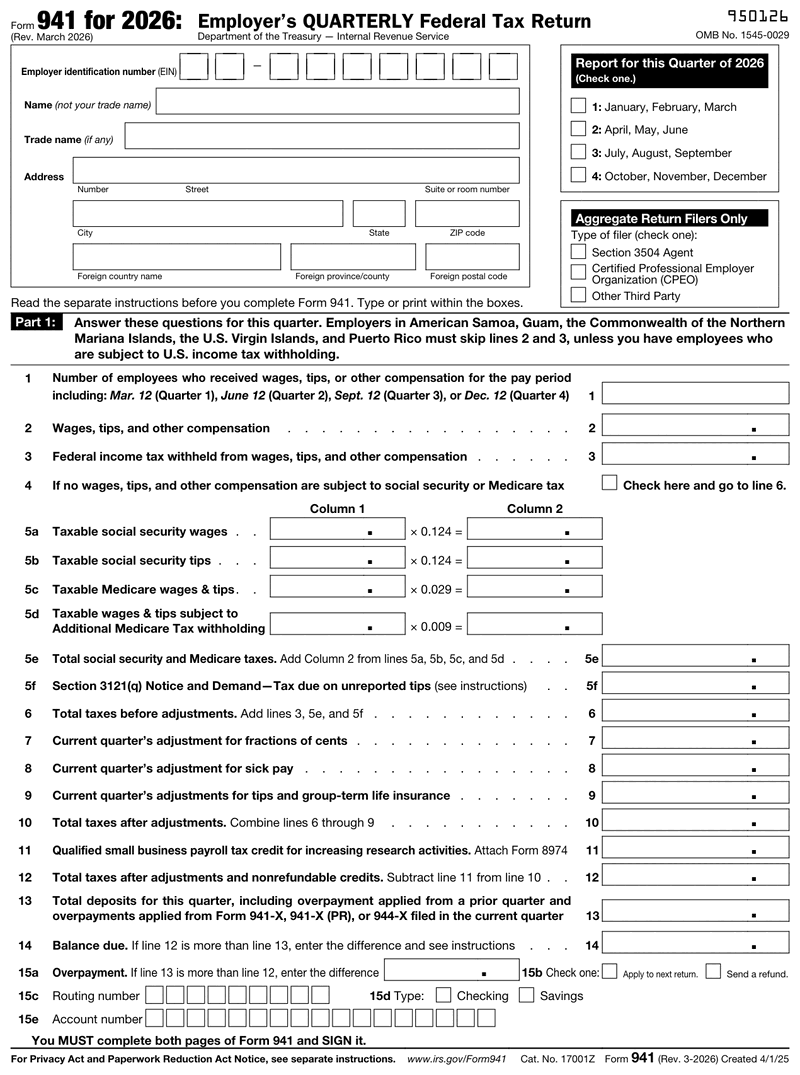
The official form 941 instructions run long, but the form itself has five parts and only Part 1 involves real math. You do not need to read the full 941 instructions cover to cover to get this right.
The header. Your EIN, business name, trade name, and address, plus a checkbox for which quarter you are reporting. Getting the EIN right matters more than people expect, since a mismatch here is a common reason returns get rejected. If you cannot find yours, here is how to track down your EIN.
Part 1, lines 1 through 15. This is the heart of it.
Part 2. Your deposit schedule and, for semiweekly depositors, your tax liability by period.
Part 3. Only applies if your business closed or you stopped paying wages, or if you are a seasonal employer who will not file every quarter.
Part 4. Whether you are authorizing a third party, such as your accountant, to talk to the IRS about this return.
Part 5. Sign it. An unsigned return is treated as unfiled, which is a frustrating way to earn a penalty.
Note that the current version is the March 2026 revision, so if you saved a blank copy from a prior year, download a fresh one rather than filing an outdated form.
For 941 form 2026 filings, these are the numbers that drive Part 1:
| Tax | Employee | Employer | Applies To |
|---|---|---|---|
| Social Security | 6.2% | 6.2% | Wages up to $184,500 |
| Medicare | 1.45% | 1.45% | All wages, no cap |
| Additional Medicare | 0.9% | none | Wages above $200,000 |
The Social Security wage base rose to $184,500 for 2026, up from $176,100 in 2025, per the Social Security Administration. Once an employee crosses that number, you stop withholding Social Security on the rest of their pay for the year, though Medicare tax keeps applying with no ceiling. The Additional Medicare Tax is withheld from the employee only, and you do not match it. The capped figure you report on line 5a is also what lands in the Social Security wages box on each W-2 at year end, so the two should agree.
You only attach Schedule B if you are a semiweekly depositor, or if you accumulated $100,000 or more in tax liability on any single day. Schedule B is a daily record of what you owed, not extra tax. Monthly depositors skip it entirely and report their totals on Form 941.
Its full name is Schedule B (Form 941), and you will see it written both ways: form 941 schedule b in some places, schedule b form 941 in others. It is the same single attachment either way. What trips people up is that the 941 schedule b looks like it is asking for more money. It is not. You are recording what your tax liability was on each specific day of the quarter, so the IRS can confirm your deposits landed on the schedule they were supposed to. The three columns correspond to the three months of the quarter, and the total at the bottom of Schedule B must match line 12 of your 941 exactly. If those two numbers disagree, the return will come back.
Your deposit schedule is not something you choose, and it is not based on how often you run payroll. It is set by a lookback period: the four quarters ending June 30 of the prior year.
There is one override worth memorizing. If you ever accumulate $100,000 or more in tax liability on any single day, the deposit is due the next business day, regardless of which schedule you are normally on, and you become a semiweekly depositor for the rest of the year and the following year. Growing businesses run into this rule after a big bonus payout and do not see it coming.
Your 941 form is due the last day of the month after each quarter closes:
| Quarter | Period Covered | Due Date |
|---|---|---|
| Q1 | January to March | April 30 |
| Q2 | April to June | July 31 |
| Q3 | July to September | October 31 |
| Q4 | October to December | January 31 |
If a due date falls on a weekend or federal holiday, you get the next business day. And if you made all your deposits in full and on time for the quarter, the IRS gives you an extra 10 days to file.
This is the question that sends people in circles, because your form 941 mailing address depends on two things: your state, and whether you are enclosing a payment. Every return with a payment goes to the same Louisville address. Where to mail 941 without payment depends on your state: those returns split between Kansas City and Ogden.
| Your State | Without Payment | With Payment |
|---|---|---|
| CT, DE, DC, GA, IL, IN, KY, ME, MD, MA, MI, NH, NJ, NY, NC, OH, PA, RI, SC, TN, VT, VA, WV, WI | Department of the Treasury, Internal Revenue Service, Kansas City, MO 64999-0005 | Internal Revenue Service, P.O. Box 932100, Louisville, KY 40293-2100 |
| AL, AK, AZ, AR, CA, CO, FL, HI, ID, IA, KS, LA, MN, MS, MO, MT, NE, NV, NM, ND, OK, OR, SD, TX, UT, WA, WY | Department of the Treasury, Internal Revenue Service, Ogden, UT 84201-0005 | Internal Revenue Service, P.O. Box 932100, Louisville, KY 40293-2100 |
| No U.S. place of business, plus American Samoa, Guam, CNMI, USVI, Puerto Rico | Internal Revenue Service, PO Box 409101, Ogden, UT 84409 | Internal Revenue Service, P.O. Box 932100, Louisville, KY 40293-2100 |
Two notes on where to mail 941 returns. Exempt organizations, governmental entities, and Indian tribal governmental entities use the Ogden address regardless of state. And these addresses do change, so confirm on the IRS Where to File page for Form 941 before you send anything, especially if you are working from a guide written in an earlier year.
You do not have to mail it at all. You can file 941 online through the IRS e-file system, either through a payroll provider or an authorized e-file provider. Filing the 941 form electronically gives you a confirmation that the return arrived, which paper never does.
Payments work separately from the return. Deposits go through EFTPS, the Electronic Federal Tax Payment System, or IRS Direct Pay for Businesses. Enrolling in EFTPS takes a few days because they mail you a PIN, so do not leave it until the day a deposit is due.
Three similar-looking numbers, three different jobs:
| Form | Who Files | Reports | Frequency |
|---|---|---|---|
| 941 | Most employers with employees | Income tax withheld, Social Security, Medicare | Quarterly |
| 940 | Employers subject to FUTA | Federal unemployment tax | Annually |
| 944 | Very small employers, by IRS assignment | Same taxes as 941 | Annually |
Unemployment tax is separate again at the state level, which is where SUI tax comes in.
When a 941 form gets kicked back, the reason is usually line 12 and line 13 not agreeing with reality. Line 12 is what you owed. Line 13 is what you actually deposited. The IRS already has its own record of every deposit you made, so if your line 13 does not match their ledger, the return stops.
Before you file, pull your deposit confirmations for the quarter and add them up by hand. Do not copy the number from memory or from an estimate. If there is a genuine gap, it is better to report it accurately and pay the balance on line 14 than to make the numbers look tidy.
The same logic applies at year end, when the IRS matches your four quarterly returns against your annual Form W-3. Those four 941s should sum to your W-3 totals. Keeping clean year-end pay records through the year makes that reconciliation a five-minute job instead of a scavenger hunt.
If you do find an error after filing, you do not redo the 941. You correct it with Form 941-X, which is built specifically for adjusting a return you already sent.
Searching "941 form 2026" lands you on the right document: the form face reads "Form 941 for 2026 (Rev. March 2026)", with a checkbox for the quarter you are reporting. Use the March 2026 revision for the first quarter of 2026, and the IRS expects that same revision to also be used for the second, third and fourth quarters of 2026. Don't use an earlier revision to report taxes for 2026.
Where the year framing breaks down is the deadline. There is no single 2026 due date, there are four, and one does not land where you would guess:
| Quarter reported | Due date |
|---|---|
| Q4 2025 | February 2, 2026 |
| Q1 2026 | April 30, 2026 |
| Q2 2026 | July 31, 2026 |
| Q3 2026 | November 2, 2026 |
| Q4 2026 | February 1, 2027 |
October 31, 2026 falls on a Saturday, which is why the third quarter rolls to November 2. No extension exists for Form 941. If all your deposits were timely and in full, you may file by the 10th day of the 2nd month after quarter end (May 10, August 10, November 10, February 10), but May 10, 2026 is a Sunday, so file by the preceding business day, not on an assumed roll.

4.4 out of 5.0 stars on 717 reviews
The IRS charges 5% of the unpaid tax for each month the return is late, up to 25%. Late deposits carry their own separate penalty. If you cannot pay the full amount, still file on time, because the failure-to-file penalty is the more expensive one.
Yes, in most cases. Once you are registered as a 941 filer, the IRS expects a return every quarter, even a zero return. You can stop only if you file a final return and check the box saying you have closed your business or stopped paying wages.
Returns without a payment go to Kansas City, Missouri, or Ogden, Utah, depending on your state. The Louisville, Kentucky address is only for returns that include a payment.
Yes. If your payroll is straightforward and your records are accurate, the form is mostly transferring quarterly totals. An accountant is worth it once you have multiple pay rates, tipped employees, or you have fallen behind on deposits.
Form 941 reports your quarterly totals. Schedule B breaks your tax liability down day by day and is only required for semiweekly depositors, or after a single day of $100,000 or more in liability. Schedule B does not add tax, it just shows timing.
Fill out our contact form, and we will get back to you as soon as we can!
Contact us
Hi! How can I help you? Kris