Our customer support is available 24/7:

Make your Schedule F in minutes. Simple to use, accurate and ready to download.
Rated 4.4/5 (770+ reviews) 35+ tax forms No subscription required
If you sold grain, livestock, or produce this year, Schedule F is the form that tells the IRS how your farm actually did. You can fill it in online at PayStubCreator.net instead of wrestling a blank PDF. It's the one page where your sales, your feed bills, your fuel, and your repairs come together into a single profit or loss number. Here's what the form covers, whether you have to file one, and how to fill it out without hiring anyone.
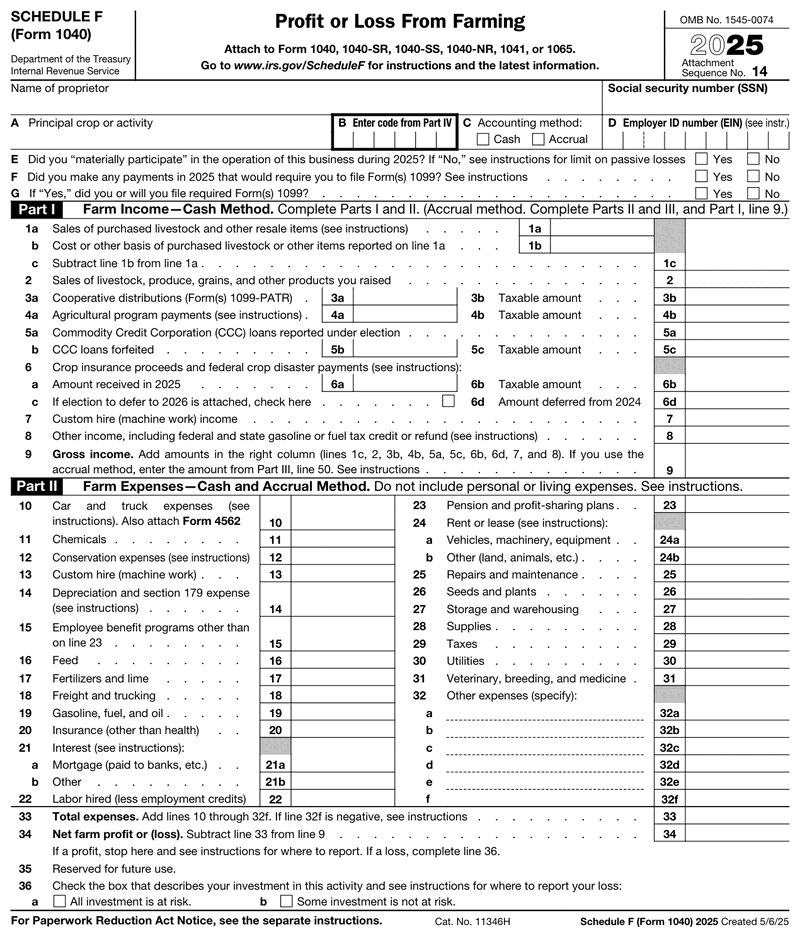
Schedule F (Form 1040) is the IRS tax form for reporting profit or loss from farming. You list your farm income in Part I and your farm expenses in Part II, then carry the net result to your Form 1040. Most farmers also attach Schedule SE for self-employment tax.
Think of it as a profit and loss statement where the IRS picked the categories, attached to your personal return rather than filed on its own. That self-employment tax on Schedule SE is the same Social Security and Medicare pairing an employer would withhold as FICA, except you cover both halves yourself.
You'll see the form written a few different ways online. Sch F, sch.f, form f, and 1040 Schedule F all point to the same tax document. What is a Schedule F in practice? One page, two main parts, and a lot of lines most small farms never touch.
You file a Schedule F, the farm tax form the IRS expects from growers and ranchers, if you run a farming business as a sole proprietor: growing crops, raising livestock, running a dairy, or keeping bees commercially. It applies whether the farm turned a profit or lost money. Fishing income is different and belongs on Schedule C instead.
A few real examples: a grain farmer selling corn, a rancher selling cattle, a landowner taking a share of the crop instead of cash rent, or a beekeeper selling honey at scale. Size doesn't decide it. A few acres and a roadside stand can still be a farming operation to the IRS.
Enter your
information
Preview
your form
Download
your form
Schedule F follows your 1040: mid-April 2027 for 2026, or October with a 4868 extension. Farmers who skip estimated payments have a special early-March filing option under IRS rules.
Settle this before you fill anything out. The form is for businesses, and the IRS looks at whether you're genuinely trying to make a profit. It weighs practical evidence: whether you keep books, how you market what you produce, the time you put in, and whether the operation has ever turned a profit.
If it's a hobby, you don't file this form. You still report the income, but hobby expenses generally can't be deducted against it, so the distinction costs real money. Borderline cases (a few animals, a small orchard, a side plot) are where a tax professional earns their fee.
Pull these together first and the form takes minutes:
Plenty of farm sales never generate a form at all. Roadside stands, farmers markets, and cash sales to neighbors rarely come with paperwork, and you still report them, the same way you'd report freelance income without a 1099.
One habit makes farm taxes far less painful. Keep a running log during the year in the same categories the form asks for, and photograph receipts the day you get them. Sorting a shoebox in April is where deductions quietly disappear.
The Schedule F form is one page split into two working parts, plus a header for your name, farming activity, and accounting method. Fill the header out first; the accounting method you check there changes how you count everything below it.
Everything the farm brought in: sales of livestock, grain, and produce you raised, cooperative distributions, agricultural program payments, Commodity Credit Corporation (CCC) loans you report as income, and crop insurance proceeds.
Your accounting method matters here. Most small farms use the cash method, so income counts when the money lands and expenses count when you pay them. Accrual counts them when earned or incurred instead.
The IRS lists more than two dozen expense lines. They sort into four groups:
Subtract Part II from Part I and you have your net farm profit or loss. For the official line-by-line detail, the Schedule F instructions point to IRS Publication 225, the Farmer's Tax Guide.
The 1040 Schedule F covers farming. Schedule C covers other self-employment, including fishing.
Here's the line that trips up small sellers: if you grow or raise what you sell, that's farming. If you buy produce wholesale and resell it at a market stand, that's retail, and it goes on Schedule C. Pure cash rent on farmland you don't operate isn't Schedule F either; that's Schedule E or Form 4835 territory.
Both the Schedule F form 1040 and Schedule C feed into Form 1040, and both can pull you into Schedule SE. If the farm is a partnership rather than a sole proprietorship, the income reaches you on a Schedule K-1 instead.
Schedule F goes in with your Form 1040, so the usual April 15 deadline applies (April 15, 2027 for the 2026 tax year).
If farming income was at least two-thirds of your gross income in the current or prior year, you can skip estimated tax payments entirely by filing your return and paying everything due by March 1. Miss that, and the fallback is a single estimated payment by January 15.
Leaving farm income off the return rarely stays quiet. Co-ops and buyers report payments to the IRS, and the cost of not filing keeps building as interest and penalties stack up. It's e-filed or mailed with your 1040, to the address listed for your state.
A blank IRS PDF gives you lines, codes, and no signal about whether you've missed something. A Schedule F generator walks you through the same fields in plain language, handles the arithmetic between Part I and Part II, and hands you a clean copy to file or pass to your preparer.
It also solves a small problem that trips people up: using the right year's template. The IRS revises the schedule most years, and stale versions float around search results long afterward. Confirm you're on the current tax year version before you start.
You can fill yours out online and download a copy when you're done, then hand it straight to whoever prepares your return.
Schedule F is reissued every year, so "Schedule F 2025" and "Schedule F 2026" really are two different documents. Pull the one matching the tax year you are reporting, not the year you happen to be filing in.
Nothing farm-specific and material changed between them. What moves is the pricing you plug into Part II, and the March date that lets you skip estimated payments.
| 2025 tax year | 2026 tax year | |
|---|---|---|
| Due with your Form 1040 | April 15, 2026 | April 15, 2027 |
| Farmer safe harbor (file and pay in full) | March 2, 2026 | March 1, 2027 |
| Extended deadline via Form 4868 | October 15, 2026 | October 15, 2027 |
| Business mileage for farm vehicles | 70 cents | 72.5 cents through June 30, 2026, then 76 cents from July 1, 2026 |
March 1, 2026 is a Sunday, which is why the 2025 safe harbor sits on March 2. March 1, 2027 is a Monday and does not roll, though the 2026 Schedule F instructions are not published yet, so treat that one as calendar math rather than a printed IRS date.
One trap worth knowing before you pick a year: taking the October extension forfeits the March safe harbor. If farming is at least two-thirds of your gross income and you want to skip estimated payments, you have to be finished in early March, not October.

4.4 out of 5.0 stars on 717 reviews
A Schedule F tax form is the IRS schedule farmers attach to Form 1040 to report farm income and expenses. On a tax return it works as the farming equivalent of Schedule C, and its net profit or loss flows into your total income.
Yes. A loss still gets reported, and it may reduce your other taxable income for the year. Skipping the form because there was no profit is a common mistake. Filing also creates the record you will want if the IRS later questions whether your farm is a business.
Schedule F is due with your Form 1040, normally April 15 of the following year. If farming was at least two-thirds of your gross income, you can skip estimated payments by filing and paying everything by March 1 instead. If March 1 lands on a weekend, you get the next business day.
Schedule F covers farming: crops, livestock, dairy, and similar operations. Schedule C covers other self-employment, including fishing. If you buy produce to resell rather than growing or raising it, that is usually retail activity on Schedule C, not farming.
Leaving out farm income understates your return, and the IRS can add interest plus penalties that grow the longer it goes unfixed. Because buyers and co-ops report payments to the IRS, unreported sales tend to surface. If you already missed it, amending is cheaper than waiting.
Fill out our contact form, and we will get back to you as soon as we can!
Contact us
Hi! How can I help you? Kris