Our customer support is available 24/7:

Create your 1099-C online in minutes. Accurate, print ready and hassle free.
Rated 4.4/5 (770+ reviews) 35+ tax forms No subscription required
Opening the mail to find a 1099 C form for a debt you thought was finished is unsettling. Maybe you settled a credit card years ago and moved on. Here's the reassuring part: it isn't a bill, and the debt hasn't come back. It's a tax document, and plenty of people who receive one owe far less than the number printed on it.
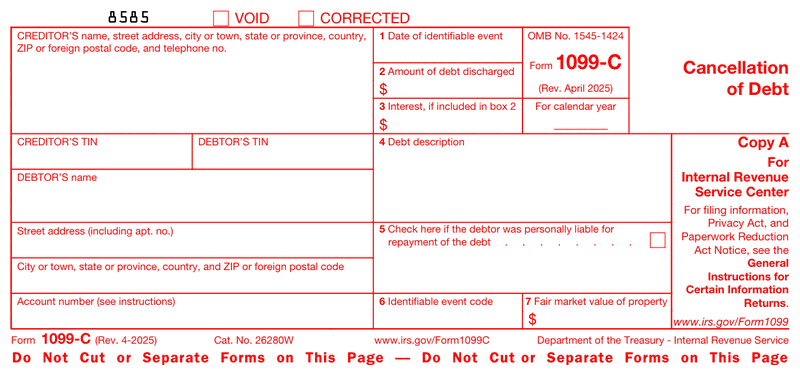
A 1099 C form, officially Form 1099-C Cancellation of Debt, is an IRS information form. A lender sends it when it forgives or writes off $600 or more of debt you owed. You receive Copy B, and the IRS receives its own copy. It reports canceled debt, not a bill.
That's the 1099c meaning in plain terms. Someone you owed money to gave up on collecting, and the tax code treats that forgiven balance as a gain for you. The official title printed on the document is Cancellation of Debt, which describes exactly what happened.
The form gets written a dozen different ways, and the version on your paperwork may not match the one you typed into Google. Searches for what is a 1099c, what is a 1099-c, and what is a 1099 c all lead to the same IRS document, so a moved hyphen is nothing to worry about. Its job is simple. It records debt cancellation so the IRS knows about it, and so you can report it correctly on your return.
Lenders, financial institutions and certain other creditors that canceled $600 or more of a borrower's debt.
The borrower whose debt was canceled - the amount usually belongs on their 1040 as income.
A real-world example: You settled a customer's $4,000 outstanding balance for $1,500 and wrote off the rest. The $2,500 you forgave is a 1099-C event.
Enter your
information
Preview
your form
Download
your form
Recipient copies are due by January 31, 2027; the IRS copy follows on the information-return schedule.
Most people who receive one fall into a handful of situations. You settled a credit card for less than the full balance. You went through a foreclosure or a repossession. A lender formally gave up on collecting and closed the account out. Or a student loan balance was forgiven.
Debt settlement companies are another common trigger. If you're wondering what is Freedom Debt Relief, or you worked with a similar service, these companies negotiate reduced payoffs with your creditors. That negotiated write-off is exactly the kind of event that generates this paperwork.
None of these mean you did anything wrong. Debt cancellation is ordinary, and the form is just paperwork catching up with something that already happened.
Usually, no. Most 1099-C forms report a debt the creditor actually wrote off, and that balance is gone. But the IRS also requires the form when an identifiable event has occurred that is only deemed to be a discharge, and in that case the debt may still exist. Check box 6, and if a collector contacts you after the form arrives, get written confirmation from the creditor that the balance was actually discharged. However, the IRS generally treats the forgiven amount as taxable income, which you report on Schedule 1 of Form 1040 unless an exclusion applies.
The creditor closed the account and reported the balance as forgiven. They can't turn around and demand payment on that same canceled amount.
What replaces the debt is a tax question, and it's usually much smaller. If a $10,000 balance was wiped out and you're in the 22% bracket, you're looking at roughly $2,200 in tax rather than $10,000. Plenty of people who receive this form owe nothing at all, thanks to the exclusions in the next section.
Insolvency means your total debts exceeded your total assets immediately before the debt was canceled. Subtract what you own from what you owe to find the amount. File IRS Form 982 with your return to exclude canceled debt up to that insolvency amount, which can reduce or erase the tax.
This is the exclusion most people miss, and it's the reason this form doesn't always produce a tax bill.
Here's the math in plain English. Add up everything you owed the day before the cancellation: credit cards, car loans, mortgage, medical bills. Then add up everything you owned: cash, bank accounts, your car, your home at its full market value, retirement accounts. Enter the home's market value, not your equity. The mortgage is already on the debt side, so using equity subtracts it twice. Subtract what you own from what you owe. If the result is positive, you were insolvent by that amount.
Say you owed $60,000 and owned $45,000 worth of assets. You were insolvent by $15,000. If $10,000 of debt was then canceled, the entire amount sits inside your insolvency figure and you can exclude all of it. If $20,000 was canceled, you'd exclude $15,000 and report the remaining $5,000.
You claim it by filing Form 982 with your return and checking the insolvency box. People searching how to avoid paying taxes on debt settlement land here for exactly this. It isn't a loophole, it's a rule for people who were genuinely underwater.
Debt discharged in bankruptcy works similarly. So does qualified principal residence debt on your main home, though that one carries a caveat: the instructions in force describe it as scheduled to expire, and they predate the most recent tax law, so confirm it still applies to your year before you rely on it.
One warning worth taking seriously: keep the worksheet you used, with the figures and the date. The IRS can ask you to support an insolvency claim, and rebuilding those numbers years later is miserable.
You never file this one yourself. Form 1099-C is filed by the creditor: banks, credit unions, credit card issuers, federal agencies, and organizations whose significant trade is lending money. So if the form landed in your mailbox, there's nothing here for you to submit. If you are the creditor, you are the one who has to issue it, and our 1099-C generator lays out every box and gives you a print-ready copy in minutes.
The $600 rule sets the threshold. If less than $600 was canceled, the creditor generally isn't required to file, though the forgiven amount can still count as income.
For debts canceled during 2025, your copy was due by February 2, 2026, and the creditor files the IRS copy by March 2, 2026 on paper or March 31, 2026 electronically. Those dates move each year when the statutory date lands on a weekend. If you know a debt was settled and nothing arrived, don't assume you're off the hook. Ask the creditor, and check the IRS guidance on About Form 1099-C.
Start by reading the boxes, because they tell you almost everything.
Box 1 is the date of cancellation, which sets the tax year the income belongs to. Box 2 is the amount of debt discharged, and that's the figure that matters most. Box 3 shows any interest included in that total. Box 6 is the identifiable event code. That single letter explains why the form was issued, such as a settlement agreement or a lender's decision to stop collecting.
If no exclusion applies, the Box 2 amount goes on Schedule 1 of your Form 1040 as other income. If you're claiming insolvency or bankruptcy, you'll attach Form 982 and exclude the amount there instead. The IRS lays out the exclusion rules on About Form 982.
Most tax software walks you through a 1099-c form once you enter the box figures.
Errors do happen. The amount may be inflated, the year may be wrong, or the form may cover a debt you actually paid in full. Contact the creditor first and request a corrected version. Don't simply leave the amount off your return while you wait, since the IRS copy is already on file. Report it, then amend if the correction arrives later.
Searching for a "1099-C form 2025" or a "1099-C form 2026" turns up the same document, because there is no annual edition of this form. The current revision is April 2025, and the IRS instructions say plainly: "Use these instructions for tax year 2025 and subsequent years until a superseding revision is issued." The $600 threshold, the boxes and the deadline rules are unchanged between the two years; only the calendar dates shift, and only because of weekend rolls. So the year in your search refers to the tax year of the cancellation, not to a different piece of paper.
What decides your tax year is when the debt was canceled, not when the form reaches you. A debt canceled in 2025 belongs on your 2025 return, and your copy was due from the creditor by February 2, 2026. A debt canceled in 2026 belongs on your 2026 return, with the statement due February 1, 2027.
One year-sensitive item does affect you directly. The April 2025 instructions state that the qualified principal residence indebtedness exclusion and the section 108(f)(5) student loan exclusion are scheduled to expire December 31, 2025. Those instructions predate P.L. 119-21, so verify current law before relying on either one.

4.4 out of 5.0 stars on 717 reviews
Usually, yes. The IRS treats forgiven debt as taxable income in the year it was canceled. But exclusions exist. If you were insolvent, in bankruptcy, or the debt was qualified principal residence debt, you may owe nothing after filing Form 982.
The IRS already has a copy, so its system flags the mismatch when your return leaves the amount out. You'll typically receive a CP2000 notice proposing extra tax, plus interest and possible penalties. Reporting it correctly the first time avoids all of that.
Yes, and it happens more often than people expect. There used to be an automatic rule that triggered a form after 36 months without a payment, but the IRS removed it in 2016. A creditor now has to point to a real event, and formally deciding to stop collecting on a stale account still counts as one. The collection clock and the tax rules also run on separate tracks, so a balance too old for the creditor to sue over can still produce a current-year form.
The form itself isn't reported to credit bureaus and doesn't directly affect your score. However, the events that lead to one, such as a charge-off, settlement, or foreclosure, are reported separately by the creditor. Those can lower your score.
Form 1099-A reports the acquisition or abandonment of secured property, typically a foreclosure. Form 1099-C reports that the debt itself was canceled. In some foreclosures you receive both, and occasionally a single form covers both events, which Box 6 will indicate.
Fill out our contact form, and we will get back to you as soon as we can!
Contact us
Hi! How can I help you? Kris