Our customer support is available 24/7:

Fill out your 1098 form online and download a print ready PDF in minutes.
Rated 4.4/5 (770+ reviews) 35+ tax forms No subscription required
Maybe a 1098 form just landed in your mailbox from your mortgage company, or maybe you sold a home with owner financing and now you are the one who has to send one. Either way, it is simpler than it looks. Form 1098 is the IRS Mortgage Interest Statement, and its whole job is to report mortgage interest of $600 or more that a lender collected during the year.
Our 1098 form generator at PayStubCreator.net lays out every box for you and gives you a clean PDF. Below is what the form is, who has to file it, how to fill it out, and the dates that matter.
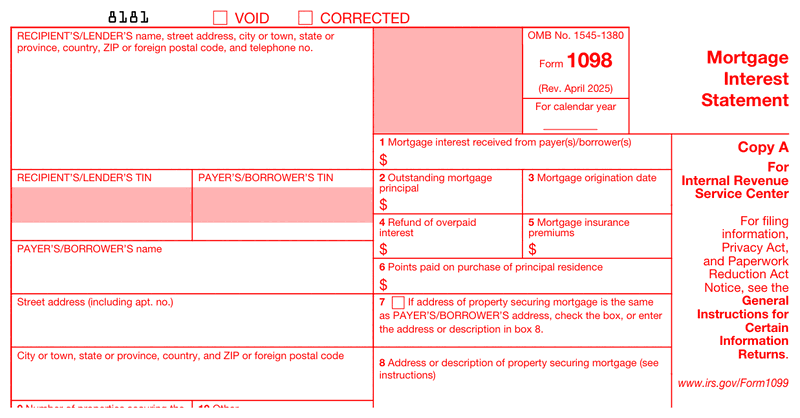
A 1098 form, officially the Mortgage Interest Statement, is an IRS document a lender uses to report $600 or more in mortgage interest it received from a borrower during the year. The lender files it and sends the homeowner a copy, which supports the mortgage-interest deduction at tax time.
The form goes by a lot of names, which is why searches for what is a 1098 form, what is form 1098, and plain what is 1098 all land on the same document. Its official title is the form 1098 mortgage interest statement, though most people just call it the 1098 tax form, the mortgage tax form, or their annual mortgage statement. The IRS lists it as tax form 1098. Whatever you call it, it is an information return: the lender files it to report your 1098 mortgage interest for the year, rather than something you fill out and mail in yourself. If you itemize, the interest shown on form 1098 is what you carry to Schedule A as your mortgage interest deduction.
Looking for your tuition tax form instead? That is the 1098-T, a school form for education credits, not this one.
Anyone in a trade or business that received $600 or more in mortgage interest from a borrower during the year must file a 1098 form. That includes banks, but also private and seller-financed lenders. If you hold a mortgage note and collect the interest, the rule can apply to you too.
Here is the part the big filing companies skip. You do not have to be a bank to need this form. If you sold a property with owner financing and you receive the mortgage interest as part of a trade or business, the same $600 rule can reach you. When it is a close call, the safe move is to issue the form. On the other side, if you are the borrower who paid the interest, you simply receive form 1098 mortgage and keep it. You do not file it yourself.
Enter your
information
Preview
your form
Download
your form
Borrower copies of the 1098 are due by January 31, 2027; the IRS copy follows on the information-return schedule.
Gather five things before you start and you can finish in one sitting: your EIN or SSN, the borrower's name, address, and TIN (get it on a Form W-9 if you do not have it), the total mortgage interest received for the year, any points paid, and the address of the property securing the loan.
Only a few boxes actually trip people up. Here are the ones to get right.
| Box | What It Reports |
|---|---|
| Box 1 | Mortgage interest received from the borrower |
| Box 2 | Outstanding mortgage principal |
| Box 6 | Points paid on the purchase of a home |
| Box 8 | Address of the property securing the mortgage |
A generator labels and lays out the rest so you are not guessing at the smaller fields.
Filing takes three steps once your details are ready.
One rule catches small filers off guard: if you are filing 10 or more information returns across all types combined, you have to e-file. That threshold dropped from 250 down to 10 back in 2024, so it now pulls in plenty of one-off filers who used to mail everything in. Printing the borrower copy at home is fine, only IRS Copy A has to be the official version.
For interest received during tax year 2026, mark these dates.
| Task | Deadline |
|---|---|
| Send the borrower their copy | February 1, 2027 |
| Paper file with the IRS | March 1, 2027 |
| E-file with the IRS | March 31, 2027 |
If a date falls on a weekend or holiday, it moves to the next business day. A few states also want their own 1098 filing, so check with your state revenue department if you are not sure. And if you are filing your own return too, it helps to know what happens if you do not file taxes on time.
The 1098 you get for a mortgage is one of a small family, and mixing them up is common. Here is the quick map: the plain 1098 reports mortgage interest, the 1098-E reports student loan interest, the 1098-T reports tuition, and the 1098-C reports donated vehicles. If your form is about anything other than a home loan, you are probably looking at one of the others.
The mistakes we see most are a wrong or missing TIN, the payer and borrower getting swapped, a Box 1 interest total that does not match your own records, and forgetting points paid. Check those before you send. If you are chasing down a borrower's TIN and are not sure which form collects it, the difference between a W-9 and a W-4 sorts that out. Late or missing forms carry a penalty for each one, and it grows the longer you wait.
Worth being straight about up front, because it changes who this tool is for: if you are a homeowner who received a 1098, you do not create one. You keep the copy your lender sent you.
Where a 1098 generator genuinely helps is narrower. An individual or private lender issuing one or two forms can lay out each box correctly instead of fighting the formatting, and anyone who wants a clean reference copy of their numbers can save one, much like getting a copy of a W-2 online. The heavy-duty filing suites built for banks and accountants running hundreds of these a season are overkill when you have a single note to report. You fill the fields on screen, preview the form free, and pay only when you download the finished PDF. No watermark, no subscription.
There is no annual Form 1098. Unlike a W-2, this one is continuous-use: a single revision serves multiple tax years, and the current form revision is April 2025. So when you search for a "1098 form 2025" or a "1098 form 2026," that year points to the tax year of the mortgage interest being reported, not to a different document.
One wrinkle trips people up. The form and its instructions carry different dates. The instructions were reissued at Rev. December 2026, while the form itself stayed at Rev. April 2025. The IRS puts it plainly: "Use the April 2025 revision of Form 1098 and these instructions to file 2026 information with the IRS in early 2027." If you go hunting for a "December 2026 Form 1098," you will not find one, because it does not exist.
The one item that genuinely changed by year is Box 5, Mortgage Insurance Premiums. The April 2025 instructions made Box 5 conditional and told filers to check IRS.gov/Form1098 first. The December 2026 instructions drop that condition entirely: enter total premiums of $600 or more paid or received for the tax year being reported, including prepaid premiums, for qualified mortgage insurance. Box numbers are unchanged, so nothing else on the form moves. If you are the homeowner, Box 5 is the one worth checking against your own records.

4.4 out of 5.0 stars on 717 reviews
A 1098 form reports how much mortgage interest a lender received from a borrower during the year. The lender files it with the IRS, and the homeowner uses their copy to claim the mortgage interest deduction on Schedule A if they itemize their taxes.
Your lender files it. If you are the borrower, you receive form 1098 and keep it with your records, then use the interest figure when you file. You only file a 1098 yourself if you are the one who received $600 or more in mortgage interest.
No, they are two different documents. One reports the mortgage interest you paid on a home loan; the 1098-T is a Tuition Statement your school issues for education tax credits. They share a number but cover completely different things, which is why so many searchers land on the wrong one.
The IRS can charge a penalty for each form that is late or missing, and the amount climbs the longer you wait. Filing even a little late is far cheaper than skipping it, so send the form as soon as you can if you missed the date.
You can print the copy you give the borrower with no problem. The catch is IRS Copy A, which has to be the official scannable form, not a plain home printout. A generator gives you clean borrower copies, and you file Copy A on paper or through the IRS e-file system.
Fill out our contact form, and we will get back to you as soon as we can!
Contact us
Hi! How can I help you? Kris