Our customer support is available 24/7:

Create your 1099-INT online in minutes. Accurate, print ready and hassle free.
Rated 4.4/5 (770+ reviews) 35+ tax forms No subscription required
An envelope shows up from your bank in January, and inside is a 1099 int form you did not ask for. Or you are on the other side of it: you paid someone interest last year, and now they need that form from you. Either way, the document is short, the language printed on it is dense, and the numbered boxes are exactly where people get stuck. PayStubCreator.net can generate the form for you, but it helps to understand it first.
A 1099 int form is the tax document your bank or credit union sends you. You get one when it pays you at least $10 in interest during the year. Form 1099-INT reports that interest to you and to the Internal Revenue Service, so the amount in Box 1 needs to show up on your tax return.
Whether you searched for what is a 1099-int, what is 1099 int, or simply 1099int with no dash, you are looking at the same document. The 1099 int meaning is refreshingly literal: it is a receipt for money your savings earned. The institution that paid the interest is the payer, and you are the recipient. The IRS gets a copy too, and that is the part that matters. If your return disagrees with the number the IRS already holds, expect a letter months later.
Banks and financial institutions - and any business that paid $600+ of interest, such as on a private or seller-financed loan.
The person or business that earned the interest; they report it on their return.
A real-world example: Your company borrowed $50,000 from a private investor and paid $3,000 of interest this year. A 1099-INT to the investor keeps both sides of that loan clean with the IRS.
Enter your
information
Preview
your form
Download
your form
Recipient copies are due by January 31, 2027; the IRS copy follows on the information-return schedule.
Interest income is the money your savings earn just by sitting in an account. It comes from savings accounts, CDs, money market accounts, Treasury bonds, and municipal bonds. The IRS treats most interest income as taxable in the year it is paid to you, even if you never withdrew it.
That last part catches people out. Say your high-yield savings account earned $340 last year and you left it untouched. That $340 is still 1099 interest income for the year it was credited. The interest income meaning is simply what the account paid you. The interest income definition the IRS works from does not care whether the money ever reached your wallet.
Most people get a 1099-int from bank accounts rather than from a person. Chase, Bank of America, Ally Bank, Marcus by Goldman Sachs, Discover Bank, and Capital One 360 all issue Form 1099 INT. These financial institutions send one to any customer who earned $10 or more in interest during the tax year.
You are the one who has to file Form 1099-INT if you PAID the interest, the same way you would when you issue a 1099-MISC. That covers cases like these:
Check the direction before you start, because most people arrive here from the other side. If you RECEIVE interest on a private note or a seller-financed sale, you do not issue a 1099-INT at all. You report it on Schedule B, Part I, and for a seller-financed mortgage you list the buyer's name, address and SSN there even when the interest is under $1,500.
Two exceptions ignore the $10 floor. A 1099-INT is required no matter how small the amount if you withheld federal income tax under backup withholding. The same applies if any foreign tax was paid on the interest.
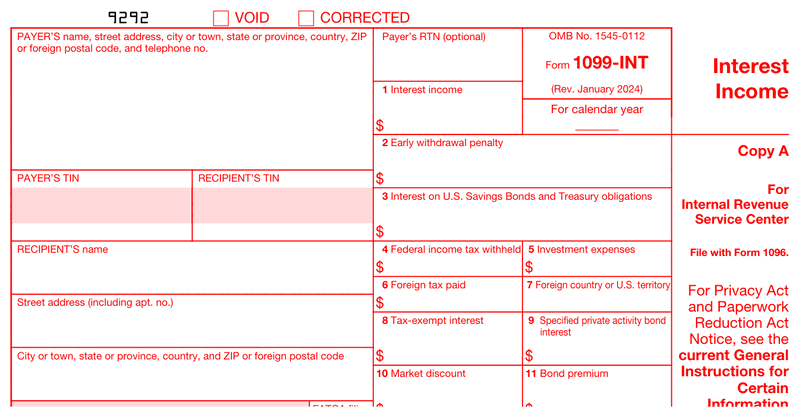
The 1099 int form has 17 numbered boxes plus payer and recipient details at the top. Most people only ever see numbers in one or two of them.
| Box | What goes in it |
|---|---|
| 1 | Ordinary taxable interest (savings, CDs, money market) |
| 2 | Early withdrawal penalty you were charged |
| 3 | Interest on U.S. Savings Bonds and Treasury obligations |
| 4 | Federal income tax withheld (backup withholding) |
| 5 | Investment expenses |
| 6 | Foreign tax paid |
| 7 | Foreign country or U.S. possession |
| 8 | Tax-exempt interest (typically municipal bonds) |
| 9 | Specified private activity bond interest |
| 10 | Market discount |
| 11 | Bond premium |
| 12 | Bond premium on Treasury obligations |
| 13 | Bond premium on tax-exempt bonds |
| 14 | Tax-exempt and tax credit bond CUSIP number |
| 15 | State |
| 16 | State identification number |
| 17 | State tax withheld |
There is also a FATCA filing requirement checkbox, which most everyday payers leave alone.
These three trip up more filers than the other fourteen combined, because all three hold interest and none of them is taxed the same way.
Box 1 is ordinary savings account interest from a bank or credit union. It is taxable federally and taxable by your state.
Box 3 is savings bond interest and interest from other Treasury obligations. It is taxable federally but exempt from state and local income tax. Fold Box 3 into Box 1 on your state return and you pay state tax you never owed.
Box 8 is tax-exempt interest, usually from municipal bonds. It is exempt from federal income tax, but you still report it, and it can affect how much of your Social Security benefit becomes taxable.
If several 1099s landed in your mailbox this year, they are easy to mix up. They report completely different kinds of money.
| Form | What it reports | You get one if... |
|---|---|---|
| 1099-INT | Interest income | A bank or credit union paid you $10 or more in interest |
| 1099-DIV | Dividends and capital gain distributions | A brokerage or fund paid you dividends, generally $10 or more |
| 1099-NEC | Nonemployee compensation | A client paid you $2,000 or more for contract work |
The short version: 1099-INT is money your savings made, 1099-DIV is money your investments paid out, and 1099-NEC is money you actually worked for, which is the kind of pay that shows up on a 1099 pay stub. Only the 1099-NEC counts as self-employment income, which is why it is the only one of the three that can trigger self-employment tax.
Do not mail it in with your return, and do not throw it away. It is an information copy, and your job is to carry its numbers onto your return correctly, the same way you would with pay stubs at tax time.
Start by matching Box 1 against your own records. Most banks post a year-end interest summary under tax documents in online banking before the paper form reaches you. If your Discover Bank summary reads $412.60 and the form reads $41.26, that is a decimal error worth catching before you file.
Then report it. Interest goes on the interest line of your Form 1040. If your total taxable interest for the year tops $1,500, you also complete Schedule B and list each payer by name. Below $1,500, most filers skip Schedule B and enter the total.
A missing form does not let you off the hook. If your account earned under $10 in interest, the bank is not required to send anything. That interest is still taxable, and it still belongs on your return. Check your December statement or online year-end summary and report the amount, just as you would when reporting freelance income without a 1099.
If a form should have arrived and did not, ask the payer for a copy. Banks reissue these routinely, and most post a downloadable version online long before a replacement gets mailed.
If the amount is wrong, do not quietly correct it yourself. Ask the payer to issue a corrected 1099-INT with the corrected box checked, which works much like receiving an incorrect W-2. Filing a number that disagrees with IRS records is what generates a notice, so make the call and fix it at the source.
If you are the payer, our 1099 int generator handles the layout and the math so you are not wrestling with a blank PDF. If you are filing as a business and need to track down your employer identification number, have it ready before you start.
Copy A goes to the IRS, with Form 1096 if you file on paper. Copy 1 goes to your state tax department if it requires one. Copy B and Copy 2 go to the recipient for their federal and state returns, and you keep Copy C.
You can preview the finished 1099-INT form before you pay, so check every box against your own records while it is still on screen. Payment only happens at download, and there is no subscription attached to it.
For interest paid during the 2026 tax year, the recipient copy is normally due January 31, 2027. That date falls on a Sunday, so the deadline shifts to Monday, February 1, 2027. Paper filings to the IRS are due March 1, 2027, because February 28 is also a Sunday, and electronic filings are due Wednesday, March 31, 2027.
The e-filing rule changed, and plenty of older guidance still has it wrong. The threshold is no longer 250 forms. If you file 10 or more information returns in total, counting W-2s, 1099-NECs, 1099-MISCs, and 1099-INTs together, you must file electronically.
Late or incorrect forms carry per-form penalties that scale with how late they are, and climb sharply if the IRS decides the failure was intentional. The cost of not filing at all is steeper still. Some states want their own copy, which is what boxes 15 through 17 exist for.
None, in the sense you probably mean. Form 1099-INT is a continuous-use form, so the IRS does not reissue it every January. The current revision is January 2024, and it stays in use until the IRS issues a new revision. If you searched for a "1099-INT form 2025" or a "1099-INT form 2026," the year you typed refers to the tax year of the interest, not to a different piece of paper. The form your bank hands you looks the same either way.
That is also why this page carries no year-over-year change list. The instructions carry no What's New section at all, only Reminders. The $10 reporting floor has not moved, and the box layout is unchanged.
One thing worth knowing if you have a car loan: the new vehicle loan interest reporting does not belong on this form. The IRS created a separate Form 1098-VLI (Vehicle Loan Interest Statement) for $600 or more of specified passenger vehicle loan interest, so do not go hunting for it among your 1099-INT boxes.

4.4 out of 5.0 stars on 717 reviews
Yes. Banks are only required to issue a 1099-INT at $10 or more in interest, but every dollar of interest is taxable regardless. Check your year-end statement or online banking summary for the exact figure and report it on your return, even with no form in hand.
Taxable interest from Box 1 goes on the interest line of Form 1040. If your total taxable interest for the year exceeds $1,500, you must also complete Schedule B and list each payer separately. Tax-exempt interest from Box 8 is reported on its own separate line.
Yes. Contact the bank or payer and request a replacement. You can also log into online banking and check the tax documents section, where most institutions post a downloadable copy. You can also request a wage and income transcript from the IRS, though those are not available until later in the filing season.
No. The IRS treats it as unearned income, not wages. That distinction matters at filing time, because interest income does not count toward the Earned Income Tax Credit or IRA contribution eligibility. It is still fully taxable, and it still counts toward your total gross income for the year.
Only one person receives the form. The bank issues a single 1099-INT under the Social Security number of the primary account holder, who reports the full amount. If part of the interest belongs to someone else, that person files a nominee 1099-INT to reassign their share.
Fill out our contact form, and we will get back to you as soon as we can!
Contact us
Hi! How can I help you? Kris