Our customer support is available 24/7:

Create your Form 4562 online in minutes. Accurate, print ready and hassle free.
Rated 4.4/5 (770+ reviews) 35+ tax forms No subscription required
You bought the truck, the laptop, or the camera kit that your work runs on. Now your tax return wants you to spread that cost across several years instead of deducting it all at once, and it wants that math on Form 4562.
If you have never filled this one out, it looks worse than it is. Six parts, a lot of columns, and language that assumes you already know what MACRS means. You do not need to. Our 4562 generator asks plain questions, handles the math, and gives you a clean copy to file.
Preview it free, pay only when you download, and there is no subscription.
Create Your Form 4562 Now
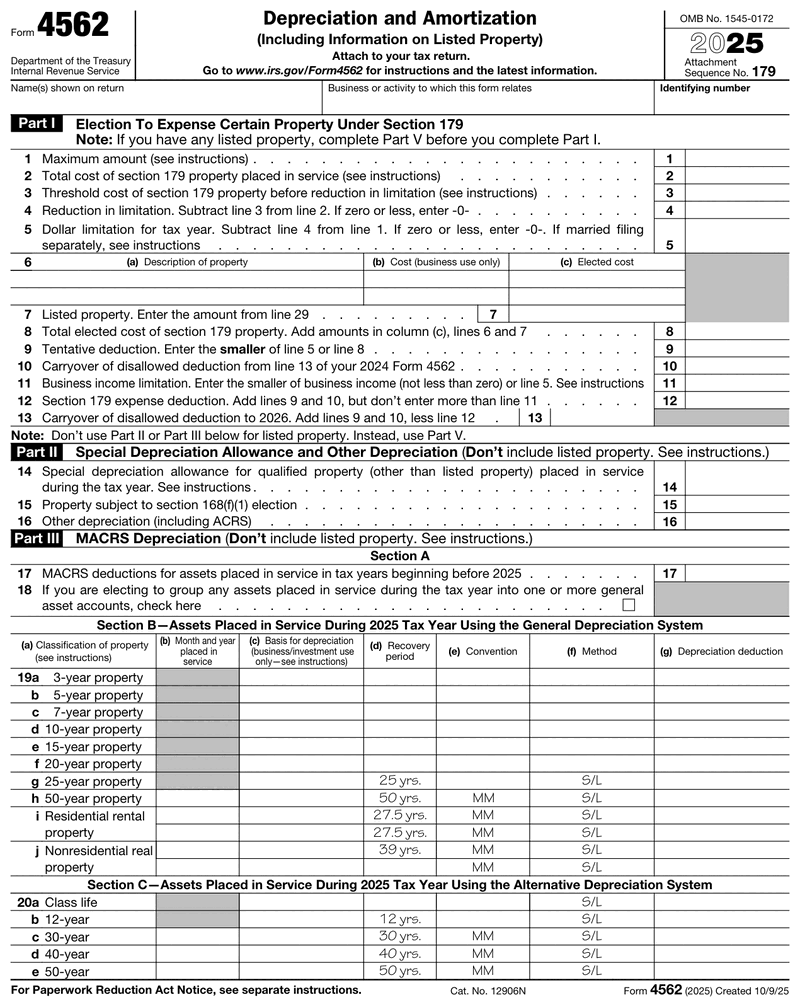
Form 4562 is the IRS form you use to claim depreciation and amortization. It lets you deduct the cost of business property, like equipment, a vehicle, or software, over the years you actually use it instead of all at once. You attach it to your tax return.
Tax software menus usually list it as form 4562 depreciation and amortization, which is its official name minus the tail end: Depreciation and Amortization (Including Information on Listed Property). The idea behind it is simple even though the form is not: when you buy something that will keep earning for you over several years, the tax code generally wants the deduction spread across those years too.
Say you are a freelance photographer and you spend $6,000 on a camera body and lenses. That kit is not a one-year expense, it is gear you will shoot with for years. It is where you tell the IRS what you bought, when you started using it, and how you are deducting it. Tax form 4562 is a worksheet, not a return, so it always rides along with your Form 1040, partnership return, or corporate return.
You file it if you are claiming depreciation on property you started using for business this year, taking a Section 179 deduction, or beginning to amortize a cost. That covers freelancers, sole proprietors, landlords, partnerships, and S corporations. Anyone claiming listed property files it too.
In practice, if you bought something for your business this year and you want to write it off over time, you need the form. The same goes if you started amortizing something, like the cost of buying an existing business.
Here is the part people miss: you do not necessarily need it every year. You can usually skip IRS Form 4562 entirely in a year when you bought nothing new, have no listed property to report, and are not starting any amortization. You are just continuing to depreciate assets you already reported, and that does not require a fresh form. It is a genuine relief for anyone who assumed this was an annual obligation forever. If you are still finding your footing with business taxes generally, our guide to self-employed taxes covers the wider picture.
Enter your
information
Preview
your form
Download
your form
The 4562 follows the return it attaches to - mid-April 2027 for 1040-based filers, or later under a valid extension.
Almost every frustrating experience with this form comes from the same place: you are halfway down the page and you realize you do not have a number you need. Ten minutes of gathering first saves you the whole headache.
Pull these together before you open the form:
Most sites skip straight to "enter your asset on line 19." Getting these five things in front of you first is what actually makes the form go quickly.
The form runs six parts, and they are not meant to be filled in strictly top to bottom. Here is what each part does and the order that actually works.
Do this first: If you are claiming a vehicle or any other listed property, complete Part V before you touch Part I. Part V calculates figures that Part I depends on. Filling them in page order is the single most common error on this form, and it quietly produces a wrong deduction rather than an obvious error.
You list the property, its cost, and how much of it you want written off immediately instead of over a period of years. Part I also applies the dollar caps and the business income limit, so this is where an over-ambitious claim quietly gets trimmed back to what you are actually allowed.
This is bonus depreciation. It covers qualified property placed in service during the year, minus anything you already expensed under Section 179. Listed property does not go here, it goes in Part V.
The main depreciation engine. Section A handles assets carried over from earlier years, which is where last year's form earns its keep. Section B covers assets you placed in service this year, sorted into property classes with their recovery period, convention, and depreciation method. Section C covers assets on the Alternative Depreciation System. For the 2025 tax year the Form 4562 IRS instructions add two new lines, 19h and 20e, for 50-year property, a class most filers will never touch.
Adds everything up. You total your depreciation from the other parts here, and this figure is what carries to your Schedule C, Schedule E, or business return.
Vehicles and other property that lends itself to personal use. You report business-use percentage, and answer questions about whether you have written records to back it up. Again, this part comes first if it applies to you.
Costs you write off on a set schedule rather than depreciate, like the intangibles that come with buying a business.
A shortcut worth knowing: if you placed several assets of the same class in service in the same year, say four pieces of office equipment, you can enter them on a single line rather than one line each. It cuts the fill-in time without costing you any accuracy. A formal general asset account election is a different and more consequential choice, because it changes what happens when you later sell or scrap one of the assets, so do not make one just to save a line. The full IRS Form 4562 instructions on IRS.gov spell out each line, and IRS Publication 946 is the deep reference on how to depreciate property.
Our generator handles the ordering and the arithmetic for you, so you are not flipping between the 4562 instructions and a calculator to work out a convention.
Section 179 is the rule that lets you skip the slow route and deduct the full cost of qualifying property in the year you put it to work. These caps are indexed for inflation each year. The figures below are the 2026 amounts:
| Limit | 2026 Amount |
|---|---|
| Maximum Section 179 deduction | $2,560,000 |
| Phase-out threshold (total property placed in service) | $4,090,000 |
| Sport utility vehicle limit | $32,000 |
There is one more limit that catches people, and it has nothing to do with those figures: your Section 179 deduction cannot exceed your taxable business income for the year. You cannot use it to create or deepen a loss. If your election is larger than your income, the excess is not lost, it carries forward to a future year.
Picture a home-bakery owner who buys a $9,000 commercial oven and nets $6,000 for the year. She can elect Section 179 on the full oven, but only $6,000 of the depreciation deduction lands this year. The remaining $3,000 waits for next year.
Bonus depreciation, formally the special depreciation allowance, is the other way to write off an asset fast. For property acquired after January 19, 2025, it is back to 100%.
It overlaps with Section 179, but the mechanics differ in ways that matter:
Most filers use Section 179 first on the specific items they want expensed, then let bonus depreciation handle the rest.
MACRS, the Modified Accelerated Cost Recovery System, is the default method for most business property. When people talk about a depreciation schedule, this is usually what they mean: the year-by-year plan for writing an asset off.
Two systems sit inside MACRS. The General Depreciation System (GDS) is the standard one and gives you faster write-offs. The Alternative Depreciation System (ADS) stretches deductions over a longer period and is required in certain situations, including listed property that falls to 50% or less business use.
Each asset lands in a property class that sets its recovery period:
| Property class | Typical assets |
|---|---|
| 3-year | Certain tools and specialized equipment |
| 5-year | Computers, office machinery, cars and light trucks |
| 7-year | Office furniture and fixtures |
Your tax depreciation schedule flows from that classification, so picking the right recovery period matters more than any other single choice on the form. Put a 5-year asset in a 7-year class and every year's number is wrong.
Listed property is business property that easily doubles as personal property, most commonly passenger vehicles and other transportation. It gets stricter treatment: you report it in Part V, document your business-use percentage, and if business use is 50% or less, your deduction options shrink.
That 50% test is the hinge. Above it, you can use Section 179 and bonus depreciation and the faster GDS schedule. At 50% or below, you lose Section 179 and bonus depreciation on that asset and must use straight-line ADS instead.
Passenger vehicles carry their own first-year caps no matter what the math would otherwise allow:
| First-year limit (2025 amounts, confirm current year) | Amount |
|---|---|
| With bonus depreciation | $20,200 |
| Without bonus depreciation | $12,200 |
The practical tip: keep a mileage log all year, in a phone note or a dedicated app, rather than reconstructing your business-use percentage from memory in April. Part V specifically asks whether you have written records to support your percentage, and a contemporaneous log is exactly what that means. A rideshare driver who logs miles weekly has a defensible number. One who estimates in hindsight does not. IRS Publication 463 covers the vehicle recordkeeping rules in detail.
Depreciation and amortization do the same basic job, spreading a cost over time, but they apply to different things. Depreciation is for physical property. Amortization is for intangibles.
Part VI is where amortization goes, and the two situations most filers run into are:
You list the cost, the date amortization began, the code section, and the period. Unlike the depreciation parts, the amortization side of the form is comparatively short.
The form is due when the return it attaches to is due:
| Filer | 2027 deadline (for the 2026 tax year) |
|---|---|
| Individuals and sole proprietors | Thursday, April 15, 2027 |
| Partnerships and S corporations | Monday, March 15, 2027 |
Both dates fall on weekdays this season, so neither one moves. That is worth checking every year rather than assuming: when a filing deadline lands on a weekend or a federal holiday, it rolls forward to the next business day, which is how the partnership date ends up in mid-March some years and a day or two later in others.
As for where it goes: nowhere on its own. You do not mail it separately or file it as a standalone document. It travels with your return, whether you e-file or mail a paper copy. If you e-file, your software transmits it as part of the return package. Missing the underlying return deadline is what creates problems, and what happens if you do not file taxes is worth understanding before it becomes relevant.
Run through this before the form leaves your hands:
The errors below account for most of the trouble people have with this form, and each one is avoidable:
Filling out Part I before Part V. Page order feels natural, but if you have listed property, Part V feeds Part I. Doing it backward produces a wrong number without producing an obvious error, which is the worst kind of mistake.
Claiming more Section 179 than your business earned. The deduction is capped at your taxable business income. Filers see the $2,560,000 headline figure and forget the limit that actually applies to them.
Picking the wrong recovery period. A computer is 5-year property, office furniture is 7-year. Guessing here throws off every year of the schedule, not just this one.
Using the purchase date instead of the placed-in-service date. Depreciation starts when the asset goes to work, not when you paid for it. Buying equipment in December that you first use in February moves it to the next tax year.
Claiming 100% business use on something you obviously also use personally. A single vehicle claimed at 100% business use with no log invites questions, and Part V asks directly whether you have written records.
Forgetting to attach it. The form supports a deduction on your return. On its own, it is just paperwork.
Tracking your write-offs as you go prevents most of this. Our guide to 1099 tax deductions covers the habit side of it.
Signing. The form has no signature line of its own. Signing the return it attaches to covers it.
Fixing an error. If you discover a mistake after filing, you correct it by amending the return. For individuals that means Form 1040-X with a corrected 4562 attached. Do not send a revised 4562 form by itself, because there is no return for the IRS to match it to.
Getting it wrong in your favor. Overstating depreciation is not a quiet error. It reduces tax you actually owed, which can mean interest and accuracy-related penalties, and depreciation you claimed follows the asset: when you sell it, depreciation recapture can turn part of your gain into ordinary income. Careful numbers now save real money later.
This form rarely travels alone. Depending on your situation, it feeds into or sits alongside:
| Form | How it relates |
|---|---|
| Schedule C | Sole proprietors and freelancers carry the Part IV total here as a business expense |
| Schedule E | Landlords report rental property depreciation here |
| Form 1065 | Partnerships attach it to the partnership return |
| Form 4797 | Reports the sale of business property, including depreciation recapture on assets you had been depreciating |
| Form 2106 | Employee business expenses, now limited to a few categories of worker |
| Form 8829 | Business use of your home, which carries its own depreciation calculation for the home itself |
One more worth knowing: if you sell depreciated business property on an installment plan and report it on Form 6252, depreciation recapture does not spread across the installments. It is recognized in the year of the sale, even if the money arrives over several years.
Partners receiving a Schedule K-1 will see their share of depreciation reported there, and anyone setting up a business entity will need an EIN before most of these forms make sense.
Filling in a static PDF means decoding line references, choosing conventions, and doing the arithmetic yourself, then discovering you completed the parts in the wrong order. Our 4562 generator handles that:
Preview your form first at PayStubCreator.net, then download it once it looks right.
Form 4562 is reissued every tax year, so searching "form 4562 2025" or "form 4562 2026" really does turn up two different documents. Take the one printed with the tax year of the return you are attaching it to, not the year you happen to be sitting down to file.
The 2026 draft is worth a heads-up. The IRS has retitled it "Depreciation (Including Information on Listed Property)," removed Part VI (Amortization) entirely, and the form now ends at line 41. That is still a draft, so it can change before the final posts, and the IRS has not said where amortization reporting goes instead.
The due date works differently from the form year. Form 4562 has no deadline of its own, it inherits one from whatever return carries it. The same 2025 Form 4562 was due April 15, 2026 attached to a Form 1040, 1120 or 1041, but March 16, 2026 attached to a Form 1065 or 1120-S. Extensions follow the parent too: October 15, 2026 for individuals, with each entity return carrying its own extended deadline. That last part matters more than it looks, because a Section 179 election generally has to be made on a timely filed return, extensions included.

4.4 out of 5.0 stars on 717 reviews
Form 4562 is used to claim depreciation and amortization deductions on business property. It reports assets you placed in service this year, any Section 179 expensing you elect, bonus depreciation, and vehicles or other listed property. The totals carry over to your business return.
Not always. You only need it in years when you place new property in service, claim Section 179 or bonus depreciation, start amortizing a cost, or report listed property. If you are simply continuing MACRS depreciation on older assets, you usually can skip it.
Listed property is business property that easily doubles as personal property, most commonly passenger vehicles and other transportation. It gets stricter treatment: you report it in Part V, document your business-use percentage, and if business use is 50% or less, your deduction options shrink.
Often yes. Section 179 lets you expense the full cost of qualifying property up front, and bonus depreciation can cover the rest. Your Section 179 deduction cannot exceed your business income for the year, though. Anything above that limit carries forward to a future year.
IRS.gov hosts both the blank form and the official instructions, and searching for IRS 4562 there brings up the current-year version. If you would rather not fill in a static PDF by hand, our generator walks you through each part in plain language and gives you a clean, ready-to-file copy.
Fill out our contact form, and we will get back to you as soon as we can!
Contact us
Hi! How can I help you? Kris