Our customer support is available 24/7:

Make your 1040X in minutes. Simple to use, accurate and ready to download.
Rated 4.4/5 (770+ reviews) 35+ tax forms No subscription required
You filed your return back in February and moved on. Then a corrected W-2c showed up in March with $1,200 in wages you'd already reported wrong. Now you're staring at it, unsure how much trouble you're in. Here's the good news: almost none. A 1040X is the form the IRS built for exactly this situation, and filing one is a routine correction rather than a red flag.
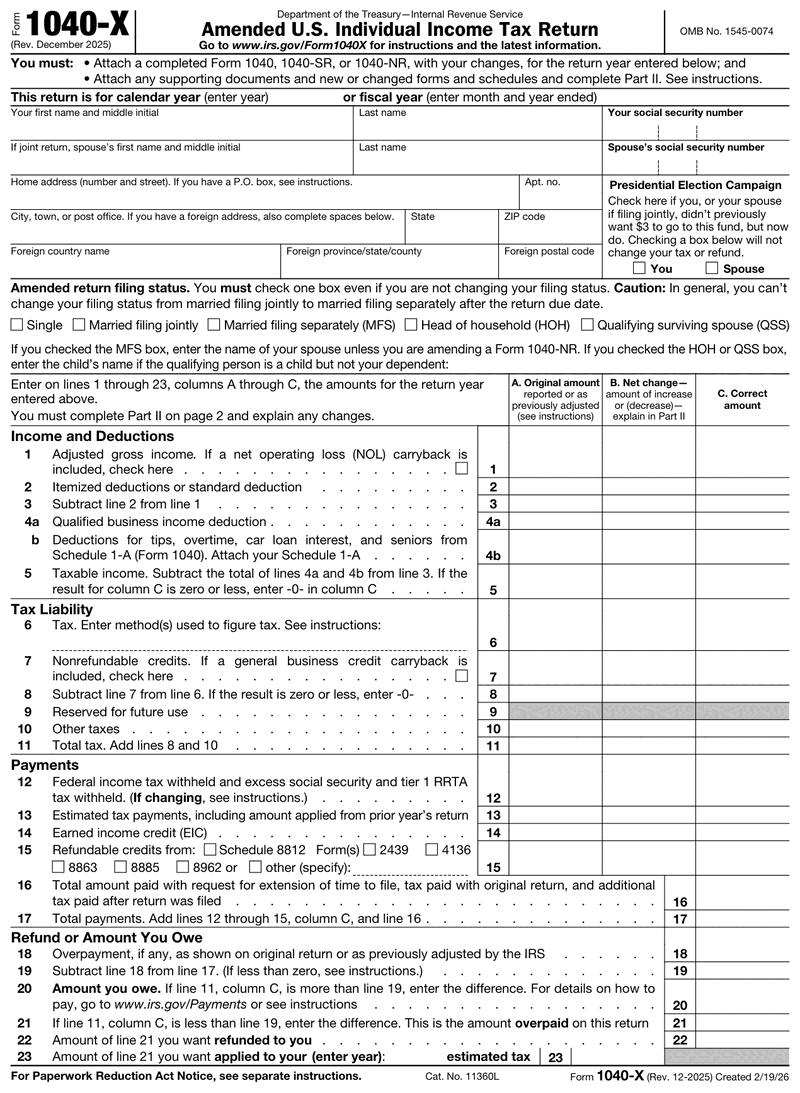
A 1040X is the IRS form you use to correct a federal tax return you already filed. Officially Form 1040-X, Amended U.S. Individual Income Tax Return, it lets you fix income, filing status, deductions, credits, or dependents. You generally have three years from your original filing date to submit an amended return, so check your tax records before you start.
Think of it as a do-over for one specific year. You're not refiling from scratch. You're showing the Internal Revenue Service three things: what you originally reported, what changed, and what the corrected number should be. A tax amendment can cover almost anything on the original income tax return, from a missed 1099 to a filing status you picked wrong. The IRS keeps the official details on its About Form 1040-X page.
You'll see the name written a few different ways, Form 1040X, Form 1040-X, or just 1040 X with a space, and they all point to the same document. One limit worth knowing up front: this is a federal form only. If the change affects your state taxes, your state has its own amended return to file. Correcting a business payroll return is a separate job handled on Form 941-X.
File one when something on your original return turned out to be wrong and it changes what you owe or what you're refunded. The most common trigger is an incorrect W-2 or a late 1099-NEC that lands weeks after you filed. Other reasons include income you forgot, the wrong filing status, a credit you missed, or a change to your dependents. The form also covers three situations people rarely think of: making certain elections after the deadline has passed, changing an amount the IRS already adjusted, and claiming a carryback from a loss or unused credit. Individuals can amend Forms 1040, 1040-SR, and 1040-NR this way, along with older 1040-A and 1040-EZ filings.
Enter your
information
Preview
your form
Download
your form
To claim a refund, a 1040-X generally must be filed within three years of the original return's filing date (or two years of paying the tax, if later). Owing more? File and pay as soon as the error surfaces - interest runs until you do.
Before you fill anything out, check whether you can skip this entirely.
The IRS corrects simple arithmetic mistakes on its own, so a math error on your original return doesn't need an amendment. The same goes if you simply forgot to attach a W-2 or 1099 you already reported: the IRS will request it if it needs it. Income you left OFF the return is different. That does need an amendment, and filing one yourself is better than waiting for a CP2000 notice with penalties and interest attached. And if you already responded to an IRS notice such as a CP2000 and the matter is settled, you're done.
Filing an unnecessary amendment just adds months of processing to something that was already handled.
Here's the process, step by step.
That's the full process for how to file an amended tax return. If you're wondering how to amend taxes for more than one year, each year needs its own separate form and its own envelope.
This form splits every line into three columns, and that's where most people get stuck.
| Column | What Goes In It |
|---|---|
| Column A | The amount exactly as you originally filed it |
| Column B | The net change, meaning the difference between what you filed and what's correct |
| Column C | The correct amount, which is simply A plus B |
The trap is Column B. It's a difference, not a replacement total. If your wages went from $48,000 to $49,200, Column B is $1,200, not $49,200. Our generator handles that subtraction for you once you've entered the original and corrected figures.
On the current version of the form, Rev. December 2025, your written explanation goes in Part II. Part I is where dependents go. Plenty of older guides still say Part III, so check that you're working from the current revision.
This box is where amended returns stall. Vague explanations slow everything down:
Name the amount, the document it came from, and why it changed. One or two plain sentences per change is plenty.
The deadline is generally three years from the date you filed the original return. There's a second clock too: two years from the date you paid the tax, whichever falls later. In practice you can amend tax return filings going back roughly three years, which during the 2026 season generally reaches tax year 2023. Check that you're using the current revision, Rev. December 2025, since the IRS reorganized the form's parts. Recent tax years can be e-filed; older ones have to be mailed. Missing the window is a different situation with its own consequences, covered in what happens if you don't file.
Check your amendment status with the IRS "Where's My Amended Return?" tool. You'll need your Social Security number, date of birth, and ZIP code. Processing usually takes 8 to 12 weeks, and up to 16 in some cases. Nothing appears for roughly the first three weeks, so start checking around week three.
The tool moves through three stages: received, adjusted, and completed. "Received" only means it arrived safely, which is worth remembering before you start reading anything into the silence.
One practical tip: skip week one. The system usually shows nothing at all for the first two to three weeks. Checking daily that early just creates worry with no new information. Start at the three-week mark, then check every week or two. If you're still searching "where my amendment" after 16 weeks with nothing to show for it, call the IRS amended return line at 866-464-2050.
The blank IRS 1040-X PDF gives you no guardrails and no math help. Our online tool asks for your figures in plain language and calculates the Column B change. You get back a clean, correctly formatted return form you can print, sign, and send. It's the same approach we use for our W-2 creator.
Need it done today? Start with PayStubCreator and skip the blank-PDF guesswork.
None, and that is genuinely the answer. There is no annual Form 1040-X. One continuous-use form, Rev. December 2025, amends every open year. So when you search "1040-X 2025" or "1040-X 2026," the year you mean is the tax year you are correcting, not a separate document. You write that year into the form's blank calendar-year field.
That also means there is no single deadline. Your window runs from your own filing date: 3 years (including extensions) after the date the original return was filed, or 2 years after the tax was paid, whichever is later. File early and the IRS treats the return as filed on the due date. Illustrations only, since your own dates govern: a 2025 return filed on or before April 15, 2026 runs to April 17, 2029; a 2026 return filed by April 15, 2027 runs to April 15, 2030; a return filed on extension in October 2026 runs to October 2029 instead.
Two things worth knowing. No Form 4868-style extension exists for a 1040-X, though declared disasters and combat-zone service can postpone or lengthen the window. And if you are amending to pay more tax rather than claim a refund, no deadline applies at all. Mailing it in? Paper filers must now attach a completed, updated Form 1040, 1040-SR or 1040-NR.

4.4 out of 5.0 stars on 717 reviews
It replaces the numbers on a return you already filed, rather than adding a second return for the same year. You submit it on Form 1040-X, showing your original figures, what changed, and the corrected totals. The original return stays on file; your corrections sit on top of it.
Most amendments clear in 8 to 12 weeks, though the IRS allows up to 16. Paper submissions take longer than e-filed ones because the IRS processes them manually. The IRS status tool won't show anything for roughly the first three weeks, so a quiet result early on doesn't mean something has gone wrong.
The IRS accepts e-filed amendments through tax software for the current tax year and the two prior tax periods, for returns originally filed on Form 1040, 1040-SR, or 1040-NR. E-filing is faster and confirms receipt. Anything older still has to be printed, signed, and mailed. If you're amending several years at once, send each year separately so the IRS processes them independently.
No. Amending is a routine correction, and the IRS processes millions of amended tax returns every year. Filing one doesn't flag your account. Correcting an error yourself is generally viewed more favorably than leaving a known mistake in place and waiting for a notice to arrive.
Usually yes, if the change affects your state taxable income. Form 1040-X only covers your federal return. Each state has its own amendment form and its own deadline, so check your state tax agency's site once the federal one is filed.
Fill out our contact form, and we will get back to you as soon as we can!
Contact us
Hi! How can I help you? Kris