Our customer support is available 24/7:

Create your Form 2106 online in minutes. Accurate, print ready and hassle free.
Rated 4.4/5 (770+ reviews) 35+ tax forms No subscription required
If someone told you to file Form 2106, or you are wondering whether you can still write off job costs your employer never paid back, start here. It is the IRS form for employee business expenses, but as of 2026 only four groups of employees can actually use it. When you are ready, our 2106 generator formats everything for you: preview it free, then pay only when you download the finished PDF, with no subscription.
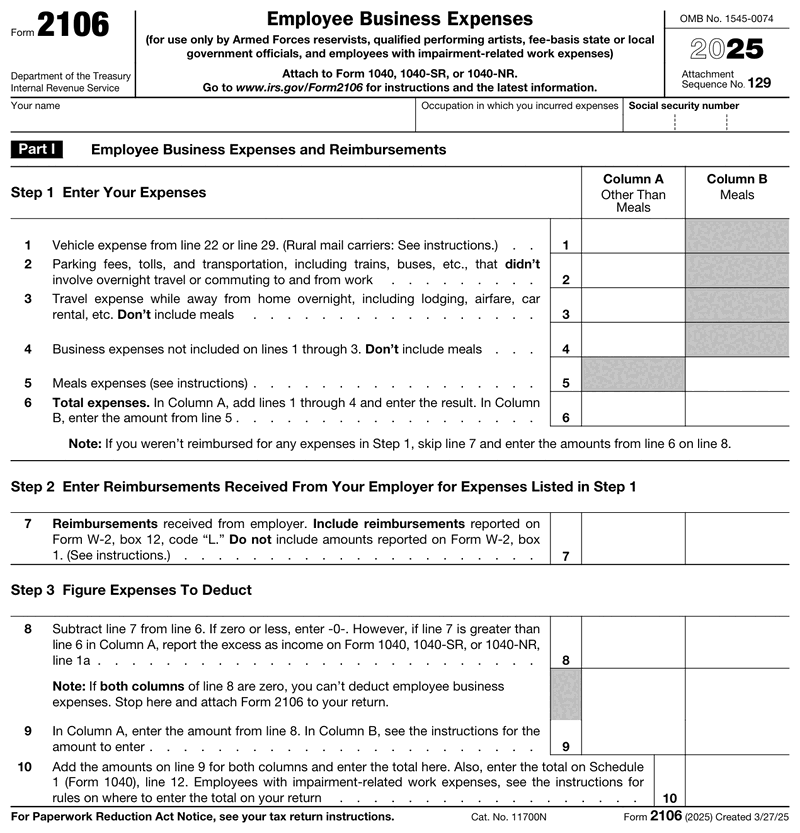
Form 2106 is the IRS form employees use to deduct job expenses their employer never paid them back for. Most filers no longer qualify, so check the eligible categories below before you fill anything in. Its full name is Form 2106 Employee Business Expenses. You attach it to your Form 1040 to claim costs like work travel, vehicle mileage, and certain tools you bought yourself.
The IRS calls these unreimbursed employee expenses, and you will also see them written as unreimbursed job expenses, which mean the same thing. So if you have been searching what is form 2106 or tax form 2106, this is it: a two-page attachment, not a return you file on its own.
The catch is who may file it. IRS Form 2106 still exists, and a fresh revision appears every year on the official IRS page. But the group who can use it shrank dramatically in 2018, which is where the confusion starts.
Only qualifying employees: Armed Forces reservists, qualified performing artists, fee-basis officials, and employees with impairment-related work expenses.
It attaches to your Form 1040 and files with it.
A real-world example: A reservist drove 900 miles to drills beyond the local area this year. The 2106 turns that travel into a deduction that survives current law.
Enter your
information
Preview
your form
Download
your form
The 2106 follows your 1040: mid-April 2027 for the 2026 tax year, or October with a Form 4868 extension.
Only four groups can still use this form: Armed Forces reservists, qualified performing artists, fee-basis state or local government officials, and employees with impairment-related work expenses. Everyone else lost the deduction in 2018, and that change is now permanent.
That last point matters. Many pages still call the deduction "suspended through 2025," which leaves you expecting it back this year. It is not: the 2025 tax law made that removal permanent.
Outside those four groups, filing a tax form 2106 will not produce a deduction. Self-employed people report on Schedule C instead, where the write-offs are far broader and still fully available.
If you qualify, you can deduct ordinary and necessary employee expenses your job required and your employer did not reimburse. That covers vehicle mileage, parking and tolls, airfare and lodging for work travel, and business meals. Part I handles those costs, and Part II covers your vehicle in detail.
In Part I you total travel, meals, and other job costs, then subtract anything your employer already paid back. Part II is all about your car, where you pick one of two methods: the standard mileage rate, or actual expenses such as gas, repairs, insurance, and depreciation.
The standard mileage rate is 70 cents per mile for the 2025 tax year, the return most people are filing now. For 2026 the rate is not flat, so check the current rate on irs.gov and split your mileage log at any mid-year changeover before you total it. Commuting between home and work never counts either way.
Vehicle basis is what your car cost you, and it is the number the IRS uses to figure your depreciation deduction. On line 30 of Form 2106 you enter the vehicle's actual cost or other basis, then your business-use percentage decides how much of it actually counts.
That is the short version of the vehicle basis meaning. In practice: say your car cost $30,000 and you drove it 40% for business. Your business-use share of that basis is $12,000, and depreciation is calculated from that figure, not the full $30,000.
A few rules people get wrong when they search what is vehicle basis on tax return:
One thing worth knowing first: vehicle basis only matters under the actual expense method. Take the standard mileage rate and you skip this part entirely.
The 2106 form runs two pages. Work through it in this order:
Attach the finished form to your Form 1040 by the April deadline, or your extended deadline if you filed for one.
Keep receipts and a mileage log as you go. The IRS wants the date, destination, miles, and business purpose of every trip, which is exactly what an automatic mileage-tracking app captures for you. Our guide to pay stubs and taxes covers what else to keep.
For the official line-by-line text, see the Form 2106 instructions or download the blank form PDF.
This is the part most guides skip, and it is worth knowing before you file. Your line 10 total does not simply disappear into your 1040.
If you are an Armed Forces reservist, a qualified performing artist, or a fee-basis official, the amount goes on Schedule 1 (Form 1040), line 12. That makes it an above-the-line adjustment, which is genuinely good news: it lowers your adjusted gross income even if you take the standard deduction and never itemize. For reservists, only travel more than 100 miles from home counts toward that line.
Employees claiming impairment-related work expenses are the exception. That amount goes on Schedule A, line 16 instead, so it only helps if you itemize.
Filling out a tax form by hand means lining numbers up across two pages and hoping you carried each one into the right box. Our 2106 generator handles the formatting: enter your expenses, mileage, and vehicle details, and it places them on the correct lines. You can preview the filled-out form free, and you only pay when you download the finished PDF to print or attach to your return.
There is no subscription and no watermark across your document. If you also need to document what you earned while pulling paperwork together, you can create a pay stub in about the same amount of time.
Form 2106 is reissued every year, so pick the version matching the tax year you spent the money in, not the year you are sitting down to file. Filing now for 2025? You want the 2025 form 2106, and it goes in with your Form 1040 by April 15, 2026, or October 15, 2026 if you filed Form 4868. Expenses you are logging this year belong on the 2026 form 2106, due April 15, 2027, extension October 15, 2027.
The deadline is the same either way, because it is really your 1040's deadline. What differs between the two versions is the math:
| What changes | 2025 tax year | 2026 tax year |
|---|---|---|
| Standard mileage rate | 70 cents per mile | 72.5 cents per mile January 1 through June 30, 2026, then 76 cents per mile from July 1, 2026 |
| First-year car depreciation cap, with the section 168(k) allowance | $20,200 | $20,300 |
| First-year cap, no 168(k) allowance | $12,200 | $12,300 |
| Second year, third year, each year after | $19,600 / $11,800 / $7,060 | $19,800 / $11,900 / $7,160 |
One catch on 2026 miles: the rate is not flat. The IRS revised it partway through the year, so your log has to be split at July 1, 2026 and each half priced separately. Any page quoting a single 2026 rate is right for only half the year.

4.4 out of 5.0 stars on 717 reviews
They are the ordinary and necessary costs you pay to do your job that your employer does not reimburse. Common examples include work-related mileage, parking, tolls, travel away from home, lodging, and job-required supplies. The IRS test is that the cost has to be both common in your line of work and helpful for doing it. Commuting between home and your regular workplace fails that test and never counts.
Usually no. Since 2018, employees have not been able to deduct unreimbursed mileage, and that change is now permanent. The exceptions are Armed Forces reservists traveling more than 100 miles from home, qualified performing artists, fee-basis government officials, and employees with impairment-related work expenses. If you are self-employed, you claim mileage on Schedule C instead.
No. This form is for employees who receive a W-2, while Schedule C is for self-employed people and independent contractors reporting business income and expenses. If you get a 1099 instead of a W-2, Schedule C is your form.
It depends on your category. Reservists, qualified performing artists, and fee-basis officials claim it on Schedule 1, line 12, so it works whether or not you itemize. Employees claiming impairment-related work expenses report on Schedule A, so they do need to itemize to benefit.
Receipts for travel, lodging, and meals, plus a mileage log showing the date, destination, miles driven, and business purpose of every trip. Reconstructing a log after the fact is the single weakest position to be in during an audit, so write trips down as they happen. If you use the actual expense method, hold onto the purchase paperwork for the vehicle too, since that is your vehicle basis.
Fill out our contact form, and we will get back to you as soon as we can!
Contact us
Hi! How can I help you? Kris