Our customer support is available 24/7:

Make your 1065 form in minutes. Simple to use, accurate and ready to download.
Rated 4.4/5 (770+ reviews) 35+ tax forms No subscription required
You and a partner started something together and split the profits. Now there's a partnership tax return with both your names on it, and neither of you has filed one before. That's the 1065 form, and it's longer than anything you've filled out for yourself.
Here's what makes it less intimidating: this return doesn't calculate a tax bill, and you can fill it out online in a few minutes. The partnership pays no income tax. It reports what the business made, hands each partner a statement showing their share, and you each pay on your own return.
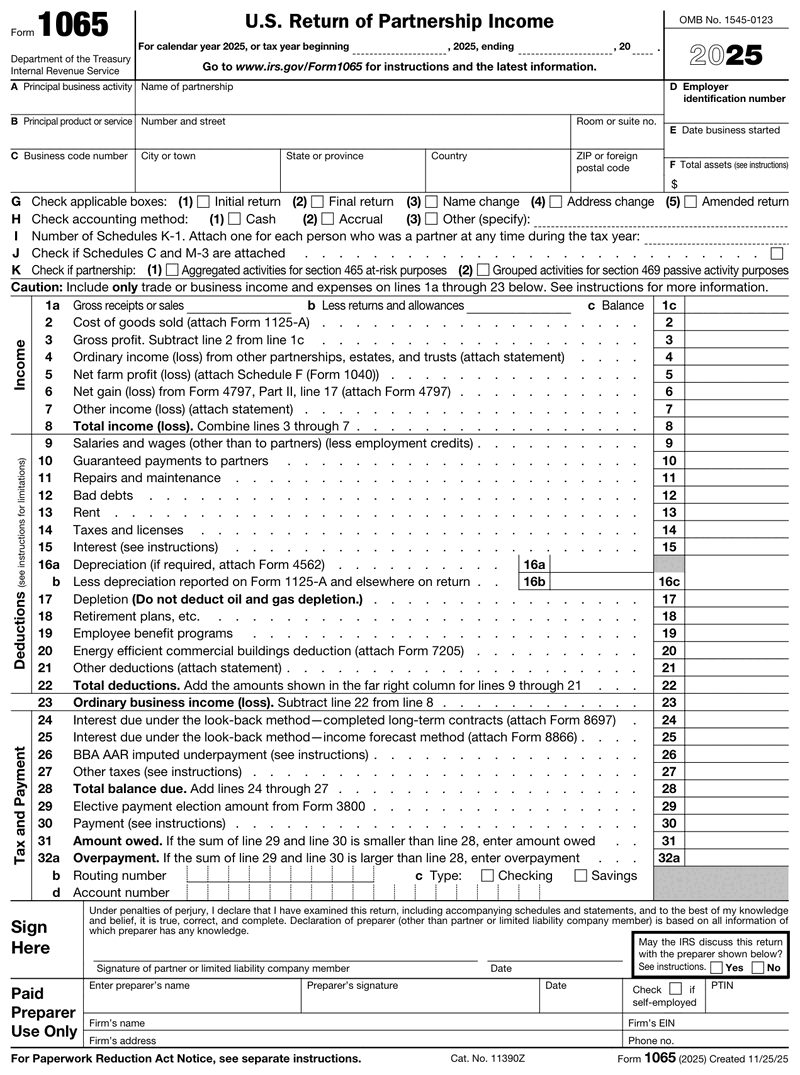
The 1065 form, officially IRS Form 1065, U.S. Return of Partnership Income, is the information return partnerships file each year. It reports the business's income, deductions, gains, and losses to the IRS. The partnership pays no income tax itself; profits pass through to partners, who report their share on their personal returns.
You'll also see it called the 1065 tax form. An information return tells the IRS what happened without settling a bill.
What Is Form 1065 Used For?
It reports the partnership's finances and splits them among the partners. The business figures its total profit or loss, then divides it by ownership percentage. That's the pass-through structure, and it's why partnerships avoid the double taxation corporations face.
Partnerships and LLCs with two or more members that haven't elected corporate taxation.
The IRS - and each partner receives a Schedule K-1 with their share of the results.
A real-world example: A two-partner consultancy cleared $140,000. The 1065 reports it; two K-1s carry $70,000 each onto the partners' 1040s.
Enter your
information
Preview
your form
Download
your form
The 1065 is due the 15th day of the third month after the partnership's year ends - mid-March for calendar-year partnerships. A timely extension request adds six months; the per-partner late penalty makes the deadline worth respecting.
Every domestic partnership must file Form 1065, including multi-member LLCs taxed as partnerships. That covers a two-person marketing LLC splitting profits 50/50, a three-partner restaurant group, and freelancers who incorporated together. Single-member LLCs do not file it; they report on Schedule C instead. Partnerships with no income generally still file.
The partnership doesn't need to be big or formal. If two people went into business together without setting up a corporation, the IRS most likely treats them as a partnership. A signed agreement isn't required.
An LLC isn't a tax classification, it's a legal structure. A multi-member LLC defaults to partnership treatment and files this return. A single-member LLC is a disregarded entity and reports on the owner's Schedule C. Same letters, completely different filing.
Gather these before you start. Hunting for them mid-form turns an afternoon into a weekend:
Keep last year's return and K-1s open while you work. Your EIN, address, and partner percentages usually carry over unchanged, so you're copying rather than researching. If you'd rather skip the blank PDF, you can answer a few guided questions instead and let the form fill itself in.
The form looks worse than it is. It's five pages of schedules, and most partnerships leave several blank.
Ordinary business arithmetic. Gross receipts, minus returns, minus cost of goods sold, gives you gross profit. Then subtract the operating costs you already track: salaries and wages, rent, repairs, taxes, interest, and depreciation. The bottom line is ordinary business income or loss.
Most of these you'll skim and skip. Cost of goods sold is not on Form 1065 itself. If you sell physical products, you figure it on Form 1125-A and carry the total to page 1, line 2. Schedule B asks a long list of yes-or-no questions about structure, ownership, and foreign activity. Answer them slowly, since several determine whether other schedules apply to you. Schedule K then totals every item that flows to partners.
These cover the balance sheet and reconcile your books to the return. Smaller partnerships that meet the thresholds in the IRS 1065 instructions can skip them entirely, which is why Schedule B asks about your totals first.
Once the return balances, you generate one K-1 per partner. Every partner needs their copy to finish their personal return, so don't treat this as an afterthought.
These two get confused constantly, and no one explains the difference plainly.
Schedule K is part of Form 1065 itself. It shows partnership-level totals: all the ordinary income, guaranteed payments, interest, dividends, and gains for the entire business.
Schedule K-1 is a separate statement, one per partner, showing that partner's slice of those same totals.
Schedule K is the whole pie. The K-1s are the individual pieces, and they have to add back up to the pie. Our Schedule K-1 guide covers it box by box.
The boxes on this statement map directly to lines on each partner's personal 1040. A Form 1065 K-1 lists their share of ordinary income, guaranteed payments, credits, and distributions, plus capital account activity. The 1065 K-1 instructions spell out the contents of every box. Partners get their copies and the IRS gets a set with the return.
Most small domestic partnerships do not. Schedule K-2 and Schedule K-3 report items of international tax relevance, such as foreign-source income and foreign tax credits. You generally need them only if your partnership has foreign activity, foreign partners, or claims foreign tax credits. Purely domestic partnerships with US-only partners can usually skip both.
If your partnership is two people running a service business in one state, this almost certainly isn't your problem. Got a partner living abroad, or income from outside the country? Then it applies, and that's a good moment to bring in a professional.
Form 1065 is due the 15th day of the third month after your tax year ends. For calendar-year 2026 partnerships, that is March 15, 2027, which lands on a Monday, so the date holds with no weekend shift. Filing Form 7004 extends the deadline six months to September 15, 2027.
That's a month earlier than the personal deadline, and it catches first-timers every year. The early date isn't arbitrary: your partners need their K-1s before they can file their own returns in April.
Form 7004 gets you the extension automatically if you file it on time. One catch: an extension moves your filing deadline, but pushing to September pushes your partners' returns too.
Late filing costs $255 for each month or part of a month, multiplied by the number of partners, for up to 12 months.
Multiply that out. A three-partner LLC that files four months late owes $3,060, on a return that produced no tax bill at all.
There's a second penalty: $340 for each Schedule K-1 you fail to furnish on time or that's missing required information. If you can show reasonable cause, the IRS can waive these, but the safer plan is filing the extension.
Most errors on the 1065 form are data entry, not tax law:
Not always. Say your partnership is a simple service business with clean books, no inventory, and no foreign activity. If nobody contributed property, filing Form 1065 yourself is realistic. Consider hiring a CPA if partners joined or left mid-year, Schedule K-2 applies, or your balance sheet will not reconcile.
Two consultants splitting everything down the middle with a clean bookkeeping year? That's a form-filling exercise. A partnership where someone contributed property, ownership shifted in July, or there's real estate depreciation to allocate? Pay someone. Those rules are genuinely difficult, and getting them wrong compounds into next year's return.
Plenty of small partnerships do their first one themselves and hand it off later.
Your K-1 doesn't get filed with your personal return. It's the source document you report from.
Ordinary business income from the K-1 flows to Schedule E of your Form 1040. Any rental income, royalties, or credits listed on it go there too.
Two things surprise first-time partners. If you're a general partner, you'll owe self-employment tax on your share of ordinary income, even if the partnership never distributed cash to you. And you can't finish your own return until the partnership return is done, which is why the March deadline sits where it does.
A blank PDF asks you to already know what every box means. A guided walkthrough asks you questions instead and puts the answers where they belong.
The 1065 generator works in that order:
Ownership percentages get checked as you go, which catches the most common error before it becomes a problem.
The alternative is buying full desktop tax software for a few hundred dollars to produce one form a year. Keep in mind that what you get here is a completed document you submit yourself, so check the electronic filing rules below before deciding how to send it in. If you also pay employees, our W-2 creator handles their year-end forms.
Form 1065 has a genuine annual edition, so the year printed at the top matters. It names the tax year the partnership is reporting, not the year you sit down to file. Your 2025 books belong on the 2025 form, filed in the spring of 2026. So "1065 form 2025" and "1065 form 2026" really are two different documents, and the deadline moves with them.
| Tax year (calendar-year partnerships) | Return due to the IRS | K-1 due to each partner |
|---|---|---|
| 2025 | March 16, 2026 (paper and e-file identical) | March 16, 2026 |
| 2026 | March 15, 2027 (paper and e-file identical) | March 15, 2027 |
One thing to check before you reach for the 2026 version: the IRS has posted a draft 2026 Form 1065 and a draft 2026 Schedule K-1, but no 2026 instructions exist yet in draft or final. A draft is not a filing copy, so wait for the final release before you commit real numbers to one.
The one change already flagged ahead for tax years after 2025 sits at line 20, code AR: an EIN will be required for an IRA partner receiving a UBTI allocation. The notice is printed on the 2025 form, but the requirement bites on your 2026 K-1s, so collect that number early if one of your partners is an IRA.

4.4 out of 5.0 stars on 717 reviews
Yes, and many partnerships have to. Partnerships with more than 100 partners are required to e-file through the IRS Modernized e-File system. Since 2024, a much broader rule catches smaller ones too: if your partnership files 10 or more federal returns of any kind in the year, counting W-2s, 1099s, and payroll returns together, electronic filing is mandatory. A two-person partnership with a handful of employees can cross that line without realizing it, so add up your total filings before you assume paper is still an option.
The blank form and its instructions are free from the IRS at irs.gov. Check the tax year printed on the form before you start. The IRS posts the next version well before the deadline, and schedules shift between them.
How you fix it depends on whether your partnership elected out of the centralized partnership audit regime on Schedule B-2. Most small partnerships did not, and those file an Administrative Adjustment Request rather than an amended return, with the adjustment generally flowing to partners in the year the AAR is filed. Only a partnership that validly elected out files a corrected Form 1065 with the amended box checked and reissues corrected K-1s. Check the Amended Return and AAR sections of the current Instructions for Form 1065 before you file either one. Fixing it yourself still costs far less than having the IRS find it later.
If your LLC has two or more members and hasn't elected corporate treatment, yes. A single-member LLC doesn't file this return; that owner reports business income on Schedule C with their personal return instead.
Usually. Most states with an income tax require their own partnership filing, and some charge annual fees regardless of profit. Deadlines often mirror the federal date but not always, so check your state's revenue department directly.
Fill out our contact form, and we will get back to you as soon as we can!
Contact us
Hi! How can I help you? Kris