Our customer support is available 24/7:

Fill out your Form 8300 online and download a print ready PDF in minutes.
Rated 4.4/5 (770+ reviews) 35+ tax forms No subscription required
Someone just handed you more than $10,000 in cash, and now you've found out the IRS wants to hear about it within 15 days. That's Form 8300, and if it's your first time, the deadline is the scary part. The form itself is only one page, and you can fill it out online in a couple of minutes.
No accounting background needed.
Form 8300 is the IRS and FinCEN report for large cash payments. You file it when your business receives more than $10,000 in cash from one buyer, in a single transaction or related ones. You have 15 days. It is not a tax bill, and it does not mean anyone did anything wrong.
You'll also see it called the IRS 8300, or just the 8300 form. It's a joint report, which is why two agencies are named on it. The IRS collects it, and the Financial Crimes Enforcement Network uses it. The point is a paper trail. Large cash movements are how money laundering and drug trafficking tend to surface. Reporting rules like this one were tightened after the Patriot Act of 2001.
So filing an IRS Form 8300 doesn't accuse your customer of anything. Plenty of people pay cash for ordinary reasons. You're just documenting it. The current version is the December 2023 revision.
Anyone in a trade or business that receives more than $10,000 in cash from one buyer must file Form 8300. That includes individuals, companies, corporations, partnerships, associations, trusts, and estates. Auto dealers, jewelry stores, pawn shops, cannabis retailers, and attorneys taking cash retainers file it most often.
Those industries show up repeatedly for an obvious reason: they sell things people buy with 10k cash. Real estate title and closing agents handling cash at settlement land here too. The cannabis industry sees them constantly, since federal banking limits keep a lot of legal sales in cash.
The phrase that matters is "trade or business." Sell your personal car to a neighbor for $12,000 cash and you don't file. Sell that same car off your lot and you do.
Enter your
information
Preview
your form
Download
your form
The 8300 is due within 15 days of receiving the cash - not at year-end. A written notice to the payer follows by January 31, 2027, of the year after the transaction.
This trips up more first-time filers than anything else, because "cash" here is narrower than you'd think.
Counts as cash:
Doesn't count:
That last one surprises people. A single $15,000 cashier's check isn't reportable by you. Two $8,000 cashier's checks for the same purchase can be.
A designated reporting transaction is a retail sale of one of three things: a consumer durable, a collectible, or travel and entertainment. "Consumer durable" has a specific meaning here. It's tangible personal property that stays useful for at least a year under normal use and sells for more than $10,000, so a $20,000 car qualifies and a $400 laptop doesn't. Collectibles cover art, rugs, antiques, gems, stamps, and coins. Those three categories are the cash payments where monetary instruments get counted alongside currency. Outside them, only actual currency counts, which is why most consumer payments never trigger anything. If you've wondered what cash transactions are reported to the IRS beyond your own filings, banks file a Currency Transaction Report on large cash deposits, and that one is their paperwork rather than yours. It's worth knowing this line cold if your business regularly handles payments made in cash.
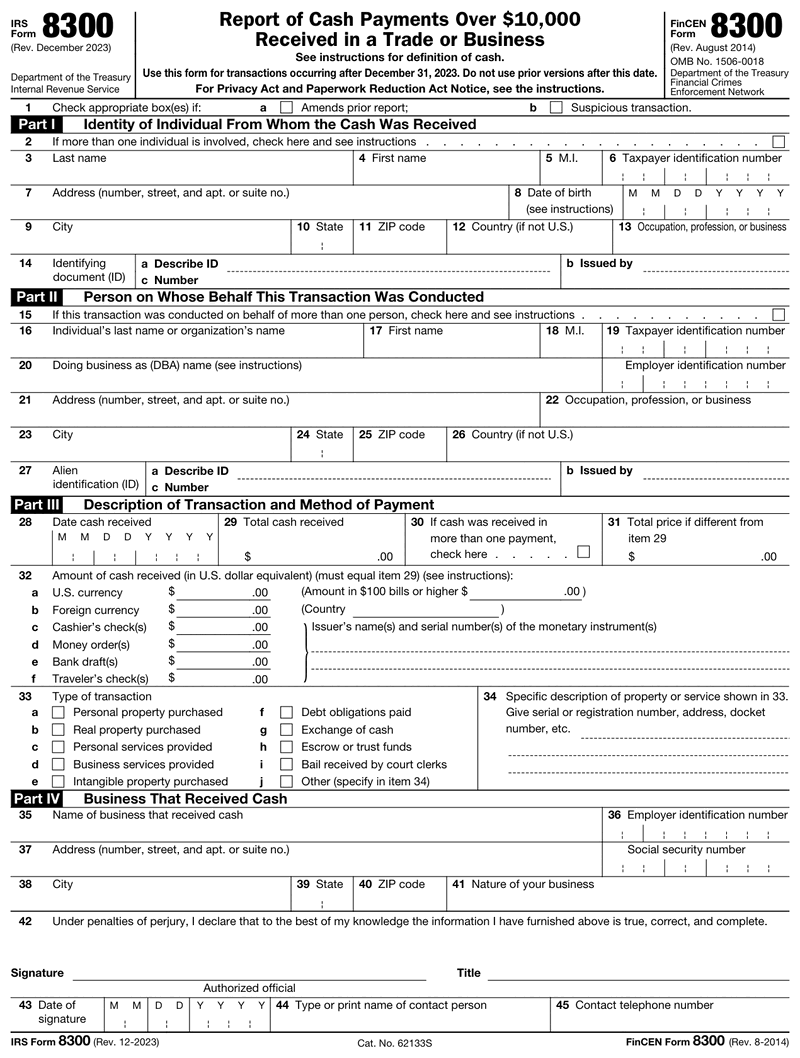
The form has four parts. They run in a logical order: who paid, who they paid for, what the payment was, and who you are.
Their full name, address, taxpayer identification number, date of birth, and occupation. You also record the ID document you checked, such as a driver's license, including the issuing state and the number. Verify the ID at the time of the transaction, because tracking someone down later rarely works.
Fill this in only when the person handing over the cash is acting for someone else, like an employee buying a vehicle for their employer. If more than one person was involved, check the box indicating that and attach the details. Leaving this blank when it applies is a common error.
The date you received the cash, the total amount, and a breakdown by type. That means how much was currency, and how much was in cashier's checks or money orders, with issuer and serial numbers. You also describe what the payment was for, such as a vehicle sale.
Your business name, address, employer identification number, and the nature of your business. An authorized person signs and dates it. There's also a box near the top to check if the transaction looks suspicious, which you can use whether or not the amount crosses $10,000.
Filling it in by hand means re-checking every box against the instructions. Our 8300 generator walks the fields in the same order the paper version does, so nothing gets left empty by accident. The math on your cash breakdown is done for you. You download a clean, filled PDF that's ready to e-file or mail.
Need one right now? Start with the generator on this page.
You have 15 days from the date you received the cash. Not 15 business days, and not 15 days from when you invoiced or delivered. If the fifteenth day is a weekend or holiday, you get the next business day.
There are two ways to file:
Over the threshold but e-filing isn't workable? Request a hardship waiver with Form 8508. Grounds include cost, no reliable internet, a disaster, your first year in business, or a religious exemption. Apply before the deadline, not after.
Most penalties come from a handful of avoidable slips.
The customer won't give a TIN. You still file. Ask for it with a Form W-9, record that you requested it, keep proof, and file on time. A missing number with documented effort is a much smaller problem than a missing form.
Missing the aggregation. Related payments count together, both within a 24-hour window and across a rolling 12-month period. Businesses that only tally cash at month-end often discover they crossed $10,000 weeks ago and blew the deadline without noticing.
The fix: log the payer's name, the date, and the amount at the moment you take any cash payment over roughly $2,000 to $3,000. Do it even when the payment is nowhere near the trigger on its own. Then the math is already done when a payment tips the total over.
One more thing: if you came here looking for Form 8308 instructions, that's a different form entirely. It reports sales of certain partnership interests, not cash. The similar numbering causes a lot of mix-ups.
Nothing happens to you directly. The business that took your cash sends you a written statement by January 31. Your name also goes into a FinCEN database that law enforcement can search. It is not an audit, an accusation, or a tax bill. Keep the statement with your records.
The database helps government investigators spot patterns across many transactions, not flag individual buyers. Being named on one is routine.
Just hold onto that statement, and be able to explain where the cash came from if it ever matters.
The most recent inflation-adjusted table in the IRS reference guide covers calendar year 2024. It sets the penalty for negligent failure to file at $310 per return. That drops to $60 if you correct it within 30 days. Annual caps run to $3,783,000, or $1,261,000 for businesses averaging $5 million or less in gross receipts.
Intentional disregard is far steeper: the greater of $31,520 or the amount of cash you received, capped at $126,000. The same holds for what happens when you don't file any required return. These figures adjust annually, so check the current Form 8300 IRS reference guide before relying on a number.
Filing isn't the last step. By January 31 of the year after the transaction, you have to give every person named on a required Form 8300 a written statement. That duty does not apply to a form you filed voluntarily to flag a suspicious transaction, and you should not notify the customer in that case.
It needs your business name and address, plus a contact name and phone number. Add the total reportable cash you received from them that year, and a line stating that you reported it to the IRS. A short letter does the job.
Hold a copy of every form you file for five years from the filing date. Keep the e-file confirmation or mailing proof with it; that's what proves you filed on time. Digital copies are fine.
An 8300 often comes up alongside other IRS paperwork. To correct a payroll tax return, use Form 941-X. To see how payroll records line up with what you report, read pay stubs and taxes.
There is no annual Form 8300. Search for "form 8300 2025" or "form 8300 2026" and you land on the same document, because the year in that search refers to when the cash changed hands, not to a different form. One revision covers both: December 2023. The form face says to use it for transactions occurring after December 31, 2023, and not to use prior versions after that date, so an older PDF sitting on your desktop is the wrong one.
The filing clock isn't tied to a tax year either. You file within 15 days of receiving the cash, which means a payment taken in March 2025 was reported in March 2025, not in the following filing season. The one fixed calendar date is January 31, when your written statement goes to each person named on a form you filed, and it is January 31 in every year.
The $10,000 trigger hasn't moved, and it isn't adjusted for inflation, so it doesn't drift. The increase from $600 to $2,000 you may have read about applies to a different reporting rule and leaves this one alone.
One caution: no extension exists. Form 8809 doesn't cover Form 8300, and Form 8508 waives only the electronic-filing requirement, never the 15 days.

4.4 out of 5.0 stars on 717 reviews
Straight from the IRS, at no charge. The official 8300 form PDF sits at irs.gov/pub/irs-pdf/f8300.pdf. Before you fill anything in, check the revision date printed in the corner: December 2023 is the current one, and outdated copies still float around on third-party sites. You can print it and fill it in by hand, or use our 8300 generator to complete the fields on screen and download a filled copy ready to file.
Deposits aren't taxed at any amount, so there's no limit to worry about. Banks file a Currency Transaction Report for cash deposits over $10,000, but that's their paperwork, not yours. Note that mobile remote deposit capture only works for checks, so large cash deposits still mean a trip to the branch.
Surprisingly, no. Federal law doesn't force a private seller to take it. Legal tender status means cash settles debts, not that every business must accept it. So is it illegal to not accept cash? Not federally, but state and local rules can say otherwise. Massachusetts and New Jersey have required it for years, Colorado and Rhode Island have since joined them, and New York State's cash-acceptance law took effect in March 2026. Cities including Philadelphia, San Francisco, and Washington, D.C. run their own ordinances on top of that. Check your local rules before going card-only.
Not right now. A law that took effect in 2024 would require businesses to report digital asset payments over $10,000. The IRS postponed it until regulations are issued. Until then, only currency and certain monetary instruments count. Watch for IRS updates if you accept crypto.
Yes. File a late 8300 as soon as you realize you missed the 15-day window, since penalties are lower when you correct quickly. To fix an error, file a new form with the amended box checked at the top and the corrected details filled in.
Fill out our contact form, and we will get back to you as soon as we can!
Contact us
Hi! How can I help you? Kris